
APAC Market Wrap - 15 Aug

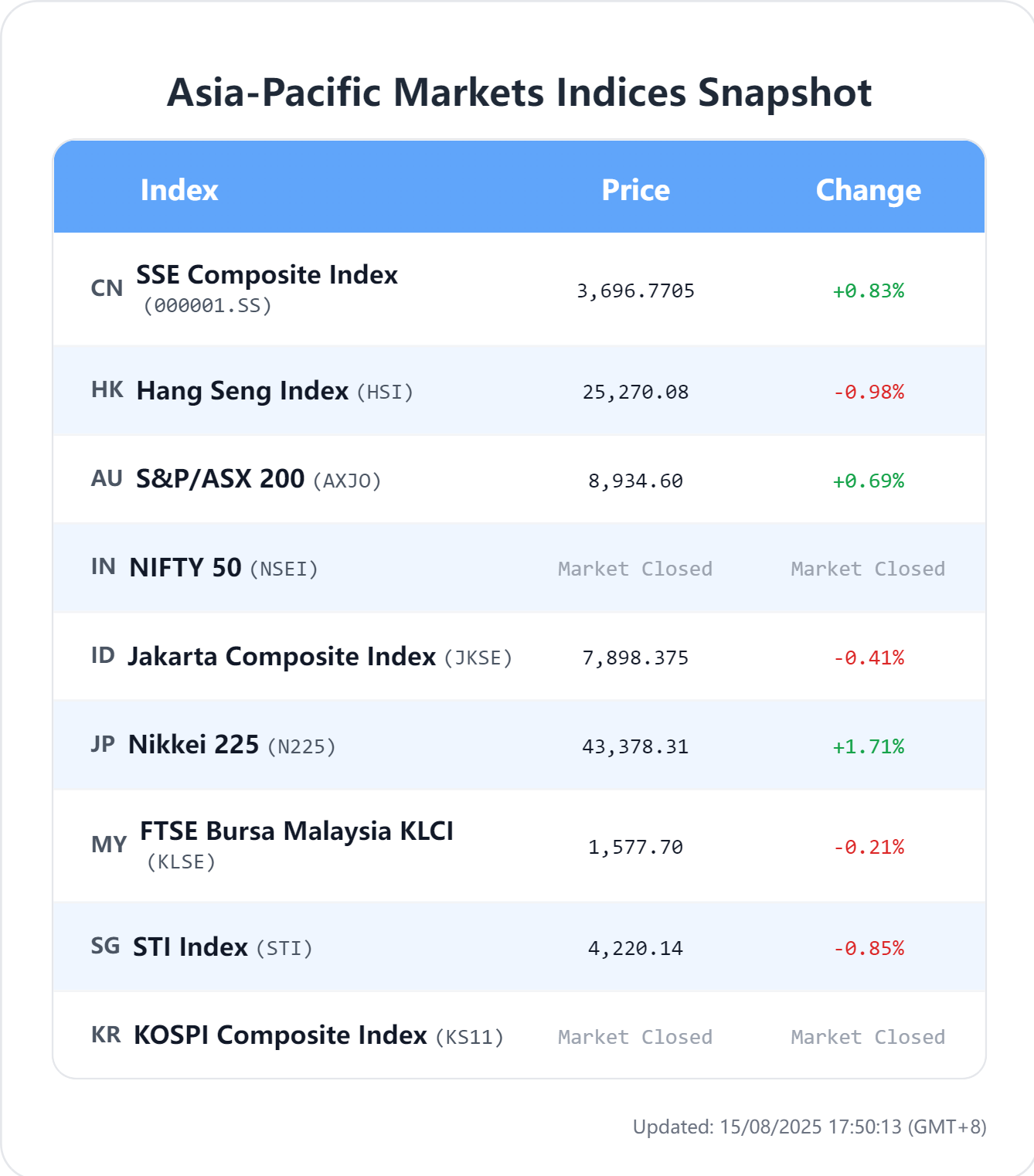
China Stock Market: The market oscillated and rebounded throughout the day, with the ChiNext Index leading the gains. At close, the Shanghai Composite rose 0.83%, the Shenzhen Component Index gained 1.6%, and the ChiNext Index surged 2.61%.
By sector, PEEK materials, liquid-cooled servers, PCB, and securities led the gains, while banking and a few other sectors declined.
Hong Kong Stock Market: The major Hong Kong indices all fell, with the Hang Seng Index dropping 0.98%, the Hang Seng Tech Index declining 0.59%, and the State-Owned Enterprises Index falling 0.98%.
By sector, most tech stocks declined, internet healthcare stocks rose, securities and brokerage stocks strengthened, semiconductor stocks trended upward, Apple concept stocks gained, and biotech stocks performed well.
Japan Stock Market: The Nikkei Average rebounded sharply by 1.71%, closing up 729.05 points at 43,378.31 points (with a trading volume of approximately 2.16 billion shares).
By sector, all 30 industries rose except for metal products, fisheries and forestry, and warehousing and transportation, with banking, non-ferrous metals, insurance, electric power and gas, and other financial sectors performing particularly strongly.
South Korea Stock Market: The Korean stock market was closed for the day.
Australia Stock Market: The S&P/ASX 200 (XJO) rose 0.73%, closing at 8,938.600 points. By sector, diversified media, education, and diversified financials saw slight gains, while packaging and containers, apparel, and industrial distribution experienced minor declines.
Singapore Stock Market: The Straits Times Index fell 0.61%, closing at 4,230.53 points. By sector, asset management, software, and consumer packaging saw slight gains, while industrial distribution, healthcare distribution, and education posted larger declines.
Malaysia Stock Market: The Malaysia Index dropped 0.30%, closing at 1,576.34 points. Transportation and logistics, construction, and financial services saw slight gains, while plantations, healthcare, and communication and media sectors declined.
Key Events
Indian PM Calls for Self-Reliance to Counter U.S. Tariffs
On Friday, during India’s Independence Day address, Prime Minister Narendra Modi urged the country to become more self-reliant, manufacturing everything from fertilizers to jet engines and electric vehicle batteries, and pledged to protect Indian farmers’ interests amid trade conflicts with Washington.
New Delhi has been grappling with Trump tariffs and stalled trade negotiations, primarily due to disagreements over U.S. agricultural and dairy imports.
Malaysia Q2 Growth Near Expectations, U.S. Tariffs Cast Shadow
Official data released on Friday showed Malaysia’s Q2 economic growth was close to expectations, but the central bank warned that uncertainties from U.S. tariffs are casting a shadow over the outlook. Joint data from Bank Negara Malaysia and the Department of Statistics Malaysia indicated that GDP grew 4.4% year-over-year from April to June, matching the first quarter’s growth rate.
Australia’s Richest Person Doubles Down on Trump’s Truth Social
Australia’s richest person, Gina Rinehart, increased her stake in U.S. President Donald Trump’s social media platform Truth Social in Q2, while the value of her U.S. stock portfolio grew by over $600 million.
According to regulatory filings, as of June 30, Hancock Prospecting Ltd., owned by Rinehart, held a U.S. stock and ETF portfolio worth approximately $3.1 billion.
Notably, the company’s stake in Truth Social operator Trump Media & Technology Group Corp. grew by 67% in Q2.
Japan Q2 Economy Grows Beyond Expectations
Japan’s Q2 economic growth exceeded expectations, driven by robust domestic demand, providing rare good news for Prime Minister Shigeru Ishiba, who is under pressure to resign.
The government reported on Friday that Q2 GDP grew 1% quarter-on-quarter annualized, surpassing economists’ forecast of 0.4%. First-quarter data was also revised upward from a contraction to a 0.6% growth. Japan’s growth was mainly driven by domestic demand, with business investment rising 1.3% (above the widely expected 0.7%) and private consumption increasing slightly by 0.2%.
Institutional Views:
Goldman Sachs: Raises MSCI Asia Pacific Index Target, Maintains ‘Overweight’ Ratings on Some Stocks
Goldman Sachs has again raised its Asia stock forecast, lifting the 12-month target for the MSCI Asia Pacific (ex-Japan) Index from 700 to 710 points, citing tariff clarity and an expected Fed rate cut in September. Just three weeks ago, the firm had increased the target by nearly 3%, from 680 to 700 points. Additionally, Goldman maintains an “overweight” rating on China, Japan, Korea, and some cyclical stocks.
Goldman Sachs: U.S. Growth Concerns Reemerge, Overweight Asia Investment-Grade Bonds
Goldman strategists Kenneth Ho and Sandra Yeung noted in a report that due to concerns over the U.S. economy and expectations of a dovish Fed, the firm has shifted back to favoring Asia’s investment-grade dollar bonds. With U.S. growth concerns resurfacing and valuations higher than at the end of 2024, they believe now is the time to overweight Asia investment-grade bonds rather than high-yield bonds.
UBS: Bearish on U.S. Economy, Dollar, and U.S. Stocks
UBS issued a warning in its latest research report on the U.S. economy, dollar, and U.S. stocks. It predicts U.S. GDP will slow sharply from a 2.0% annual growth rate in Q2 to 0.9% in Q4, well below the consensus economist forecast of 1%. UBS also expects interest rates to drop by 1% by year-end, double the market’s expectation. For stocks, UBS sets a year-end target of 960 points for the MSCI World Index and 1,000 points for 2026, but warns of significant near-term downside risks.