
APAC Market Wrap - 18 Aug

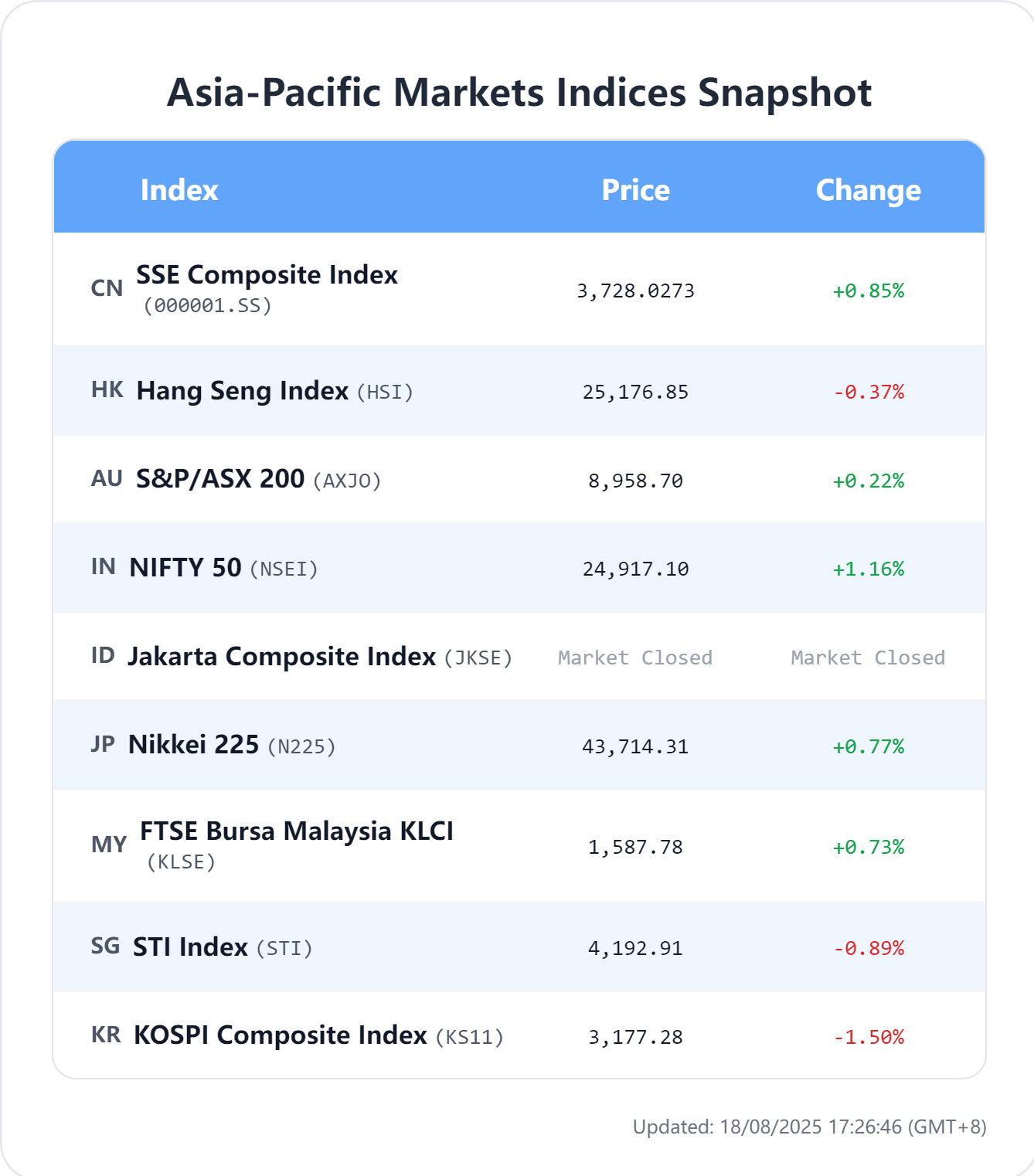
Chinese Stock Market: The market surged early but retreated later, with the Shanghai Composite Index hitting a near 10-year high and the Beijing Stock Exchange 50 Index reaching an all-time high. The Shenzhen Component Index and ChiNext Index both surpassed their highs from October 8, 2024.
By the close, the Shanghai Composite rose 0.85%, the Shenzhen Component gained 1.73%, and the ChiNext soared 2.84%. Sector performance showed liquid cooling servers, film, CPO, and rare earth magnets leading gains, while coal, non-ferrous metals, and steel sectors led declines.
Hong Kong Stock Market: Hong Kong’s three major indices had mixed results. The Hang Seng Index fell 0.37%, the Hang Seng Tech Index rose 0.65%, and the State-Owned Enterprises Index dipped 0.06%.
Sector-wise, internet and tech stocks mostly rose, online healthcare stocks performed strongly, coal stocks largely declined, auto stocks gained strength, gold stocks saw widespread declines, and construction materials stocks performed well.
Japanese Stock Market: The Nikkei 225 Index continued its rise, up 0.77%, closing above its historical high of 43,714.31 yen, gaining 336.00 yen.
By sector, 25 industries, including services, transportation equipment, information and telecommunications, and precision equipment, rose, while 8 industries, including banking, shipping, electrical, and insurance, fell.
South Korean Stock Market: The KOSPI Index dropped 1.50% to 3,177.28 points.
Leading sectors included shipping companies, consumer services, publishing, leisure equipment, and electric utilities, while healthcare technology, electrical equipment, banking, and electrical products led declines.
Australian Stock Market: The XJO S&P/ASX 200 Index rose 0.23%, closing at 8,959.300 points.
Sectors like home construction, semiconductors, real estate, and interactive media saw significant gains, while agriculture, diversified financials, aerospace, and packaging and containers saw slight declines.
Singapore Stock Market: The Straits Times Index fell 0.88%, closing at 4,193.16 points.
Sectors such as forestry products, automotive parts, and waste management saw modest gains, while personalized services, regulated utilities, and non-alcoholic beverages saw larger declines.
Malaysian Stock Market: The Malaysia Index rose 0.55%, closing at 1,584.96 points.
Sectors like utilities, construction, and communications and media saw modest gains, while commercial trusts, transportation and logistics, and energy sectors declined.
Key Events
Malaysian Minister Expresses Concern Over U.S. Chip Tariffs
Malaysia’s Minister of Investment, Trade, and Industry, Zafrul Aziz, stated that Malaysia must respond cautiously if U.S. President Trump pushes for high tariffs on semiconductors.
He expressed confidence in finding a mutually beneficial solution with the U.S., noting that transshipment issues are not a primary concern. Malaysia has recently reached a free trade agreement with South Korea, set to be signed soon.
Japan to Approve First Yen-Pegged Stablecoin
Japan’s Financial Services Agency will approve the country’s first yen-pegged stablecoin this month.
Fintech company JPYC Inc. will be registered as a remittance business, with sales expected to begin weeks after registration. The digital currency, backed by liquid assets like government bonds, will maintain a stable value of 1 JPYC = 1 yen.
Ukrainian President Zelenskyy Calls for Cooperation with U.S. and Europe to Push Russia Toward Peace
Ukrainian President Zelenskyy posted on the X platform, stating, “Russia must end this conflict.” He expressed gratitude for an invitation and a strong desire to end the conflict swiftly and reliably.
He added, “I hope that, together with our American and European friends, we can push Russia toward true peace.” Zelenskyy has arrived in Washington to meet with U.S. President Trump and European leaders.
Institutional Views
Citigroup: Overweight U.S. Stocks, Bearish on Dollar
Dirk Willer, head of Citigroup’s global macro and asset allocation research, stated that Citigroup is overweight on equities, particularly in the U.S. and to some extent Europe, while underweight on U.K. stocks.
The bank is neutral on government bonds, overweight on emerging market bonds, and underweight on Japanese government bonds.
It is underweight on European and U.S. investment-grade credit, neutral on commodities but favors a “buy-the-dip” strategy, and is bullish on silver. In forex markets, Citigroup is bearish on the dollar, citing structural and cyclical downward pressures.
Bank of America: U.S. Stocks May See Profit-Taking After Jackson Hole
Bank of America strategists predict that if the Federal Reserve signals dovish policies at the Jackson Hole symposium, investors may take profits, leading to a U.S. stock market pullback.
This year’s symposium is “particularly significant” and could set the tone for monetary policy for the rest of the year.
Oaktree Capital’s Howard Marks: ‘Magnificent Seven’ Not Overvalued
Wall Street value investing legend and Oaktree Capital co-founder Howard Marks believes the valuations of the U.S. “Magnificent Seven” tech stocks are not excessive.
Instead, he sees potential issues with other S&P 500 constituents. He argues that, given their superior products, high market share, high margins, and strong moats, their valuations are reasonable.
Nomura Securities: Fed Unlikely to Cut Rates by 50 Basis Points in September
Nomura Securities expects the Federal Reserve to cut rates by 25 basis points in September, with a 50-basis-point cut being unlikely. As signs of a U.S. economic slowdown emerge, more Wall Street banks anticipate a September rate cut, but opinions remain divided on whether it will be 50 or 25 basis points.
World Bank: Infrastructure Investment Remains Attractive
The World Bank notes that despite rising interest rates and inflation reshaping return expectations and complicating financing conditions, infrastructure remains a preferred asset class.
With relatively stable income and strong government support, infrastructure investments continue to offer lower risk, more predictable returns, and stronger performance compared to other private investment opportunities.