
Is September Really a Done Deal?: Why the Fed Cut Bets Could Snap Back

Markets are pricing an almost inevitable sequence of rate cuts from the Federal Reserve, but that view may be dangerously optimistic. A senior Fed watcher, Tim Duy of SGH Macro Advisors, warns that September’s cut is not guaranteed and that if the underlying assumptions are wrong, market pricing could reverse violently. Powell’s Jackson Hole remarks on August 22 and the incoming data between now and the September meeting will decide the outcome.
Why this matters now. Traders had trimmed expectations for a 50-basis-point cut after a worrying PPI release, yet the market still assumes an aggressive easing path. If Fed messaging or subsequent data suggest inflation remains too sticky, risk assets and fixed-income positions that bet on rapid easing could face swift repricing.
Quick takeaways: what you must remember
- Tim Duy (SGH Macro Advisors) says September is not a sure thing; a “chaotic insurance cut” is possible but not a commitment to follow-up cuts.
- Markets currently price three cuts this year and roughly 100 basis points over the next 12 months.
- PPI surprises have already reduced bets on a 50bp September cut, but optimism about the speed and scale of easing persists.
- Professional forecasters still expect core PCE growth to run near 3.1% year-over-year in Q4, well above the Fed’s 2% goal.
- Powell’s Jackson Hole speech on Aug 22, 10:00am ET (Beijing time Aug 22, 10:00pm) is the immediate focal point; follow-up media interviews from Fed officials will matter as much as the speech text.
Stop and think: are markets counting the Fed’s chickens?
Markets have moved quickly to price in multiple rate cuts. That optimism rests on two assumptions: that labor market cooling will continue and that inflation will fall toward target. Tim Duy cautions both assumptions are fragile. If either is wrong, or if Powell refuses to lock in a multi-cut path, the market’s view could unwind fast.
The danger is not only a single policy pivot. It is the mismatch between the simplicity of market pricing and the Fed’s stated willingness to tie action to incoming data. Where markets see a schedule, the Fed may see a conditional step.
What Tim Duy actually argues
Tim Duy’s new note lays out a nuanced scenario. He expects the Fed might execute a “chaotic insurance cut” in September—but crucially, Powell would not promise a series of cuts afterward. Instead the Chair is predicted to link future moves explicitly to fresh data, keeping markets on edge.
Duy reasons that durable inflation and resilient consumer demand could limit the Fed’s appetite for a sustained easing cycle. He expects two total cuts this year (September and December), not the three many market participants have priced in.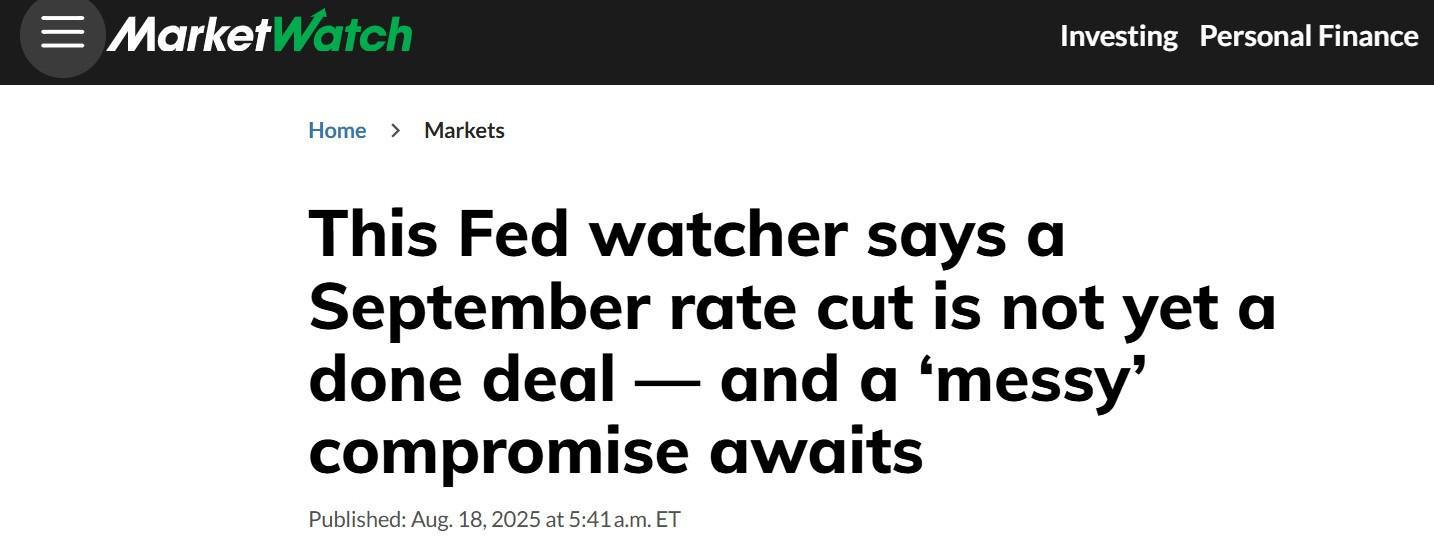
The data picture: inflation and jobs still control the script
Recent producer price data shook markets and reduced odds of an outsized 50bp cut in September. At the same time, surveys of professional forecasters put core PCE around 3.1% year-over-year for Q4. Unemployment projections cluster near 4.4% for Q4—below earlier estimates—so labor market slack may be slower to appear.
Those numbers matter because the Fed’s preferred inflation gauge (core PCE) remains well above target. That explains why Fed officials may be wary of making broad forward promises; drilling down to how inflation is evolving will remain their priority.
Jackson Hole: what to watch (and when)
Powell’s keynote at the Jackson Hole symposium will be the focal event. The Chair speaks on Aug 22 at 10:00am ET (Beijing Aug 22, 10:00pm) under the session title “Economic Outlook and Framework Review.”
Goldman flags three key moments: Powell’s keynote, a same-day luncheon speech, and Saturday’s closing panel that features other central bank chiefs. Because much of Jackson Hole isn’t live-streamed, off-stage interviews and reporters’ access to attendees will be critical for fresh policy reads.
Expect Powell’s words to be cautious. Market strategists—Nomura among them—don’t expect a firm multi-cut commitment from the Chair. Some banks (Bank of America, Morgan Stanley) even forecast Powell will emphasize inflation risks and resist market’s easing hopes.
How investors might trade the event risk
If you expect the speech to sound dovish and to cement cut odds, a bull call spread on an index is one way to play upside with limited risk: buy a nearer-money call and sell a higher-strike call, same expiry. This reduces cost versus a naked long call and caps both profit and loss.
If you fear a hawkish surprise that pressures equities, protective puts offer downside insurance for existing holdings. Buying puts near current levels hedges short-term drops without selling core equity exposure.
Both strategies reflect the binary nature of this weekend: Powell can either reassure markets, or he can press home the Fed’s data-dependent stance and force rapid repricing.
Why officials’ off-stage comments matter as much as the speech
Historically, Jackson Hole speeches and that weekend’s interviews often shape market reaction. Fed officials typically grant media interviews and panels that reveal nuance absent from formal texts. That’s why Goldman and others warn investors to watch not only Powell’s prepared remarks but also his Q&A and surrounding interviews.
Expect about five Fed officials to accept media interviews on or around Aug 22. These conversations often supply the market’s next moves when formal language is deliberately calibrated.
The Fed’s framework review: more than semantics
Powell’s remarks may also touch the Fed’s ongoing framework review. Some analysts expect partial reversals of the 2020 changes—moving away from a flexible average inflation target toward a more traditional flexible inflation approach, and re-emphasizing the role of tight labor markets in inflation dynamics.
Framework shifts are not immediate policy moves—but they change the Fed’s decision lens. A less flexible framing would make the Fed more cautious about easing until inflation is clearly and sustainably falling.
Near-term timetable: key dates and data
- Aug 22: Powell keynote at Jackson Hole (10:00am ET).
- Aug 22–24: Media interviews and panel sessions, including international central bank leaders.
- Sep 5: U.S. nonfarm payrolls for August — the data most likely to sway September voting.
Between now and the September FOMC meeting, inflation prints, labor indicators, and consumer activity releases will be dissected for any sign that policy can safely ease.
Bottom line: plan for uncertainty, not certainty
Markets that treat September as a foregone conclusion are risking a disorderly repricing. The most likely path is conditionality: the Fed may open the door to easing, but it will tie subsequent steps to data. That means investors should prepare for both a measured Powell reassurance and the opposite—an insistence that inflation risks endure.
Trade decisions should reflect this binary risk: hedges that limit downside, defined-risk bullish structures that cap cost, and close attention to each incoming data release. Jackson Hole is not a verdict; it is a spotlight. What matters next are the monthly numbers that will determine whether the Fed cautiously lowers the rate bar—or holds it steady.
Short checklist for traders and investors
- Read Powell’s Jackson Hole speech and immediate Q&A carefully.
- Monitor off-stage Fed interviews as closely as the keynote text.
- Treat September cuts as conditional—position with asymmetric risk (defined downside, limited cost upside).
- Watch August nonfarm payrolls and upcoming inflation prints for directional cues.
- Expect volatility: market pricing may swing fast if Fed language contradicts current cut assumptions.
The market wants a neat easing story. The Fed may prefer to keep the script messy and conditional. That gap between market desire and policymaker caution is the real event risk—one likely to dominate headlines long after Jackson Hole closes.