
Elon Musk Says Tesla Robo-Taxis Are Almost Here

$TSLA CEO Elon Musk recently announced that the company’s self-driving taxi service in Austin, Texas, will open to the public in September. That means anyone—residents, investors, or reporters—could try a ride in just a few weeks.
Tesla first launched its robo-taxis in Austin eight weeks ago. It started small, with a handful of Model Ys carrying Tesla-selected passengers in a limited area, always with a safety monitor in the front seat. The car did the driving, and the coverage area has gradually expanded since then.

Now, Tesla is ready to let anyone willing to try the service ride, with additional software upgrades planned. The taxis rely on Tesla’s Full Self Driving (FSD) software, which uses AI to improve driving performance with each update. Musk tweeted on August 10 that the upcoming FSD release “will be a dramatic gain” and is currently undergoing training and testing.
Technology and Scale Will Decide the Race
Waymo remains the largest self-driving taxi operator, completing over 250,000 fully autonomous rides per week. Waymo uses LiDAR, radar, and cameras, along with advanced software. Tesla, on the other hand, relies on cameras and FSD software, making its approach simpler and cheaper.

Musk is betting that this combination, along with Tesla’s massive manufacturing scale, can make it the leader in self-driving taxis. Essentially, any recently produced Tesla with the latest FSD software can become a robo-taxi, and the company can produce millions of cars annually.
The potential market is huge—Wall Street estimates the AI-powered ride-hailing opportunity could reach trillions of dollars. Many analysts say Tesla’s AI projects, including self-driving and humanoid robots, account for up to 75% of the company’s total valuation.
What This Means for Investors
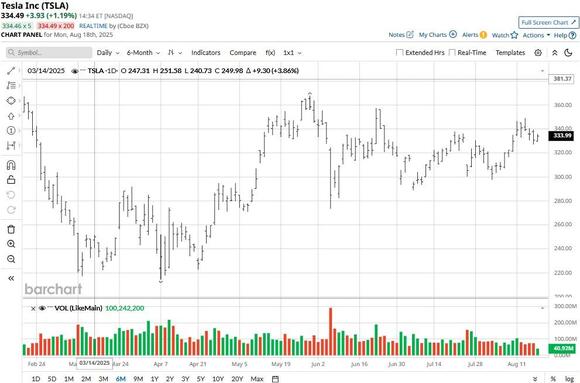
Since Tesla’s robo-taxi launch in Austin on June 22, the stock has moved from $322 to around $330. Investors seem to be waiting for more concrete progress, including software updates, service expansion, and regulatory approvals.
Musk told investors in July, “Our goal is to provide autonomous ride-hailing to about half of the U.S. population by the end of the year, depending on regulatory approvals. Technically we can do it, but we are very cautious and don’t want to take any chances.”
It’s worth noting that Austin represents only a tiny fraction of the U.S. population, so reaching 50% coverage in just a few months would be a major challenge. In the short term, investors may need patience as Tesla scales its service.
My Take
There are three key points to watch for Tesla’s robo-taxis:
-
Technology and cost advantage: Using cameras instead of LiDAR reduces costs and enables faster fleet expansion.
-
Regulatory and safety hurdles: Even with solid tech, government approvals, insurance, and public acceptance could slow progress.
-
Long-term potential: If FSD becomes widely available and reliable, every Tesla could become a revenue-generating vehicle, reshaping ride-hailing and shared mobility.
Short-term stock movements may be volatile, but if AI and autonomous driving continue to improve, the long-term opportunity is significant. Investors should focus on software upgrades, fleet expansion, and regulatory approvals as the main drivers.