
APAC Market Wrap - 19 Aug

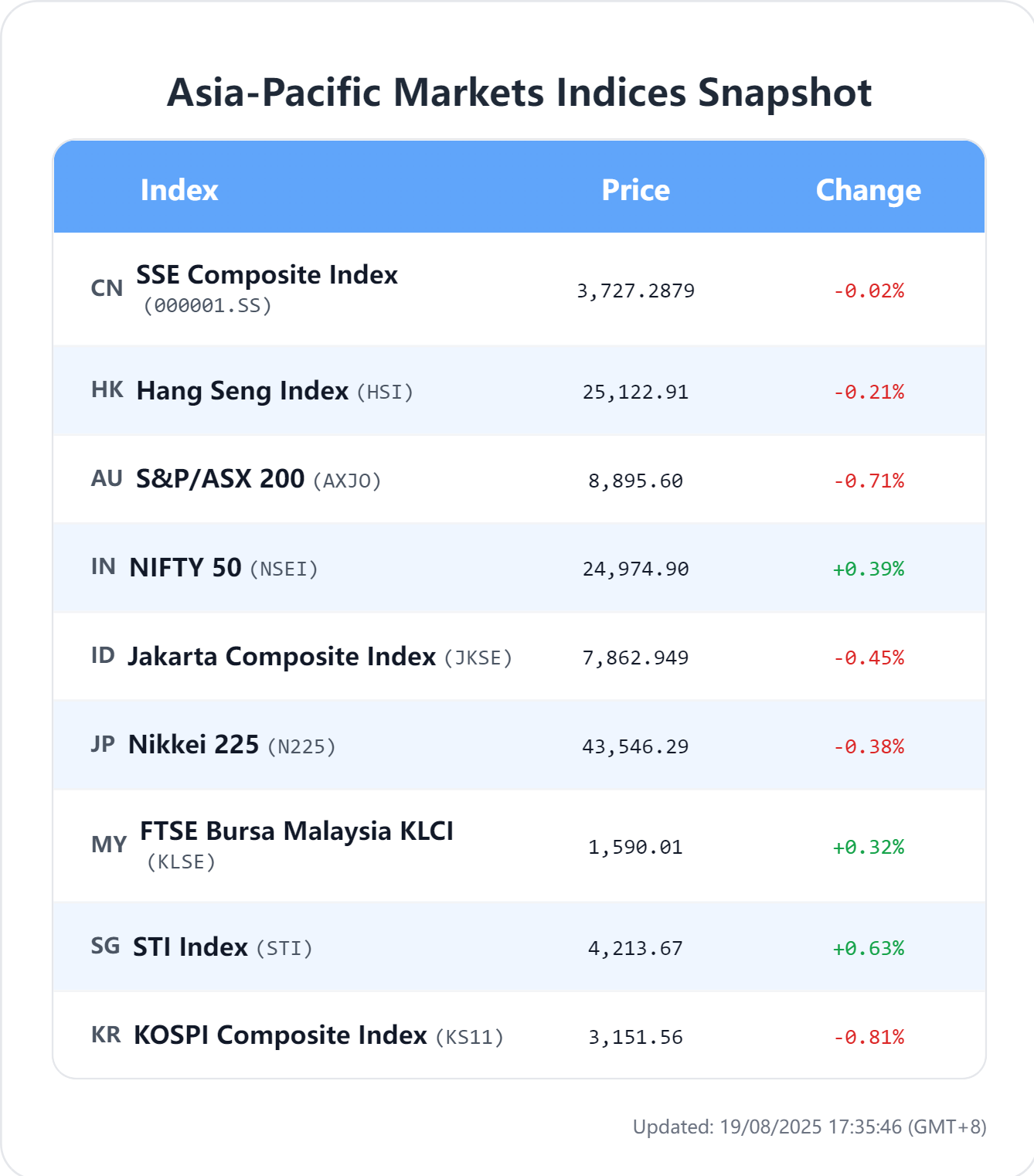
China Stock Market: The market surged early but closed lower, with the three major indices posting slight declines. By the close, the Shanghai Composite Index fell 0.02%, and the Shenzhen Component Index dropped 0.12%.
Sector-wise, liquor, Huawei HiSilicon, CPO, and humanoid robot sectors led gains, while insurance, military, securities, and gaming sectors saw the largest declines.
Hong Kong Stock Market: All three major Hong Kong indices ended lower, with the Hang Seng Index down 0.21%, the Hang Seng Tech Index down 0.67%, and the State-Owned Enterprises Index down 0.30%.
Sector performance saw broad declines in tech stocks, gains in sports apparel stocks, mostly rising alcohol beverage stocks, falling semiconductor stocks, declining securities and brokerage stocks, and mostly lower biotech stocks.
Japan Stock Market: After three days of gains, the Nikkei Average retreated, falling 0.38% or 168.02 yen to close at 43,546.29 yen (with a trading volume of about 198 million shares).
By sector, 25 business categories, including services, transportation equipment, information and telecom, and precision instruments, rose, while 8 categories, such as banking, shipping, electrical, and insurance, declined.
South Korea Stock Market: The KOSPI index fell 0.81% to 3,151.56 points.
Sector-wise, gaming, publishing, broadcasting and entertainment, auto parts, and automotive sectors led gains, while aerospace and defense, utilities, machinery, and biotech sectors saw the largest drops.
Australia Stock Market: The S&P/ASX 200 (XJO) declined 0.70% to close at 8,996.200 points.
Sector performance showed slight gains in automotive and parts, packaged consumer goods, and medical diagnostics, with minor declines in biotech, industrial distribution, and building materials.
Singapore Stock Market: The Straits Times Index rose 0.69% to close at 4,216.19 points.
Sector-wise, steel, conglomerates, education, and credit sectors saw slight gains, while software, furniture, industrial products, and chemicals posted larger declines.
Malaysia Stock Market: The Malaysia Index rose 0.33% to close at 1,590.24 points.
Sector-wise, energy, industrial goods, and business trusts saw slight gains, while communication and media, technology, and transportation and logistics sectors fell.
Key Events
Thailand to Simplify Crypto-to-THB Conversion to Boost Tourism
Thailand will streamline the process for foreign tourists to convert cryptocurrency into Thai Baht. Reports indicate the government aims to stimulate tourism through this measure.
The country relies heavily on tourism and views cryptocurrency as an innovative way to attract more visitors. However, goods cannot be purchased directly with crypto. Digital assets must be converted to Thai Baht.
Additionally, the “Tourist Digipay Program” will run as an 18-month pilot.
Apple Expands iPhone Production in India for U.S. Market
Apple is increasing iPhone production at five factories in India.
Insiders reveal the company is manufacturing all four iPhone 17 models, set for release next month, in India—a first where all new iPhones, including Pro versions, will ship from this South Asian nation from the outset.
To mitigate tariff impacts, Apple is shifting most iPhone production for the U.S. market to India and adding local iPhone factories.
South Korea and U.S. May Sign Energy Investment Deal
Herald Business Newspaper, without citing sources, reports that South Korea and the U.S. may sign an investment agreement during a summit between Lee Jae-myung and Trump on August 25, focusing on nuclear power, bio, and energy sectors.
The paper, quoting an unnamed government official, said 25% of a $100 billion energy product procurement deal reached with the U.S. last month will be liquefied natural gas, with the rest being crude oil.
Korea Gas Corp., a state-owned entity, may sign a liquefied natural gas procurement deal next week.
SoftBank Invests $2 Billion in Intel, Becomes Fifth-Largest Shareholder
On Monday, Intel and SoftBank Group jointly announced that the Japanese conglomerate will invest $2 billion in the struggling chipmaker.
Under the agreement, SoftBank will buy Intel common stock at $23 per share, a 2.8% discount from Monday’s closing price of $23.66. Following the announcement, Intel’s after-hours stock surged 6% to $25.
Institutional Views
Russell Investments: Jackson Hole meeting may cool Fed rate cut expectations
Global Chief Investment Strategist Ettelmann said in a report that the outcome may differ from market expectations.
Ettelmann suggested Fed Chair Powell’s Jackson Hole speech might be less dovish than anticipated, considering FOMC divisions and the cross-trend of employment downside risks and inflation upside risks. The firm sees a September rate cut as “possible” rather than “certain,” with a 25-basis-point cut rather than 50.
Commerzbank: Tariffs may raise U.S. inflation and weaken the dollar
Michael Pfister of Commerzbank noted that U.S. firms may pass tariff costs to consumers, heightening economic concerns and pressuring the dollar downward. This could increase inflationary pressure and reduce consumer spending. “As U.S. consumers are the main driver of U.S. growth, this could deepen concerns about the real economy,” he said.
Higher inflation data may become more evident. However, given political pressure on the Fed to cut rates, it’s unclear if it will halt easing. Commerzbank forecasts EUR/USD to rise steadily through 2026.
Fitch: Higher U.S. tariffs pose a threat to India’s 6.5% growth forecast
If U.S. tariffs on India remain above those on other Asian markets, they risk Fitch’s 6.5% growth projection for India’s fiscal year. The U.S. imposed 25% reciprocal tariffs on India from August 7, with an additional 25% effective August 27.
Fitch currently sees minimal impact on India’s IT services and domestic-focused sectors like oil and gas, cement, construction materials, engineering, telecom, and utilities. However, higher tariffs will pressure company profitability. If U.S. tariffs shift supply to markets including India, these sectors could also be affected. Fitch warns of potential downside risks to domestic prices for steel and chemicals.