
Medtronic Reports Strong Q1 2026 Revenue and Raises Full-Year Earnings Outlook

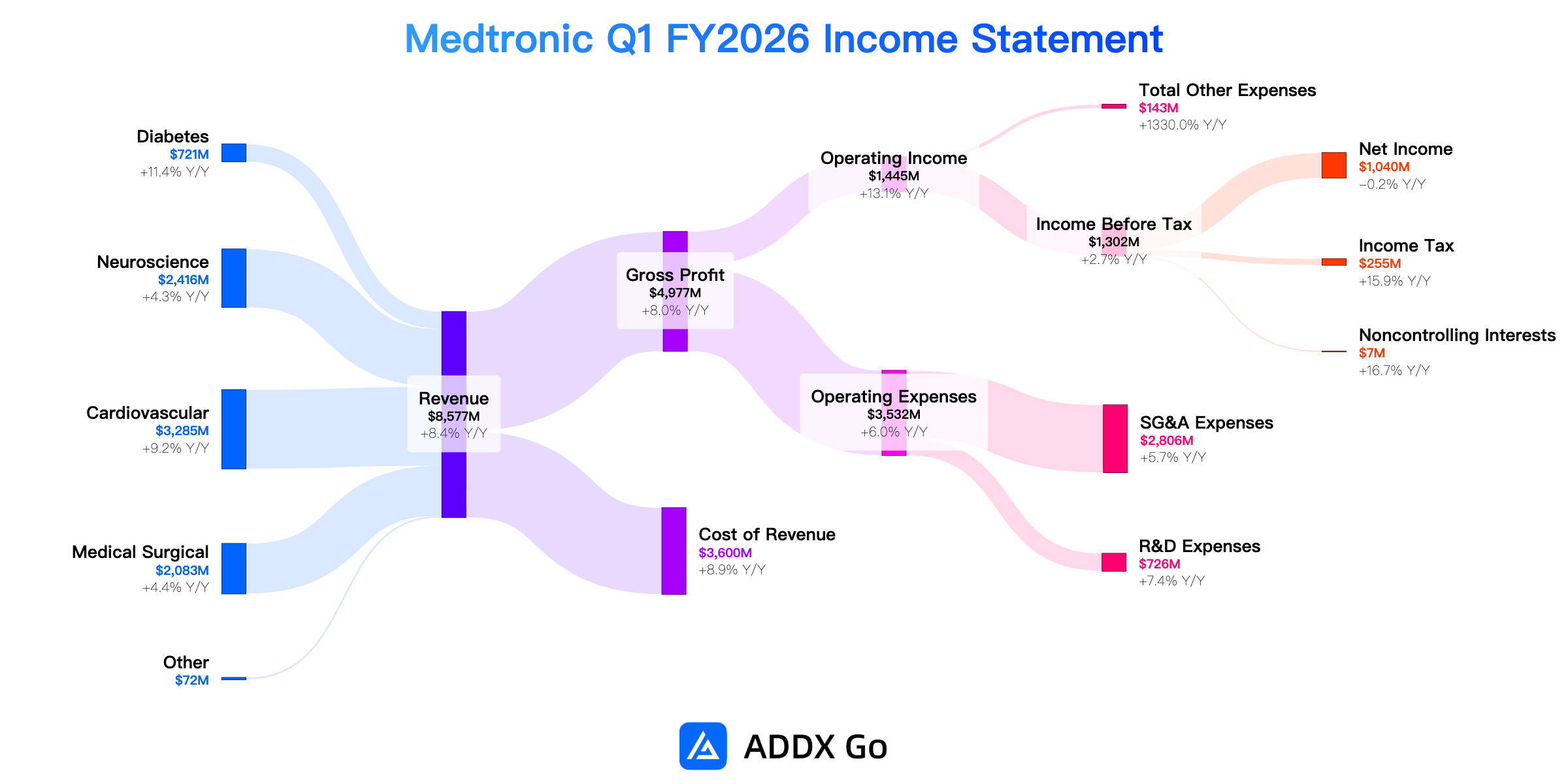
Medtronic (MDT.US) reported first-quarter fiscal year 2026 adjusted revenue of $8.5 billion, marking an 8.4% increase as reported and 4.8% organic growth. The company's non-GAAP diluted EPS reached $1.26, representing a 2% increase year-over-year and surpassing analyst estimates of $1.23. These results indicate a strong start to the fiscal year, with key segments contributing significantly to the overall performance for the period ending July 25, 2025.
Key Business Drivers
Medtronic's performance was significantly driven by strong growth across several innovative product categories. The Cardiovascular Portfolio revenue increased 9.3% as reported and 7.0% organically, with Cardiac Ablation Solutions revenue surging nearly 50%, including 72% in the US, primarily due to the strength of pulsed field ablation (PFA) products. The Diabetes business also showed robust growth, with revenue increasing 11.5% as reported and 7.9% organically, reflecting continued momentum in this segment.
Other significant contributions came from the Neuroscience Portfolio, which saw revenue rise 4.3% reported and 3.1% organically, driven by high-single digit growth in Neuromodulation. Despite a slight decrease in Specialty Therapies, Cranial & Spinal Technologies achieved mid-single digit growth. The Medical Surgical Portfolio experienced 4.4% reported and 2.4% organic growth, with both Surgical & Endoscopy and Acute Care & Monitoring segments showing low-single digit organic increases.
Management Outlook
Medtronic's management expressed confidence in accelerating revenue growth in the latter half of the fiscal year, building on the consistent performance in Q1 FY26. The company reiterated its FY26 organic revenue growth guidance of approximately 5%, indicating continued strategic focus on key growth drivers.
Furthermore, Medtronic raised its FY26 diluted non-GAAP EPS guidance to a new range of $5.60 to $5.66, up from the prior range of $5.50 to $5.60, largely due to Q1 outperformance and an improved tariff impact assumption. Management emphasized ongoing efforts in manufacturing efficiencies, supply chain optimization, and operating expense management to drive earnings growth, alongside increased investments in R&D, sales, and marketing.