
XPeng Auto Releases Record-Breaking Q2 Earnings

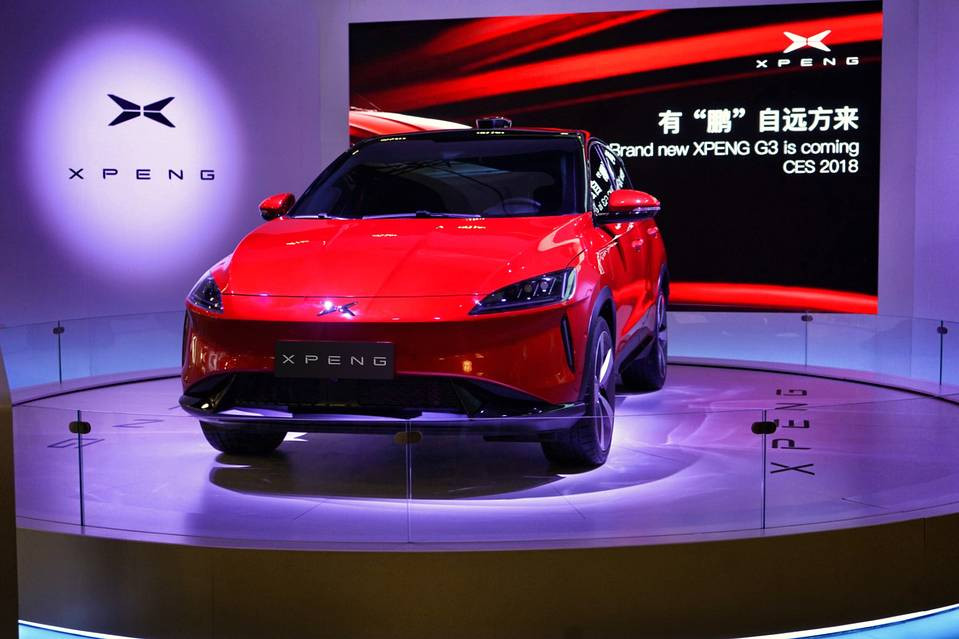
On August 19, XPeng Auto released its Q2 earnings report. Though still not profitable, the company achieved all-time highs in key metrics: total revenue, gross margin, cash reserves, and delivery volumes.
The earnings showed a narrowed net loss of 480 million yuan in Q2, compared to a 1.28 billion yuan loss in Q2 2024 and 660 million yuan in Q1 2025.
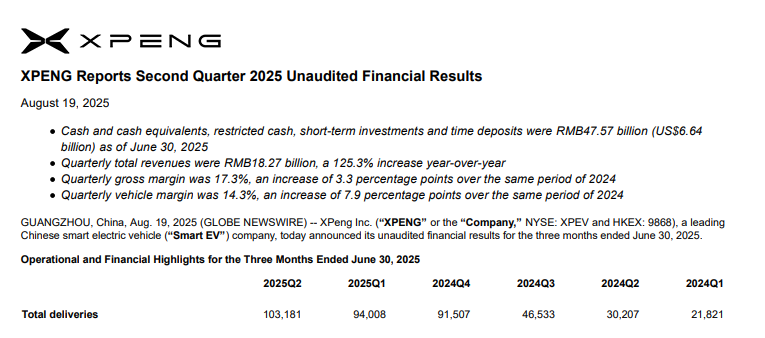
Post-earnings, XPeng’s U.S.-listed stock rose 3.72% to $20.64, pushing its market cap to $19.645 billion. Year-to-date, the stock has climbed 68.36%, adding $7.7 billion to its valuation.
If you had asked me about XPeng Auto a year ago, I might have said it was facing severe challenges. But now it tells us that it is thriving.
Sold 197,000 Vehicles, Revenue Hits 34 Billion Yuan
Think of an earnings report as a “health checkup” for a growing automaker, with four key indicators: sales, revenue, gross margin, and cash reserves.
XPeng’s first-half sales figures are impressive. The company delivered 197,200 vehicles, nearly 3.8 times last year’s same period and surpassing its full-year 2024 total. Q2 alone saw 103,200 deliveries, up 241.6% year-over-year.
While XPeng isn’t the top seller among new-energy brands—trailing Zeekr, Huawei’s Aito, and Li Auto—it’s the only one exceeding half its annual target. With a goal of 380,000 vehicles, it’s already at 52% through June.
Despite strong sales, XPeng’s product mix shows imbalance. Sedans dominate, with the MONA M03 and P7+ together selling over 136,000 units—nearly 70% of total deliveries. SUVs lag, with the G6 and G9 combined at 35,500 units, or just 18% of the total.
This stands out in China’s SUV-friendly market, where Tesla’s Model Y outsells the Model 3 by about two-to-one.
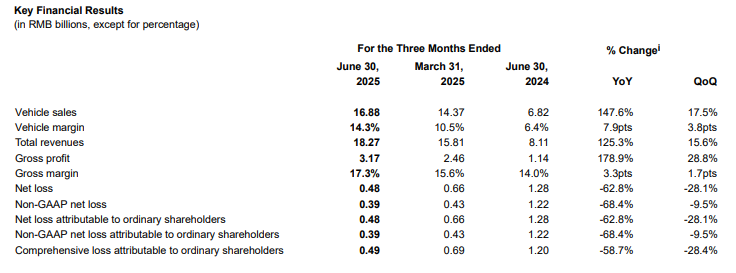
Higher sales mean more revenue. XPeng’s first-half 2025 revenue reached 34.09 billion yuan, up 132.5% from 2024. Q2 revenue hit 18.27 billion yuan, soaring 125.3% year-over-year and up 15.6% from Q1 2025.
XPeng’s Q2 gross margin reached 17.3%, edging out Tesla’s 17.2%. Its vehicle gross margin hit 14.3%, doubling from 6.4% in Q2 2024.
In short, profit per car has doubled, thanks to two factors: optimized manufacturing costs via tech and production improvements, and a better product mix with hits like the G7, which likely offer higher margins.
Losses Halved, Cash Reserves Near 50 Billion Yuan
2025 marks a new “profitability test” for China’s EV industry. Peers like Xiaomi, NIO, and Zeekr have set goals to turn profitable this year.
So, who’s the “top student” in this test?
On August 18, Zeekr reported a first-half net profit of 30 million yuan, its first profitable half. Geely’s Zeekr posted an operating profit of 285 million yuan in Q2, also a first. Xiaomi’s Q2 operating loss narrowed to 300 million yuan, with profitability expected in the second half.
You might wonder: How much did XPeng earn?
Q2 net loss was 480 million yuan.
Seeing “loss” might suggest the company’s still unprofitable—and it is—but the trend matters. The Q2 2024 loss was 1.28 billion yuan, and Q1 2025 was 660 million yuan.
The loss has shrunk by over half—a strong “bleeding control” signal.
It’s like a leaky bucket that’s now had most holes plugged. For a company still investing heavily in R&D and factories, “losing less” is as big a win as “turning profitable”—a sign XPeng is nearing its profitability goal.
XPeng Chairman and CEO He Xiaopeng has said Q4 profitability “isn’t a challenging target,” with this year’s results likely to exceed expectations.
Beyond profits, cash reserves reveal a company’s “safety net.” As of June 2025, XPeng held 47.57 billion yuan in cash, cash equivalents, and short-term investments.
“With grain in hand, no panic in heart.” Nearly 50 billion yuan gives XPeng ample “ammunition” to face competition, fund R&D, and avoid worrying about next month’s payroll.
Overall, XPeng resembles a promising “straight-A student”: not yet profitable but with surging sales, doubled margins, halved losses, and huge potential.
From ‘Tech Nerd’ to Embracing ‘Emotion’
Once seen as a “tech geek” focused solely on innovation, XPeng hasn’t abandoned its AI strengths—they’ve grown stronger.
In June, it flexed its muscles: a “Chasing Light Panoramic” HUD co-developed with Huawei; the new G7 with L3-level computing power landing 2,000 TOPS and a fully local AI model; and a 72-billion-parameter model unveiled at CVPR 2025, a top AI conference.
Its tech prowess remains a solid foundation.
But He Xiaopeng realized a great car needs more than tech—it must “feel right.” He introduced four new standards: design, aesthetics, quality, and emotion, with “emotion” being his latest buzzword.
“Emotion” is intriguing. Why do you love Pop Mart blind boxes or why did Xiaomi SU7 go viral? Beyond functionality and looks, they deliver joy and satisfaction.
XPeng once hit rock bottom but turned it around with this “tech-plus-emotion” approach, regaining market trust.
The auto industry is a relentless race—today’s leader can be tomorrow’s underdog. XPeng’s biggest test is building a strong “moat” as the final lap tightens. The outcome remains uncertain, adding suspense to its story. $XPEV