
APAC Market Wrap - 20 Aug

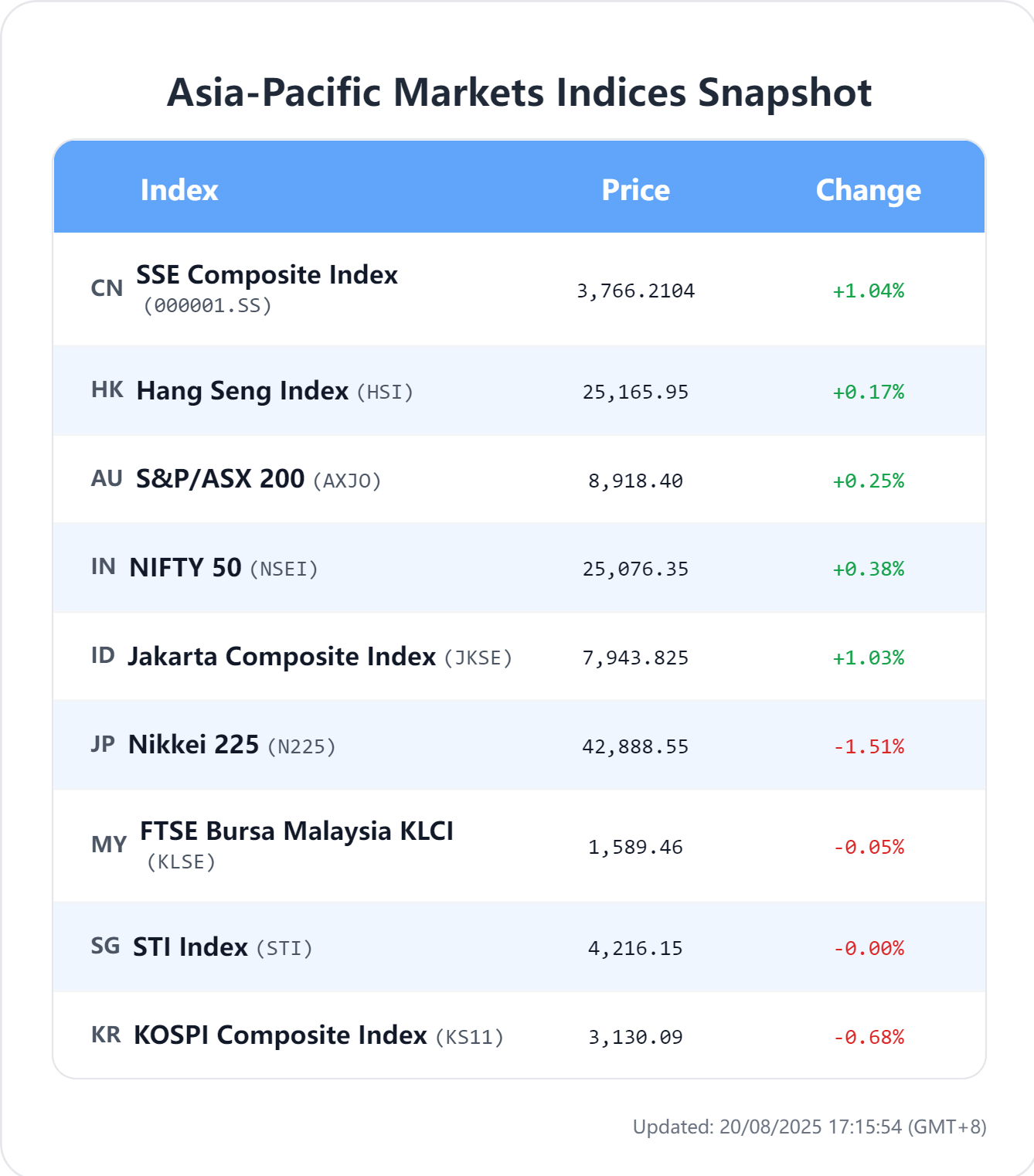
China Stock Market: The market rebounded from its intraday low, with the Shanghai Composite, Shenzhen Component, and STAR 50 indices hitting new yearly highs. By the close, the Shanghai Composite rose 1.04%, the Shenzhen Component gained 0.89%, and the ChiNext Index edged up 0.23%.
Sector-wise, liquor, semiconductors, AI glasses, and minor metals led the gains, while film, chemical pharmaceuticals, CRO, and vitamins saw the largest declines.
Hong Kong Stock Market: The major Hong Kong indices saw mild fluctuations on Wednesday. The Hang Seng Index closed up 0.17% at 25,165.94 points; the Tech Index dipped 0.01% to 5,541.27 points; and the State-Owned Enterprises Index rose 0.08% to 9,013.27 points.
Market performance showed solar, paper, new consumption, semiconductors, and consumer electronics stocks leading the gains, while healthcare and cryptocurrency stocks weakened.
Japan Stock Market: The Nikkei Average plummeted 1.51%, dropping 657.74 yen to close at 42,888.55 yen (with a trading volume of about 1.91 billion shares), falling below 43,000 yen for the first time in four sessions.
By sector, 18 industries, including fisheries, agriculture, food, land transport, and mining, posted gains. Meanwhile, 15 sectors, such as non-ferrous metals, other products, telecommunications, and machinery, declined.
South Korea Stock Market: The KOSPI fell 0.68% to 3,130.09 points. Sector-wise, tobacco, hotels, internet, and auto sectors led the gains, while electrical equipment and machinery sectors saw the steepest drops.
Australia Stock Market: The S&P/ASX 200 (XJO) rose 0.25% to close at 8,918.000 points.
Sectors like cyclical retail, packaging and containers, construction, and banking saw slight gains, while building materials, aerospace, non-alcoholic beverages, and semiconductors experienced modest declines.
Singapore Stock Market: The Straits Times Index edged up 0.01% to close at 4,216.69 points. By sector, building materials, non-alcoholic beverages, business services, and real estate saw slight increases, while forestry products, agriculture, education, and software sectors posted larger declines.
Malaysia Stock Market: The Malaysia Index dropped 0.13% to close at 1,588.21 points. Sector-wise, industrial products and services, and plantations saw modest gains, while telecommunications and media, utilities, construction, and real estate sectors declined.
Key Events
Indian State Refineries Boost Russian Oil Purchases Despite U.S. Criticism
Despite facing higher trade tariffs and a barrage of criticism from Trump administration officials, Indian state-owned refineries have resumed buying Russian oil after a brief pause.
Informed traders say that over the past two days, companies like Indian Oil Corporation and Bharat Petroleum purchased some Urals crude from Russia. Speaking on condition of anonymity due to lack of authorization to comment publicly, they added that these crude shipments are slated for September and October loading.
Japan’s July Exports See Largest Drop in Over Four Years, Auto Shipments to U.S. Slump
Japan’s exports fell 2.6% year-on-year in July, marking the third consecutive month of decline and the largest drop in over four years. Exports to the U.S. dropped 10.1% due to auto shipments, marking a fourth straight month of decline.
To retain market share, Japanese automakers have cut prices in the U.S.—the average export price of passenger cars fell from $28,700 in Q1 to $23,500 in June-July, a drop of about 18%. By volume, exports in June were down 5% from the April-May average, with a further 12% decline in July.
Investment banks warn that this “volume-for-price” strategy is unsustainable, with tariff pressures likely to erode profits in the near term.
South Korea Unveils Measures to Support ‘Voluntary’ Petrochemical Industry Restructuring
The South Korean Ministry of Trade, Industry, and Energy announced on Wednesday that the government will assist the struggling petrochemical sector with “voluntary” restructuring to address a global oversupply crisis.
The ministry stated that the petrochemical industry roadmap aims to reduce oversupply, shift toward high-value specialty products, improve financial health, and minimize the impact of structural adjustments on regional economies.
South Korea Plans to Procure Over 35,000 GPUs in Next Two Years
The South Korean Ministry of Science and ICT announced on Wednesday that it will procure over 35,000 graphics processing units (GPUs) over the next two years as part of a nationwide AI infrastructure boost.
Minister Lee Jong-ho told parliament that the government’s long-term goal is to secure 50,000 GPUs by 2030.
Institutional Views
Singapore’s Non-Oil Exports Face Gloom
Analysts Cite Tariff Risks and Weak External Demand: Economists at CGS International warn that U.S. tariff policy risks could suppress Singapore’s non-oil domestic exports (NODX) outlook. July’s weak export data reinforces their view of “softening growth momentum in the second half.”
Analysis highlights the evolving tariff landscape as a core external demand risk, given Singapore’s heavy reliance on the U.S. and China as trading partners.
Goldman Sachs: Expects 25 bps Fed Rate Cut in September, 5-Year Treasuries Best Pre-Cut Play
Goldman Sachs’ global banking and markets chief strategist Sharmin Mossavar-Rahmani said the 5-year U.S. Treasury is the most attractive trade amid potential Fed rate cuts. She noted that yields in the 3%-4% range offer value while providing protection during market risks. The current 5-year yield stands at 3.85%, down from 4.38% earlier this year.
ING: RBNZ to Cut Rates by 25 bps, Policy Path in Focus
ING Bank predicts the Reserve Bank of New Zealand will cut rates by 25 basis points this week, in line with market expectations.
The upcoming interest rate path forecast may fully reflect an additional 25 bps cut to 2.75% in November, but since markets have priced in a terminal rate of 2.75%, even a clear signal won’t be seen as an unexpectedly dovish move.
ING maintains its forecast of 25 bps cuts in August and November, marking the end of this easing cycle.
OCBC: Thailand Faces Cyclical Challenges, U.S. Tariffs to Exacerbate Vulnerability
OCBC economists noted in a report that reciprocal U.S. tariffs could worsen Thailand’s economic fragility. The country currently faces cyclical issues, including fewer foreign tourists and potential political shifts reshaping parliament, alongside structural problems like high household debt, limited export competitiveness, and rapid aging.
OCBC warns that Thailand’s prior “front-loaded export” strategy to the U.S. may soon fade. With an effective tariff rate of 19.6%—the highest among tracked regional economies—Thailand could be the hardest hit, followed by Vietnam, Malaysia, India, the Philippines, and Indonesia.
RBC: BoC Likely Done Cutting Rates
Claire Fan of Royal Bank of Canada said overall CPI in Canada is still influenced by the April cancellation of the federal consumer carbon tax surcharge, but July’s inflation eased from 1.9% in June to 1.7%, reflecting reduced underlying pressure.
She noted that the Bank of Canada’s preferred core CPI median and trim measures grew below 0.2% month-over-month in July, though CPI diffusion indicators show broad inflation pressure across the consumption basket. With significant cuts over the past year and softening labor market signs expected to bottom out, Fan believes no further rate cuts are likely in this cycle.