
Morgan Stanley: Will AI Unlock $16 Trillion in Value for U.S. Stocks?

Morgan Stanley released a major research report titled "AI Adoption and the Future of Work" on August 17.
The report seeks to address two critical questions: How much value can AI create for businesses? And how will it reshape the future of work?
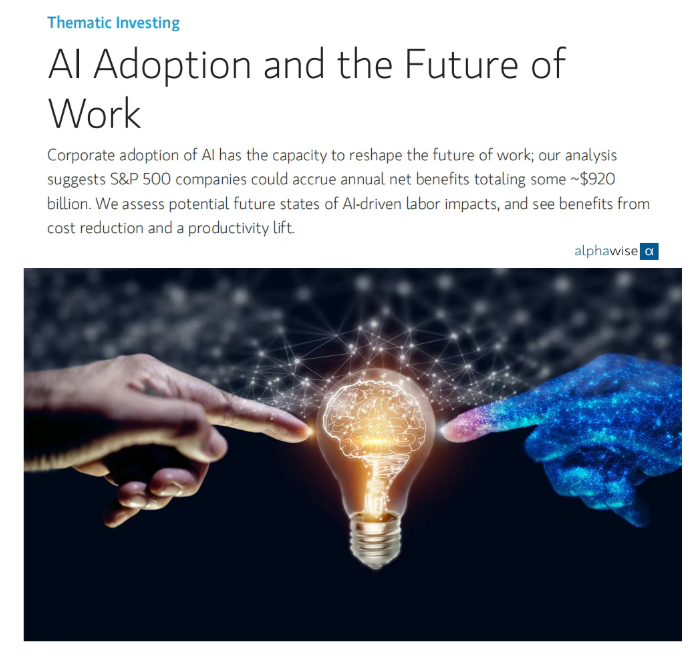
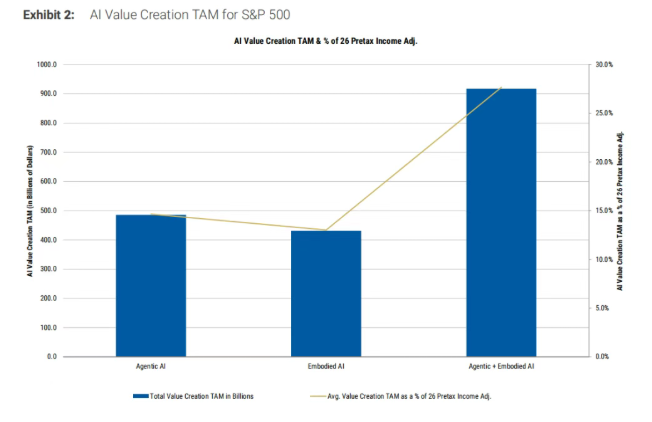
The conclusions are strikingly bold: If AI is fully implemented across S&P 500 companies, it could release $920 billion in net benefits annually, translating to a long-term market capitalization creation of $13-16 trillion.
This figure represents about one-quarter of the current S&P 500 total market value.
Dual Impact of AI on Work
The report suggests that in the future, 90% of occupations will be affected by AI to varying degrees. However, a key distinction exists:
- Augmentation: AI takes over repetitive, low-value tasks, allowing humans to focus on creation and value-added activities.
- Automation: Some roles will be directly replaced, particularly those with fixed processes and low creativity demands.
Morgan Stanley further categorizes AI into two types:
- Agentic AI (Software-based AI): Broad coverage, mostly enhancing roles.
- Embodied AI (Robotics AI): Narrower scope, with stronger replacement potential.
In other words, AI is more likely to act as a “helper” rather than a “complete replacement.”
Which Industries Will Be Most Affected?
The report estimates that, in terms of cost savings and efficiency gains, some industries could see benefits exceeding 100% of their 2026 pre-tax profits:
- Biggest Beneficiaries: Retail distribution, real estate management, transportation, medical equipment, and services.
- Limited Benefits: Hardware manufacturing, semiconductors.
Notably, these industries with the greatest potential gains are traditional sectors with high labor costs and low profit margins. AI could fundamentally transform their profitability structures.
Historical Mirror: How Technological Waves Rewrite Work
This isn’t the first time technological innovation has sparked employment concerns. Over the past 150 years, each major tech revolution has been accompanied by “job losses + new job creation”:
- Electrification eliminated steam engine workers but gave rise to electrical engineers.
- Tractors reduced farm labor but spurred urban industrialization.
- Computers cut secretarial and bookkeeping roles but created the programming industry.
- The internet phased out some retail jobs but birthed e-commerce and digital marketing.
AI is likely to follow a similar path: some jobs will disappear, but many new roles will emerge.
New Roles and Positions
Morgan Stanley predicts AI will usher in a range of new roles:
- Chief AI Officer (CAIO): Oversees corporate AI strategy.
- AI Governance and Compliance Roles: Ensures data security and risk management.
- Hybrid Talent: Roles like “product manager + engineer” (leveraging natural language programming for rapid product iteration).
- Industry-Specific Roles: Such as AI drug development scientists, smart grid analysts, and digital twin engineers.
Investment Perspective: Who Are the Winners?
Morgan Stanley’s answer is clear:
- AI Infrastructure: Data centers, chips, and servers are definite beneficiaries, with global investment in these areas expected to exceed $3 trillion by 2028.
- AI Adopters: Giants in labor-intensive sectors like retail, healthcare, and transportation will reap significant dividends from efficiency gains.
- Talent and Governance: AI governance and training will emerge as new investment themes.
AI is not merely a “job-cutting machine.” It’s a force reshaping work patterns, industry landscapes, and capital markets.
For businesses, the key lies in balancing automation with augmentation, redirecting saved labor toward innovation and growth.
For individuals, the focus should be on quickly acquiring new skills to find their place in the AI wave.
AI’s future is both an efficiency revolution and an opportunity reallocation.
Thoughts for Investors
For retail investors, AI themes offer both opportunities and risks.
- Short Term: AI may reflect more “hype” and “sentiment premiums,” leading to high stock volatility.
- Medium Term: Infrastructure segments (chips, compute power, data centers) are more likely to deliver tangible results.
- Long Term: The real value lies in how AI transforms profitability models in traditional industries, especially those with high labor costs and low margins.
In other words, AI isn’t a “single-track” opportunity but a structural one spanning multiple industries.
For investors, understanding its impact on cost structures, profitability, and industry dynamics is more important than chasing trends.