
Citron Slams Palantir: Even at $40, It’s Still Too Expensive

Shearing sheep
August 21, 2025
GoGPT Summarizes Articles
The AI trade has been on fire for the past two years, and Palantir ($PLTR) has been one of the biggest beneficiaries. Its stock surged ten-fold from early 2023, riding the wave of excitement over artificial intelligence and data analytics.
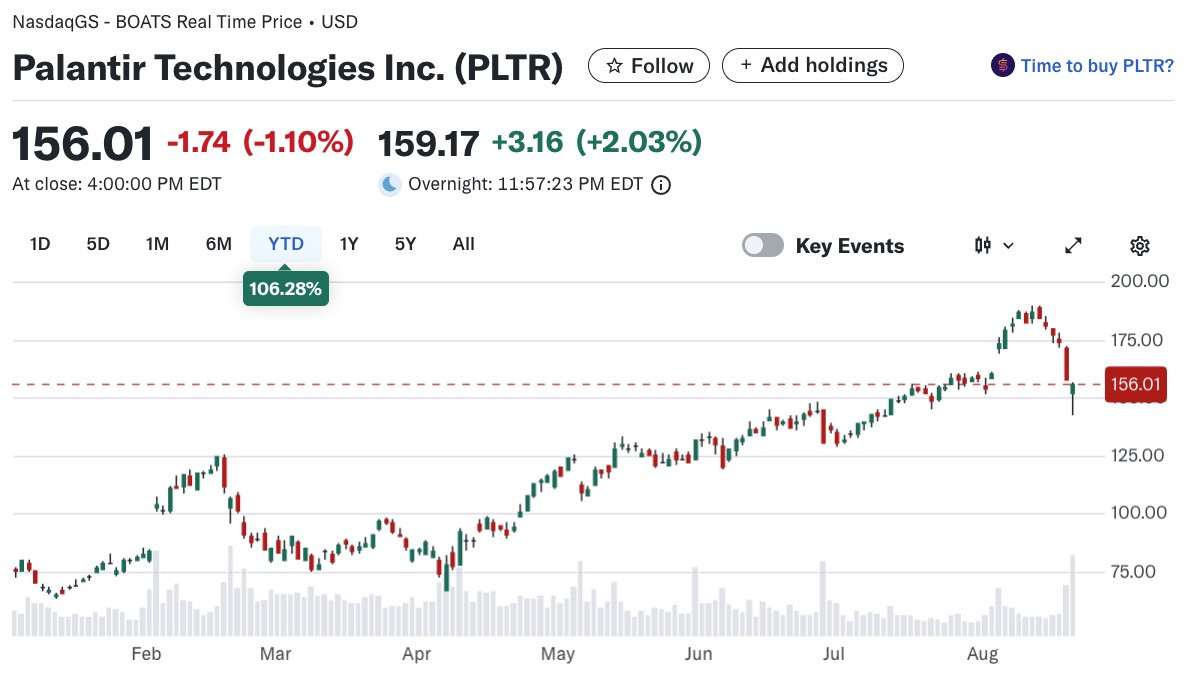
Earlier this month, the company even hit an all-time high near $190 a share, briefly putting its market cap above $400 billion. But now the mood is shifting, and one of Wall Street’s most notorious short sellers has stepped in to throw cold water on the party.
Andrew Left, the founder of Citron Research, argues that Palantir’s valuation has simply spun out of control. In his latest report, he compares Palantir directly with OpenAI, which is preparing a secondary share sale valuing the company at about $500 billion.
OpenAI reportedly generates close to $30 billion in annual revenue, which translates to a price-to-sales multiple of around 17×. Using the same yardstick, Palantir—with roughly $5.6 billion in annual revenue—would be worth closer to $40 a share, not the $150–160 level where it trades today.
Left went further, saying that even at $40, Palantir would remain one of the most expensive SaaS stocks in history.
OpenAI’s growth has been called “unprecedented” in the history of tech: its products have gone global almost overnight, with subscription-like models that scale seamlessly.
Palantir, by contrast, built its business on government contracts—especially with defense and intelligence agencies—and only in recent years has pushed into commercial clients. It has introduced new AI platforms, but its revenue model remains more project-driven and less universally scalable.
Citron’s point is that it’s hard to justify giving Palantir the same kind of multiple that investors are willing to award OpenAI.
The timing of the report was also telling.
Palantir had been sliding for several sessions before Citron’s latest note, and the short call accelerated that decline. Since peaking on August 12, the stock has fallen more than 15%, one of its sharpest pullbacks this year.
Some analysts suggest this is part of a broader cooling in the AI trade—Nvidia, CoreWeave, and other high-flyers have also pulled back—but Palantir has been particularly vulnerable given how stretched its valuation metrics have become.
Reports note that CEO Alex Karp has recently sold nearly $2 billion worth of shares, a move that hardly reassures investors already nervous about frothy pricing.
That said, Palantir is not without strengths.
Its most recent quarterly results showed more than $1 billion in revenue for the first time, margins are improving, and management raised full-year guidance to over 50% growth. By traditional SaaS standards, those are undeniably strong numbers, and its “Rule of 40” score—a measure combining growth and profitability—hit an impressive 94%. Technical ratings like Relative Strength remain high as well, which suggests that despite the sell-off, big institutions are still paying attention.
In other words, there are reasons why Palantir has attracted so much investor enthusiasm in the first place.
The bigger question is whether investors are mistaking momentum for fundamentals.
OpenAI’s $500 billion valuation has set a new benchmark for the AI space, and when you hold Palantir up against it, the gap in business models, scale, and growth trajectories becomes obvious. Even Sam Altman, OpenAI’s own CEO, has been warning about an AI bubble, drawing parallels to the dot-com era when valuations ran far ahead of reality.
If the leader of the pack is cautioning against over-excitement, it makes Citron’s warning about Palantir look less like noise and more like a dose of sober perspective.
So where does that leave investors?
Palantir sits at a crossroads.
Bulls will argue that the company has unique positioning in government and enterprise data, that its AI platforms are just beginning to gain traction, and that it could eventually justify its lofty multiples.
Bears will counter that the stock is already priced for perfection, leaving no margin for error if growth slows or government budgets tighten.
In many ways, the debate is less about Palantir itself and more about how far the AI trade can stretch before gravity takes hold.
The market is currently trying to decide whether Palantir is a legitimate long-term winner or simply the most crowded trade of the moment.
Citron’s $40 “fair value” target might feel extreme, but it forces investors to confront a simple truth: even in the hottest sector, fundamentals eventually matter.
#Market Spotlight: The Stories Driving Today’s Trading#$Palantir Technologies Inc. Class A Common Stock(PLTR)