
APAC Market Wrap - 21 Aug

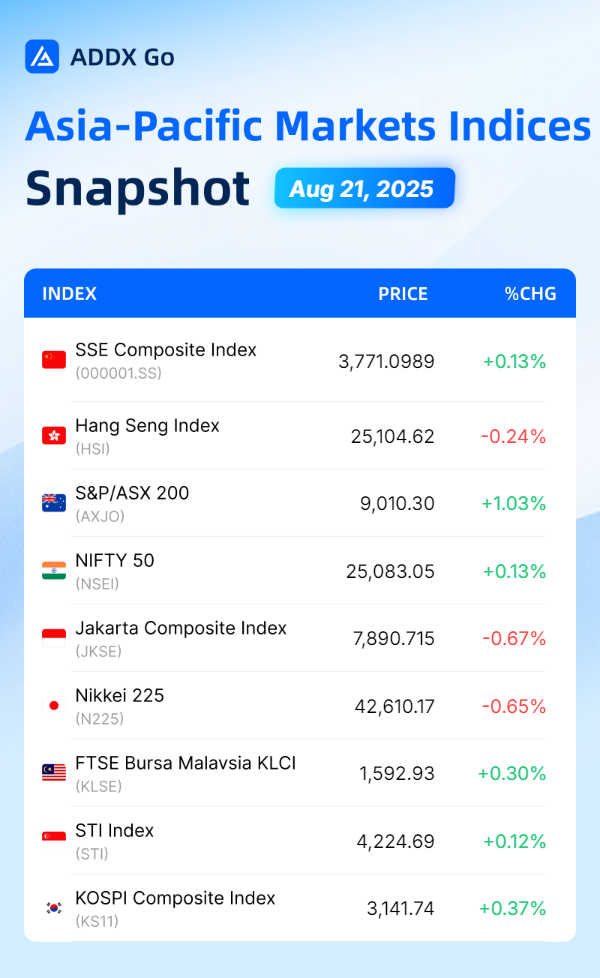
China Stock Market: The market experienced volatility throughout the day, with the major indices showing mixed results. By the close, the Shanghai Composite Index rose 0.13%, the Shenzhen Component Index fell 0.06%, and the ChiNext Index dropped 0.47%.
In terms of sectors, oil and gas, digital currency, beauty care, and banking led the gains, while rare earth permanent magnets, PEEK materials, liquid-cooled servers, and CPO saw the largest declines.
Hong Kong Stock Market: The major Hong Kong indices weakened collectively today. By the close, the Hang Seng Index fell 0.24% to 25,104.61 points, the Hang Seng Tech Index dropped 0.77% to 5,498.50 points, and the State-Owned Enterprises Index declined 0.43% to 8,974.77 points.
Market performance showed internet healthcare, pharmaceuticals, infrastructure, and cryptocurrency concept stocks outperforming, while consumer electronics and new consumption stocks generally retreated.
Japan Stock Market: The Nikkei Average fell for the third consecutive day, down 0.65% to close at 42,610.17 yen, a drop of 278.38 yen (with a trading volume of approximately 1.74 billion shares). The decline was influenced by falling U.S. tech stocks and a strengthening yen, triggering sell-offs in semiconductors and auto-related stocks.
By sector, 10 industries, including non-metallic, steel, pulp and paper, mining, and chemicals, rose, while 23 industries, such as pharmaceuticals, transportation equipment, construction, land transport, and food, declined.
South Korea Stock Market: The KOSPI rose 0.37% to 3,141.74 points.
By sector, life insurance, electric utilities, diversified consumer services, paper, and timber led the gains, while shipping companies, semiconductors and equipment, electronic products, and biotechnology saw the largest drops.
Australia Stock Market: The S&P/ASX 200 (XJO) rose 1.13% to close at 9,019.100 points.
In terms of sectors, business services, hardware, furniture, and consumer packaging saw slight gains, while medical diagnostics, building materials, and diversified financials experienced modest declines.
Singapore Stock Market: The Straits Times Index rose 0.29% to close at 1,592.87 points.
By sector, forestry products, building materials, and non-alcoholic beverages saw slight increases, while insurance, defensive retail, and diversified media posted larger declines.
Malaysia Stock Market: The Malaysia Index rose 0.29% to close at 1,592.87 points.
By sector, energy, industrial products and services, and utilities saw slight gains, while communications and media, technology, and healthcare declined.
Key Events
South Korea Introduces Restrictions on Foreign Home Purchases to Curb Speculative Demand
The South Korean government announced on Thursday that it will restrict foreigners from buying homes in key areas of Seoul, Incheon, and Gyeonggi to curb speculative demand driven by overseas capital inflows.
The Ministry of Land, Infrastructure, and Transport stated that a central city planning committee meeting held that morning approved a plan to include foreign residential buyers under the Real Estate Transaction Reporting Act.
South Korea’s Chip Exports Surge Nearly 30% in First 20 Days of July
Data released by the Korea Customs Service on Thursday showed that South Korea’s exports grew 7.6% year-on-year to $35.5 billion in the first 20 days of August, driven by strong demand for semiconductors and automobiles.
The average daily export value also rose 7.6% compared to the same period last year. The number of working days was 14.5, unchanged from last year.
During this period, imports increased by 0.4% to $34.7 billion, resulting in a trade surplus of $0.8 billion.
Nomura: Indian Stocks Become Most Underweighted by Emerging Market Investors
According to Nomura’s analysis of major global funds, Indian stocks have become the most underweighted asset among emerging market investors, with funds reallocating to stocks in mainland China, Hong Kong, Taiwan, and South Korea.
“As of the end of July, 71% of emerging market funds were underweight on Indian stocks (up from 60% previously), making India the most underweighted market in emerging market portfolios,” strategists including Chetan Seth wrote in the report.
Institutional Views
Goldman Sachs: Expected Dollar Weakness to Boost Emerging Market Carry Trades
Goldman Sachs stated that high-yield emerging market currencies remain vulnerable to growth concerns but are set to perform well in carry trades under an expected dollar weakening.
If tariff outcomes are milder, the Indian rupee will continue to appreciate. Medium-term, Goldman favors the Brazilian real, South African rand, and Hungarian forint as carry trade long positions.
Capital Economics: U.S. Short-Term Rates Face Upside Risk, Market Overestimates Fed Rate Cuts
Capital Economics investment committee member Kevin Thozet said in a report that U.S. short-term rates face upside risk. He noted that markets are overly confident in Fed rate cut expectations, with U.S. money markets pricing in at least two cuts this year, reflecting expectations of further economic and inflation slowdown.
Thozet stated: “Given the resilience of the U.S. economy, policy uncertainty, and persistent inflationary pressures, we believe this expectation is too high.” He added that the outlook for long-term U.S. Treasury yields is more balanced, with the current 10-year yield at 4.300% expected to fluctuate within a 50-basis-point range around current levels.
Barclays: UK Core Services Inflation Slows, November Rate Cut Still Possible
Barclays economists reported that while overall inflation remained strong in July, core services inflation in the UK showed signs of slowing. Excluding indexation, volatile items, rents, and overseas travel, UK annual core services inflation eased from 4.2% in June to 3.9% in July.
However, overall services inflation accelerated from 4.7% in June to 5.0% in July. Economists noted that the slowdown in core services inflation keeps a Bank of England rate cut in November on the table.
Société Générale: Bleak UK Fiscal Outlook to Weaken Pound Mid-Term
Société Générale analyst Kit Juckes said in a report that the pound may weaken mid-term due to a bleak UK fiscal outlook. He noted: “Higher taxes are coming, growth will slow, and the pound will weaken further.” However, he believes the decline will be gradual, advising investors to “be very patient” or capitalize on short-covering opportunities for better entry points.
Juckes expects the euro/pound chart support to rise to 0.8700 by the end of summer, with potential to move higher.
CICC: Global AI Liquid Cooling Market to Reach $8.6 Billion by 2026
A CICC research report states that as AI models evolve and applications expand, demand for computing power rises, increasing chip power consumption and density. Liquid cooling, with its high efficiency and deployment density, is rapidly replacing air cooling as the mainstream solution.
The global AI liquid cooling market is projected to reach $8.6 billion by 2026.
CITIC Securities: Large Model Industrialization Cycle Just Beginning, Compute Investment Surging
A CITIC Securities research report notes that the user penetration rate of AI large models remains low, with development still in an early-to-mid stage. The industrialization cycle is just starting, and compute investment driven by large models is gaining momentum.
Capital expenditure will grow with large model revenue, with a high investment ceiling. Both North American and Chinese compute infrastructure chains warrant attention.