
APAC Market Wrap - 22 Aug

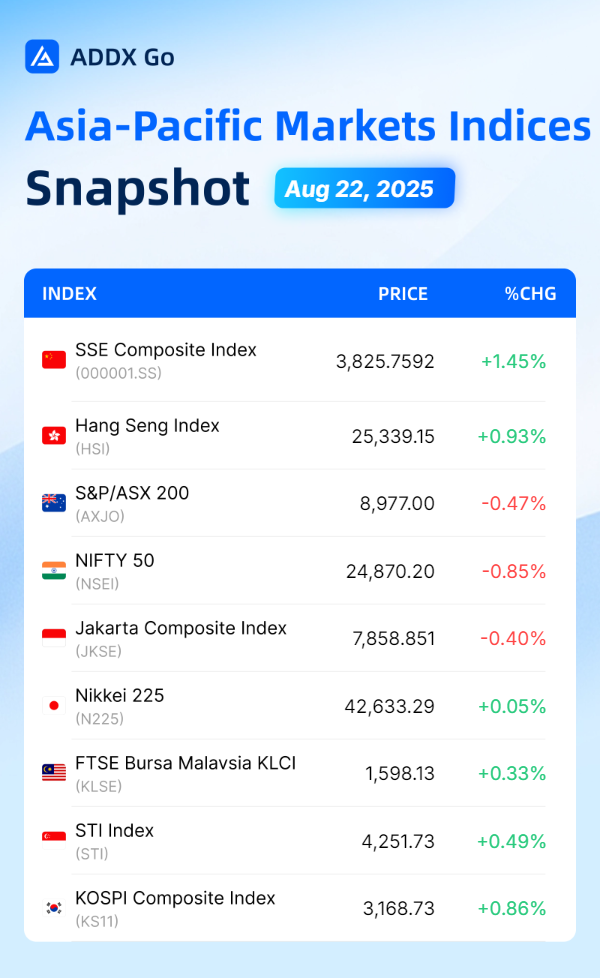
China Stock Market: The market oscillated upward throughout the day, with the Shanghai Composite Index breaking above 3,800 points and the ChiNext 50 rising over 8%, hitting a more-than-three-year high. By the close, the Shanghai Composite Index gained 1.45%, the Shenzhen Component Index rose 2.07%, and the ChiNext Index climbed 3.36%.
In terms of sectors, semiconductors, CPO, securities, and computing power led the gains, while gas, steel, banking, and dairy sectors saw the largest declines.
Hong Kong Stock Market: As of Friday’s close, the Hang Seng Index rose 0.27% to 25,339.14 points; the Tech Index gained 1.89% to 5,647.68 points; and the State-Owned Enterprises Index increased 0.45% to 9,079.93 points.
This week, Hong Kong stock market hotspots rotated rapidly, with mid-year earnings reports from individual stocks offering numerous highlights, and the broader market experiencing two-way volatility. From a performance perspective, sectors like semiconductor chips, media and entertainment, and telecom equipment showed clear strength, while financials, real estate, appliances, and coal industries saw pullbacks.
Japan Stock Market: After four days of declines, the Nikkei Average rebounded slightly by 0.05%, closing at 42,633.29 yen, up 23.12 yen. In terms of sectors, 25 industries, including insurance, securities, commodities futures, banking, mining, and electricity and gas, rose, while 8 industries, such as chemicals, air transport, services, precision instruments, and steel, fell.
Korea Stock Market: The KOSPI rose 0.86% to 3,168.73 points. In terms of sectors, aerospace, electrical equipment, healthcare management, and non-metallic minerals led the gains, while broadcasting and entertainment, chemicals, air cargo, and furniture sectors saw the largest declines.
Australia Stock Market: The S&P/ASX 200 (XJO) fell 0.57% to 8,967.400 points. In terms of sectors, credit, hardware, aerospace, and building materials saw slight gains, while restaurants, furniture, and biotechnology experienced modest declines.
Singapore Stock Market: The Straits Times Index rose 0.52% to 4,253.02 points. By sector, automotive and parts, steel, and diversified media saw slight increases, while waste management, non-alcoholic beverages, and healthcare services posted larger declines.
Malaysia Stock Market: The Malaysia Index rose 0.29% to 1,597.47 points. By sector, technology, communications and media, and industrial products and services saw slight gains, while energy, utilities, and real estate declined.
Key Events
Japan’s July Inflation Remains Above BOJ’s 2% Target, Rate Hike Expectations Rise
Japan’s consumer price growth slowed in July but still far exceeded the Bank of Japan’s 2% target. This trend has strengthened expectations of an imminent rate hike.
Korea Suspends Imports of Argentine Poultry Due to Bird Flu Outbreak
The Korean Ministry of Agriculture, Food and Rural Affairs announced on Friday that it has suspended imports of poultry and related products from Argentina due to an outbreak of highly pathogenic avian influenza. The ministry stated that the ban applies to goods loaded on or after last Sunday (August 17).
Poultry products exported from Argentina after August 3 will also undergo mandatory testing for highly pathogenic avian influenza upon arrival in Korea.
Institutional Views
Morgan Stanley believes that, driven by improved liquidity, outflows from bonds and savings, and growing investor confidence in policy easing, the current rally in China stocks could persist until the end of summer. Analysts led by Laura Wang reaffirmed in a Thursday research note to overweight A-shares relative to offshore China stocks.
Trends in onshore bond yields suggest that domestic investors’ outlook on the long-term macroeconomic landscape is turning more positive.
Christoph Rieger, head of rates and credit research at Commerzbank, said in a report that the Federal Reserve Chair has previously used the Jackson Hole Symposium to signal important policy shifts, but this year is unlikely to see such a move.
Rieger noted: “While we expect no major shift from Powell’s previous guidance—i.e., the Fed awaiting more data—leaving the door open for a 25-basis-point rate cut in September would be a reasonable step.”
Ashley Webb from Capital Economics wrote in a report that signs of robust UK business activity increase the likelihood of the Bank of England maintaining interest rates for a longer period. According to a business survey released Thursday, economic activity accelerated this month, indicating stronger vitality in the private sector than previously feared.
Webb said: “At present, BOE policymakers may follow a rate cut this month with another in November, though the November decision will be a very close call.”
Economist Kapos from the Commonwealth Bank of Australia said that Federal Reserve Chair Powell’s speech at the Jackson Hole annual symposium will be the next catalyst for the dollar’s movement. However, don’t expect Powell to send a clear signal in either direction.
Kapos said he may keep his options open, awaiting more data. But if Powell indicates a willingness to cut rates, markets are likely to price in a September rate cut more fully, leading to a mild dollar decline. He noted that the probability of a September rate cut is currently around 70%, setting a high bar for Powell to deviate from market expectations.
CICC Strategy remains optimistic about the Hong Kong stock market outlook. Based on current data, mid-year earnings for Hong Kong stocks are improving, with the profit forecast rate hitting a three-year high, and the higher “new economy” content in Hong Kong stock earnings may improve before A-shares.
In previous bull markets, Hong Kong indices slightly underperformed A-shares, so for this cycle’s allocation, CICC suggests focusing on differentiated directions from A-shares. The recommended sequence is: new drugs first (due to loose liquidity and positive BD data), then internet (with a turning point in the delivery war), and finally new consumption (once macroeconomic and profit turning points emerge).