
Leveraging ADDX, $1,000 Entry for DBS Ethereum Tokenized Notes for Institutional Investors!

Singapore’s largest bank, DBS, is once again leading financial innovation.
Recently, DBS officially announced the launch of tokenized structured notes on the Ethereum blockchain, opening a more flexible, low-barrier digital asset investment gateway for qualified investors and institutional clients.
This move not only marks a deep integration of traditional finance with the crypto world but also signals the accelerating wave of asset tokenization.
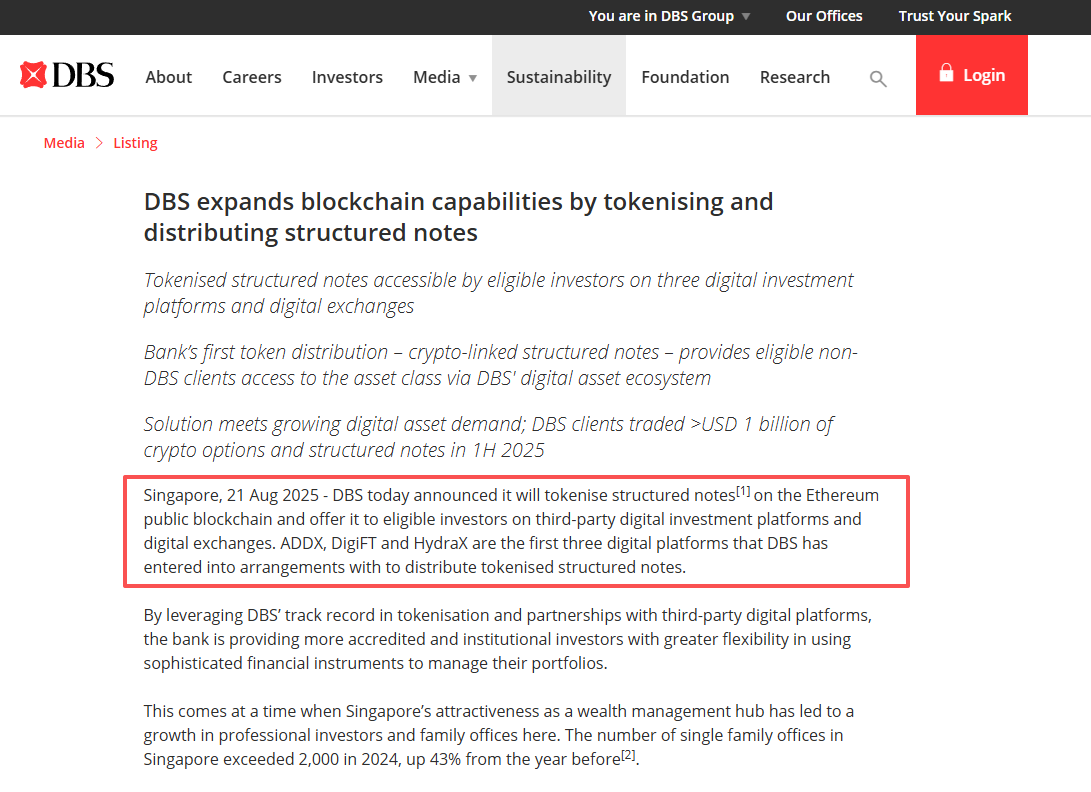
(The screenshot is from the official website of DBS Bank)
What are tokenized structured notes?
Structured notes are complex financial products issued by banks, typically linked to assets like stocks, interest rates, commodities, or cryptocurrencies, featuring customizable and flexible yield structures.
However, these products have long faced two major pain points:
- high entry barriers (minimum investments often exceeding $100,000)
- poor liquidity (opaque trading and difficult transfers).
The product launched by DBS Bank this time is a note linked to crypto assets. Its design is quite ingenious, somewhat like an “offensive and defensive” investment tool:
- When the market is good: If the linked crypto assets rise, you can directly receive cash profits.
- When the market is bad: If the market falls, its structure is designed to cushion part of the loss, providing a safety net.
However, what’s most exciting this time is the significant change in the investment threshold. Previously, buying such structured notes required hundreds of thousands of dollars, making it out of reach for most.
But now, by tokenizing it on Ethereum, DBS Bank has boldly lowered the minimum investment threshold to $1,000 per unit.
According to DBS Bank itself, the market has a strong appetite for this type of product. Just in the first half of this year, clients traded over $1 billion worth of these products, with the second quarter seeing a nearly 60% surge compared to the first.
Why Ethereum specifically?
With so many blockchains available, why did DBS settle on Ethereum? The decision runs deep.
Ethereum is currently the largest and most widely accepted smart contract platform globally. Its openness and transparency act like a “trust machine,” providing a natural foundation for issuing and trading financial products.
DBS Bank’s head, Li Zhen, was also quite candid: “Asset tokenization is the next big wave in financial markets. We’ve been working on this since 2021, aiming to address real market issues and make financial markets more efficient and accessible.”
Notes issued on Ethereum can theoretically be traded globally 24/7, and in the future, they could even integrate with various DeFi applications in innovative ways.
Though initially, trading will be limited to permitted “whitelisted wallets,” this is undoubtedly a significant step forward for a traditional major bank.
What Impact Will This Have?
DBS Bank’s latest move isn’t just a simple product launch—it’s the convergence of several major trends that could quietly transform the entire financial industry.
The concept of "everything on the chain" is drawing closer.
From real estate and company equity to artwork and financial notes, moving real-world assets (RWA) onto the blockchain has been the biggest opportunity bridging these two worlds.
Boston Consulting Group (BCG) predicts this market could reach an astonishing $16 trillion by 2030. With a “mainstream player” like DBS stepping in, it’s injecting unparalleled confidence into this space.
Traditional finance and DeFi are no longer separate.
In the past, big banks had a love-hate relationship with public blockchains and crypto assets. But now, pioneers like DBS are no longer content to just watch from the sidelines—they’re rolling up their sleeves and diving in.
Leveraging blockchain’s efficiency and transparency while drawing on their expertise in compliance, risk management, and client resources, a new “hybrid finance” model is taking shape.
Singapore demonstrates bold vision and foresight.
It’s worth noting that Singapore’s regulatory environment has been crucial to making this happen. Under initiatives like Project Guardian, Singapore has consistently encouraged financial institutions to explore asset tokenization. A progressive yet clear regulatory framework naturally attracts giants like DBS and JPMorgan to test new ideas here.
What Lies Ahead? From Crypto Notes to “Everything Tokenizable”
DBS has made it clear that these crypto notes are just the beginning.
The next step is to tokenize more asset types like stocks and bonds, ultimately aiming for a “everything can be tokenized” future.
For everyday investors, this heralds a more equitable, efficient, and choice-rich investment era. For the financial industry as a whole, a new blockchain-based infrastructure is being built, fundamentally altering how assets are issued, traded, and managed.
In a sense, DBS’s small step is a giant leap for the financial industry toward the future. When the credibility of traditional finance truly merges with blockchain technology, a more open financial world is no longer just talk—it’s becoming reality.
What happens next? We’ll be watching closely.
By the way, it’s worth mentioning that, currently, this tokenized product is only available to qualified investors and institutional clients, distributed through Singapore-licensed digital investment platforms, and in the future, we will be able to purchase it directly on ADDX.