
Powell’s Pivot: Is the Fed Finally Opening the Door to Cuts?

At Jackson Hole, Federal Reserve Chair Jerome Powell signaled a meaningful shift in the Fed’s risk assessment that markets interpreted as an opening to easier policy: stocks ripped higher, traders increased the odds of a September cut, and demand for long-dated corporate bonds surged as investors scrambled to lock in yields.
Key Points
- Powell said the risk balance is changing: downside job risk has risen while tariffs are putting upward pressure on some goods prices.
- The Fed issued a revised “Statement on Longer-Run Goals and Monetary Policy Strategy,” removing key 2020-era language and reaffirming a 2% inflation target.
- Markets reacted sharply: Dow +1.92%, Nasdaq +1.96%, S&P 500 +1.47% intraday; traders priced roughly two 25bp cuts by year-end.
- Macro snapshot cited by Powell: three-month average payrolls ≈ 35,000 vs 2024 monthly average ≈ 168,000; unemployment ≈ 4.2%; GDP ≈ 1.2% this year (vs 2.5% in 2024); headline PCE ≈ 2.6%, core PCE ≈ 2.9%; core goods inflation +1.1% year-over-year.
- Long-dated corporate bonds were heavily bid—example: Eli Lilly issued $2bn (30/40-year) against about $14.7bn in orders.
Powell’s message and the Fed’s framework change
Powell framed Jackson Hole as more than a speech: it was an assessment of a shifting risk landscape. He noted that employment downside risks have risen even as certain goods prices are being pushed upward by tariffs.
That combination—rising downside risk to jobs and incremental inflation pressures—creates a delicate trade-off for policymakers. Powell’s language was cautious but consequential: he said these evolving risks “may require adjustments” to policy, explicitly leaving room for easing if data confirm growing weakness in the labor market.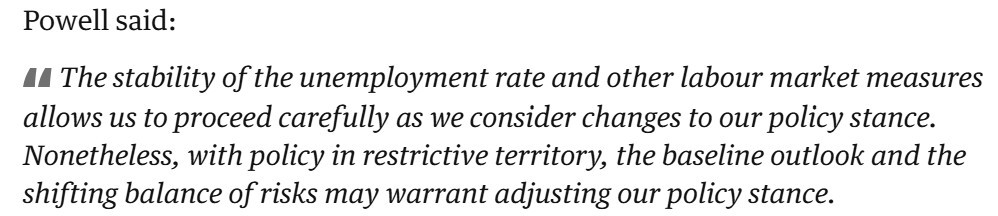
Alongside the remarks, the Fed released an updated policy statement after a multi-year review. The revisions remove the 2020 emphasis on the effective lower bound as a defining environment and step away from explicit “make-up” or averaging language that suggested tolerating inflation overshoots.
The term “shortfalls” used to describe employment gaps was deleted and replaced with language that stresses a balanced approach when employment and price stability conflict. Importantly, the Fed reaffirmed its 2% long-run inflation goal and emphasized that any policy change will be data dependent, not pre-committed.
This is an evolution, not a repudiation. Powell repeatedly emphasized data dependence and the absence of a preset path.
Still, the shift in framing—less emphasis on the lower bound, removal of explicit “make-up” wording, and the acknowledgment of a changed risk balance—was sufficient to signal to markets that the Committee has greater latitude to consider easing if downside job risks materialize.
Market response and the bond stampede
Markets moved fast. Equity indices opened sharply higher during Powell’s remarks: the Dow climbed about 1.92%, the Nasdaq about 1.96%, and the S&P 500 roughly 1.47% intraday.
Traders quickly re-priced Fed expectations, elevating the probability of a September cut and pricing roughly two 25-basis-point cuts by year-end. The immediate reaction indicates investors took Powell’s conditional language as an actionable hint that the tightening phase may be nearer its end than previously thought.
At the same time, fixed-income markets showed a striking demand shock for long-dated, high-quality corporate bonds. Institutional buyers rushed to lock in yields that, for some maturities, sit above 5.5%. Issuers, however, remain wary of committing to decades of elevated interest expense; the supply of long-dated paper is limited.
That supply–demand imbalance led to heavy oversubscription for the deals that did hit the market. A notable example: Eli Lilly sold $2 billion of 30- and 40-year bonds but drew about $14.7 billion in orders.
Long-dated credit spreads have tightened—around six basis points year-to-date for 10-year-plus paper—outpacing the tightening in shorter maturities and underscoring concentrated investor hunger.
The combination of surging demand and limited supply compresses longer maturities’ spreads and amplifies price sensitivity to shifts in Fed expectations. If the Fed follows through with cuts, long yields and long credit spreads could move materially lower; if data belie the easing narrative, that same positioning could reverse quickly.
The macro backdrop and policy outlook
Powell presented a mixed macro tableau. Labor market momentum has slowed sharply: the recent three-month average of nonfarm payroll gains is roughly 35,000 per month versus a 2024 monthly average near 168,000.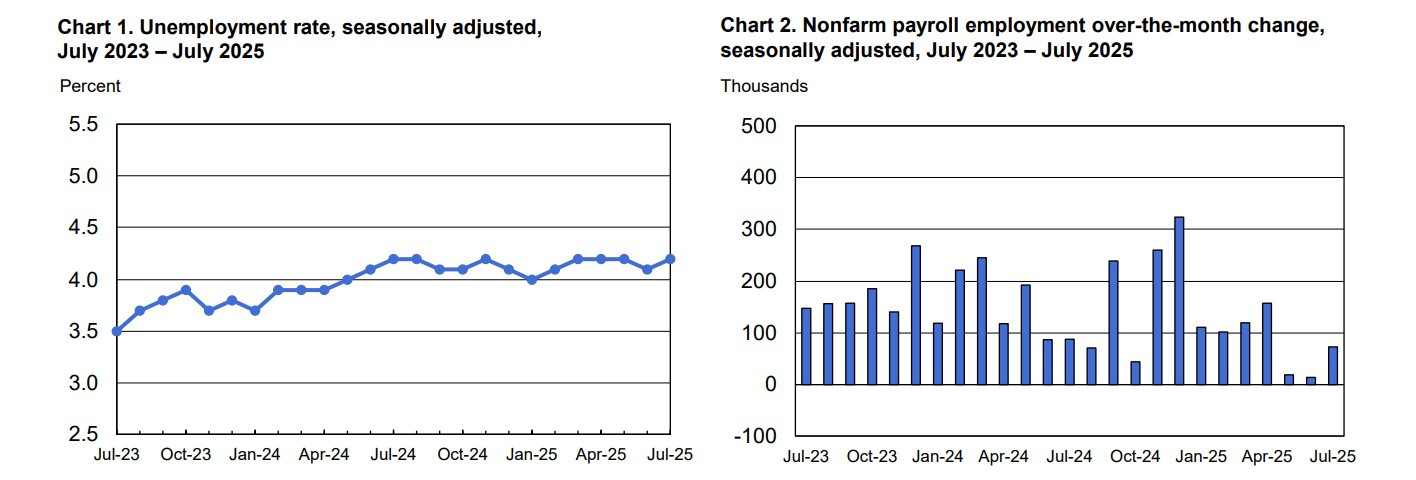
Despite that slowdown, the unemployment rate remains low at about 4.2%, and broader labor indicators—quits, layoffs, vacancy ratios, and nominal wage growth—have softened only gradually.
This simultaneity of a pronounced slowdown in hiring alongside a still-tight unemployment rate creates a fragile balance: if labor demand softens further, unemployment could rise rapidly, generating genuine downside risk.
Growth has decelerated: Powell cited GDP slowing to around 1.2% this year, roughly half the 2.5% pace seen in 2024, driven primarily by cooler consumption. On inflation, 12-month headline PCE stands near 2.6% with core PCE about 2.9%; core goods inflation has turned positive, rising about 1.1% year-over-year after modest declines the previous year.
Tariffs are already exerting upward pressure on particular goods prices, and Powell acknowledged that the pass-through through supply chains may take time.
The Fed judges much of the tariff effect to be a level shift, not necessarily a persistent re-anchoring of inflation expectations, but it remains vigilant for any wage-price feedback loops or changes in long-term expectations.
Taken together, these data points create a policy dilemma: downside risk to employment argues for easier policy, while tariff-driven price pressures argue for caution. Powell’s message was that this trade-off will be managed by weighing the magnitude and persistence of deviations from goals and acting only as the data warrant.
What this means for investors and what to watch next
In the short term, markets will be hyper-sensitive to incoming labor data, core inflation prints, and Fed commentary. Key items to watch include monthly payrolls, unemployment filings, and the path of core PCE.
Because the Fed signaled no preset path, a single hotter-than-expected inflation print or resilient payrolls could quickly reduce the probability of cuts; conversely, a clear weakening in jobs would raise those odds materially.
For fixed-income investors, the current environment favors locking attractive long yields—but it also requires careful duration management: a rapid pivot to cuts could produce capital gains, while renewed inflationary surprises could pressure bonds.
Equity investors may benefit from easier policy via higher valuations, but they should weigh this against the risk of weaker growth undermining corporate earnings.
Corporate issuers face a strategic decision: issue long-dated debt now to lock in attractive yields amid heavy demand, or postpone issuance in anticipation of lower yields after potential Fed cuts. That choice depends on each issuer’s refinancing needs and risk tolerance.
Conclusion — a conditional opening, not a commitment
Powell’s Jackson Hole address changed the tone: the Fed acknowledged a shifting risk balance, revised its strategic language, and left the door open to easing if data support it.
Markets have already priced a faster pivot, and long-dated bond demand reflects that belief. Yet the Fed’s updated statement and Powell’s remarks were emphatically conditional: policy will be driven by incoming evidence, not rhetoric.
Investors should treat the pivot as a contingent possibility, monitor data closely, and position for both the potential rewards and the risks of a quickly changing macro landscape.