
Intel at the Crossroads: Can Cash and State Backing Reverse a Fallen Giant?

In August 2025 two very different lifelines landed at $INTC ’s door: SoftBank bought roughly 2% of Intel at $23 per share for about $2 billion, and the U.S. federal government acquired 10% of the company at $20.47 per share, investing roughly $8.9 billion. Those moves make $INTC not just a corporate turn-around story but a strategic pivot in the global AI and semiconductor contest.
Key Points
- SoftBank (Aug 19, 2025): ~$2B for ~2% of Intel at $23/share.
- U.S. government (announced Aug 23, 2025): Bought 433.3M shares at $20.47, ~$8.9B, equal to 10% ownership; funding split ~$5.7B CHIPS Act funds and $3.2B from a secure-chip program. A warrant allows purchase of an additional 5% under certain conditions.
- Company state: 2024 net loss $18.8B; leadership change (Pat Gelsinger retired Dec 2024; Lip-Bu Tan became CEO Mar 2025); board additions include former ASML CEO Eric Meurice and Steve Sanghi.
- Tech status: $INTC reports High-NA EUV in Oregon and counts $MSFT as an 18A customer, but external volume is “not significant.” Ohio fab plans delayed toward 2030; capital spending is more restrained.
- Market context: Intel lags $NVDA and $AMD in data-center compute; advanced-node, EUV and packaging leadership now determine competitive advantage. Reports indicate $AVGO and $TSM have explored $INTC business options.
Why this week?: The case for urgency
Two injections of capital in days underscore a single judgment: Intel’s role is strategic, not merely commercial.
SoftBank’s $2 billion is a private vote of confidence from an active tech investor. Washington’s 10% stake is a policy decision: the state is buying industrial resilience as much as equity.
Taken together, they amount to time and political cover for a company in deep technical catch-up.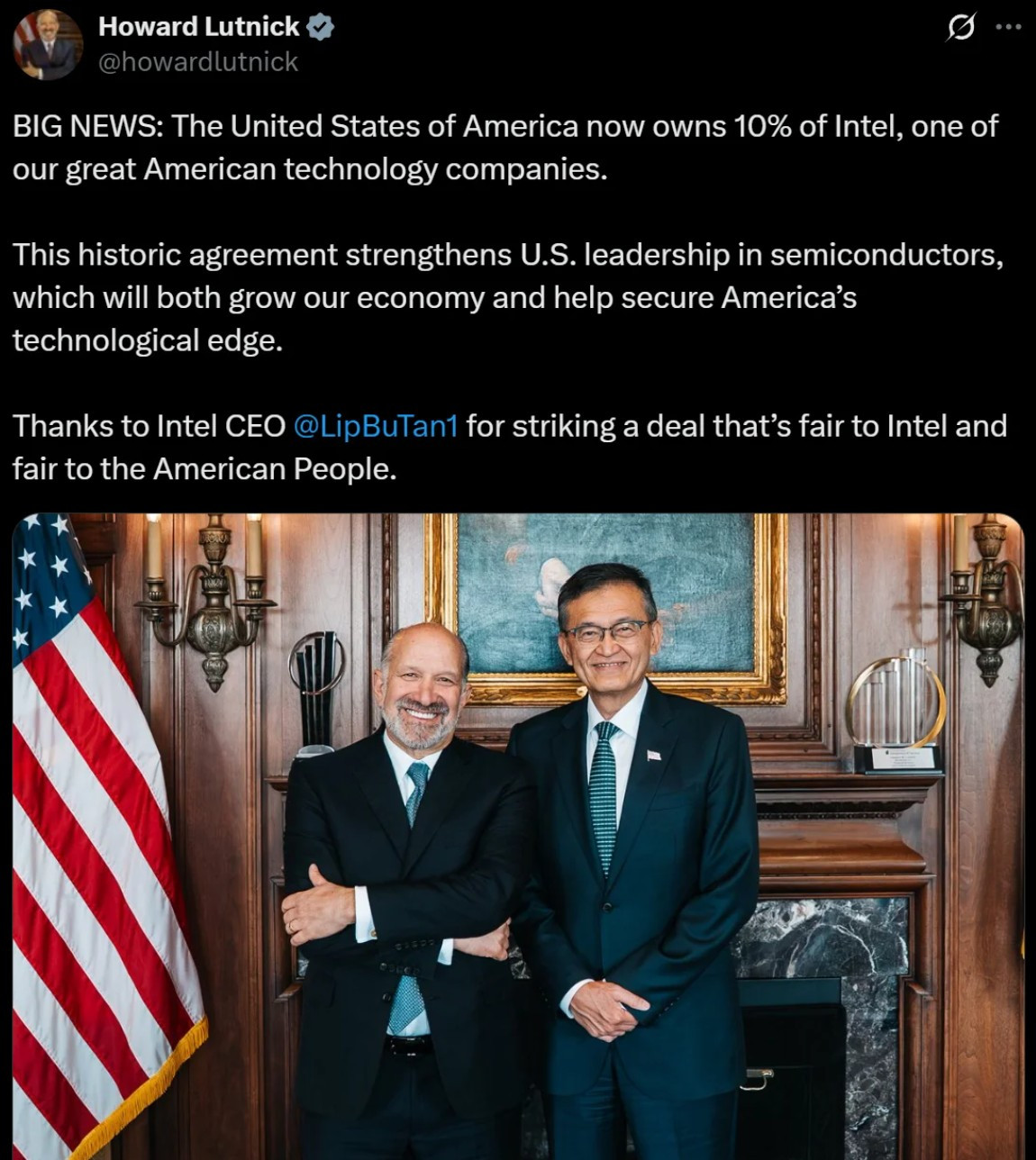
What exactly is at stake?: Manufacturing, energy, and compute scale
AI’s future rests on scalable, affordable compute — which in turn depends on advanced fabrication and reliable energy.
Chips are not only architecture; they are the output of materials science, lithography, packaging and yield engineering.
$INTC is unique among major U.S. players: an IDM able to site design, wafer fab and packaging domestically. If Intel stabilizes, the U.S. retains an onshore anchor; if it fails, advanced manufacturing becomes more geopolitically concentrated overseas.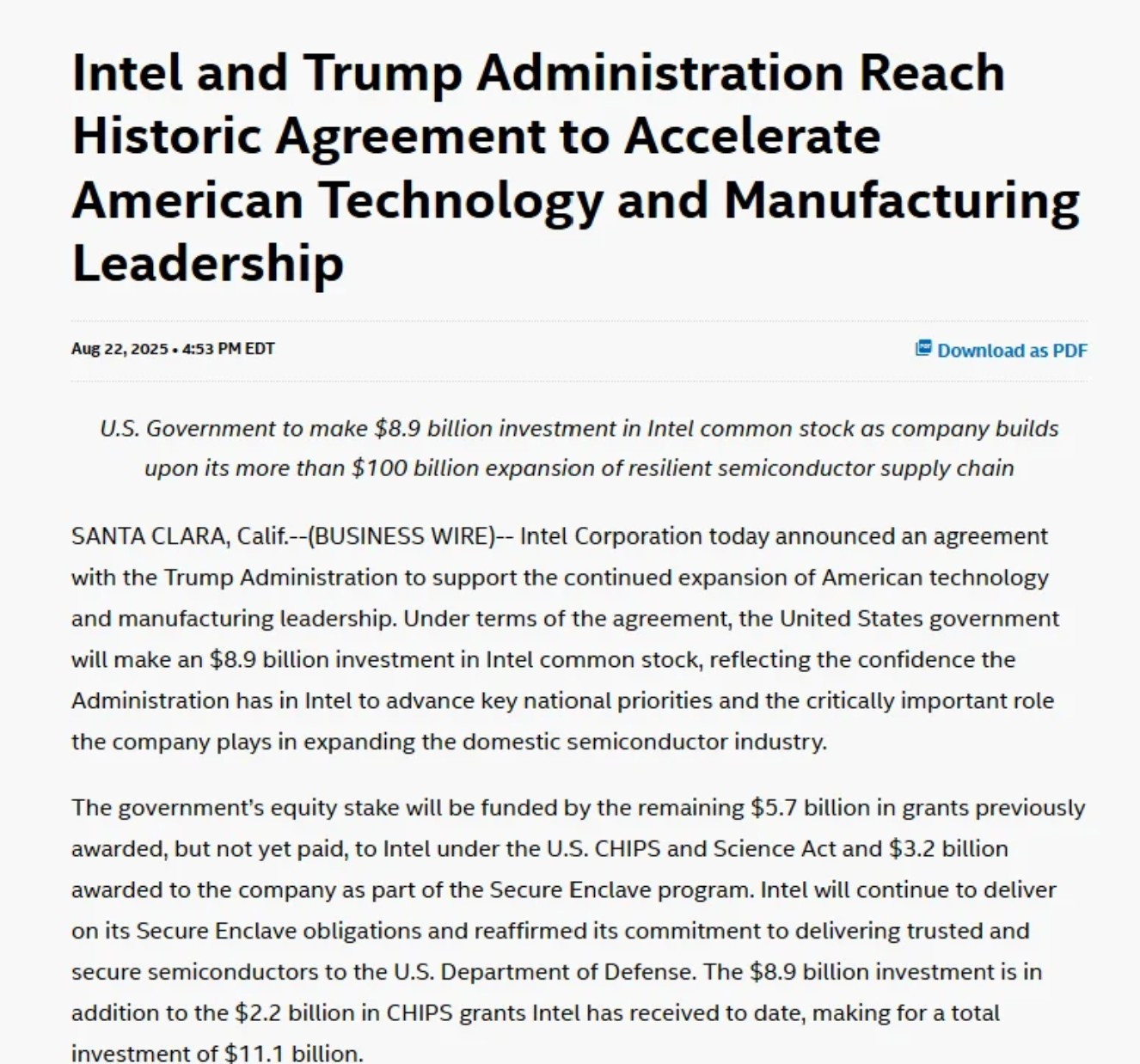
How did Intel lose the lead?: Three structural missteps
Process miscalibration: $INTC ’s aggressive node targets and postponement of EUV sealed a comparative lag to foundries. Business inertia: the IDM model, once protective, resisted the industry’s shift toward fabless-foundry specialization. Leadership and cadence: missed product windows and organizational slowness allowed rivals to convert node and packaging advantages into market share.
What is Intel trying now?: IDM 2.0, High-NA and board surgery
$INTC frames its recovery as IDM 2.0 — a hybrid that preserves in-house capability while courting external foundry clients.
The company highlights High-NA EUV as a technical lever and advanced packaging as a route to AI orders.
Board hires—former ASML chief Eric Meurice, Steve Sanghi, and Stacy J. Smith—signal a deliberate rebuild of technical leadership.
But those hires and new phrases still need yield, cost and customer-scale evidence to matter commercially.
Does money solve the hard problems?: Not by itself
Capital buys runway, but engineering breakthroughs require time, disciplined execution, and repeatable yields.
The U.S. stake reduces immediate financing pressure and tightens political alignment. SoftBank’s check signals private conviction but cannot substitute for wafer yields or packaging throughput. The big tests remain 18A and 14A production yield, packaging acceptance from major AI customers, and scaled external shipments.
What will success look like?: Clear technical and commercial milestones
A credible revival would show three things: sustained, increasing external 18A volume; demonstrable 14A + High-NA yields; and large AI packaging contracts moving to production.
Customer commitments from hyperscalers at scale would convert technical progress into revenue and a resumption of capital flows.
Absent those signs, the company risks remaining a project that is politically useful but commercially precarious.
Why is government involvement so consequential?: Sovereignty and leverage
The CHIPS-backed equity purchase signals that advanced logic manufacturing is now a matter of national strategy.
By acquiring shares and a warrant mechanism, Washington gains leverage over corporate choices tied to domestic foundry control. That posture can protect supply resilience, but it also introduces political calculus into long-term industrial refinement. Policy continuity across administrations will matter as much as any engineering milestone.
What could go wrong?: A short, sharp list of failure modes
Yield shortfalls: high-NA and ribbon-FET complexity could stall; cost per wafer might never match competitive economics.
Capital fatigue: government money plus SoftBank’s stake are helpful but insufficient if sustained CapEx is withdrawn.
Customer flight: if hyperscalers prefer proven external foundries, Intel may struggle to convert technology into orders.
Strategic drift: politicized ownership could slow flexible corporate choices and scare off long-term commercial partners.
Who gains if Intel fails?: Geopolitical and industrial shifts
Failure would further concentrate advanced logic production offshore, strengthening TSMC and Samsung’s leverage.That concentration would alter bargaining power in trade and national supply plans, and narrow options for onshore resilience.Competitors who already scaled packaging and multi-chip systems could accelerate market dominance in AI compute.
How should investors and policymakers watch?: A compact checklist
- Track 18A external shipment signals and any shift from “not significant” to volume.
- Watch 14A + High-NA yield reports and customer tape-outs.
- Monitor advanced packaging orders and utilization tied to AI workloads.
- Note additional capital moves: private placements or further public support.
- Observe political statements for durability of government backing.
Conclusion — a variable, not a verdict
Intel stands as the industry’s largest single variable: its recovery would broaden onshore manufacturing options and rebalance strategic maps. Its failure would signal deeper concentration of advanced nodes overseas and a tougher geopolitical reality for compute sovereignty. SoftBank’s investment and Washington’s equity purchase change probabilities, but they do not remove the hard technical and commercial tests ahead.
The next few quarters of yield reports, customer orders and capital decisions will tell whether this is a genuine reboot or a prolonged staying action.