
Global Funds Are Bullish! Will Emerging Market Stocks “Overwhelm” Developed Markets in the Next Year?

Global fund managers have recently expressed optimism, suggesting that emerging market assets could outperform their developed market counterparts over the next year.

Since U.S. President Trump launched a tariff offensive in April, the performance of both has been nearly “neck and neck”…
Institutions like Fidelity International, T. Rowe Price, and Ninety One Plc highlight that further easing by the Federal Reserve, a shift in investor focus toward emerging markets, and more conservative fiscal policies in emerging market countries could drive a relatively stronger performance for these assets. Additionally, a favorable inflation environment suggests a prosperous outlook for emerging markets.
According to a survey of industry analysts, the MSCI Emerging Markets Stock Index is expected to rise by approximately 15% over the next 12 months, compared to a projected 10% gain for its developed market counterpart.
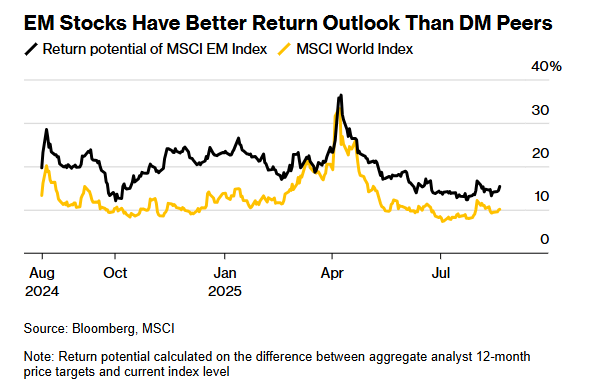
Data tracking fund flows into some of the world’s largest ETFs also shows that inflows into emerging market stocks have recently outpaced those into developed markets.
“Emerging market stocks are poised to outperform as they benefit from the easing local currency policies in most markets—boosting domestic lending and consumption—while a weakening dollar adds further momentum,” said George Efstathopoulos, fund manager at Fidelity Investments Singapore.
“Moreover, as the world’s most influential central bank, the Fed is likely to restart easing policies in the coming quarters.”
Emerging Markets Showcase “Money Magnet” Appeal
Data indicates that since Trump’s “Liberation Day” tariff announcement on April 2, global capital flows have consistently favored emerging markets.
Since then, investors have injected approximately $5.8 billion into the world’s largest emerging market ETF, the iShares Core MSCI Emerging Markets ETF, accounting for about 5.8% of its total assets. In contrast, the giant Vanguard FTSE Developed Markets ETF saw inflows of only $5.6 billion, or about 3.3% of its total assets.
In terms of performance, both the MSCI Emerging Markets Index and its developed market counterpart have risen about 14% since April 2, as markets optimistically view Trump’s tariff threats as a negotiation tactic. Emerging and developed market bonds have also performed similarly—Bloomberg’s Emerging Market Debt Index returned 4%, while a comparable developed market debt index returned 3%.
Archie Hart, an emerging market equity fund manager at Ninety One in London, said one of the biggest reasons emerging market assets might outperform developed market assets is their more orthodox and market-friendly fiscal policies.
“If we look at policymakers in emerging markets, they are currently conservative—constrained by market discipline and pragmatic—so we don’t see the massive, unsustainable fiscal deficits seen in developed markets,” he said.
Federal Reserve Chair Jerome Powell hinted last Friday that the Fed might cut rates in September, potentially further boosting emerging market assets. Following his remarks at the Jackson Hole global central bank symposium, investor bets on a rate cut at the Fed’s September 16-17 meeting have intensified.
Undeniable Valuation Appeal
Additionally, T. Rowe Price noted that emerging markets currently offer more attractive valuations.
“We are overweight on emerging market equities in our multi-asset portfolios,” said Thomas Poullaouec, portfolio manager at the company’s Singapore office, “because their valuations remain more reasonable than developed markets, with higher earnings growth prospects.”
Poullaouec also expressed optimism about the currencies of several developing countries but emphasized the need for selectivity.
“Much of the upside for emerging market currencies is already priced in, especially given the overly concentrated short positions on the dollar,” he said. “However, we remain positively positioned on Latin American currencies, particularly the Brazilian real, due to its high yield spread and improving fiscal outlook.”
With inflation kept relatively mild, emerging market bonds are also seen as attractive.
Citi’s Emerging Market Inflation Surprise Index averaged negative 19 this year, down from a peak above 40 in 2022. The similar index for G7 economies stood at negative 12 this year. Negative readings indicate that actual inflation data has come in below expectations.
Efstathopoulos of Fidelity said, “The tailwinds that drove local currency emerging market bonds higher over the past year—such as declining inflation and manageable fiscal deficits—remain in place, whereas developed market bonds still face growing debt levels and massive fiscal deficits.”