
Small Caps Could Be the Surprise Winners of a Fed Rate Cut

Markets are now almost certain that the Federal Reserve will lower interest rates in September, most likely by 25 basis points. On the surface, that looks like just another policy adjustment. But for investors, it could be the beginning of something bigger. After years of tech giants dominating the market, this shift may finally bring new life to small cap stocks.
What Small Caps Really Are
When people talk about “small caps,” they mean companies with relatively small market values, often between $300 million and $2 billion. These firms are usually found in the Russell 2000 index and cover industries like retail, healthcare, energy, and manufacturing. They are not household names like Apple or Microsoft.
Over the past two years, small caps have badly lagged behind large companies. The main reason comes down to financing. Smaller firms often rely heavily on bank loans to fund their operations. Many of those loans carry floating interest rates, which means borrowing costs go up immediately when the Fed hikes rates. Add in weaker cash reserves compared with big corporations, and small caps simply do not have the same ability to weather a high-rate environment.
The result has been a long stretch of underperformance. While large tech names surged to record highs, small caps have mostly been left behind.
Why a Fed Cut Could Change the Game
A Fed rate cut changes the math for small companies almost overnight. Lower rates mean cheaper loans and less interest expense. For businesses where every dollar counts, this is a big deal. In fact, small caps tend to feel the relief much more quickly than large caps because they are more sensitive to borrowing costs.

Think of it this way. A mega-cap tech company is like a luxury cruise ship—it can keep moving steadily even when the waters are rough. A small company is more like a speedboat—it reacts instantly when the water level rises or falls. When rates come down, that speedboat suddenly has a smoother ride.
Investors are already starting to position for this. Last week, the Russell 2000 jumped nearly 4% in a single day, far outpacing the S&P 500’s 1.5% gain. That is a clear sign that money is beginning to rotate into small caps on expectations of lower rates.
History Offers More Support
There is also a historical case for optimism. Looking back, when the Fed has paused between five and 12 months before cutting rates again, the S&P 500 has rallied in 10 out of the past 11 instances over the following year.
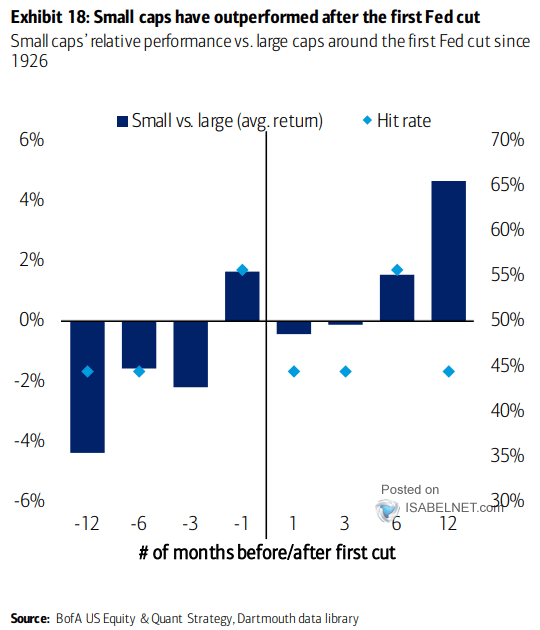
This time the pause has already lasted nine months, giving investors confidence that the Fed is easing at just the right moment. For small caps, the potential upside is even greater because they have so much lost ground to make up.
A Broader Rally Could Follow
If the Fed delivers on rate cuts, analysts expect the rally to broaden. Large tech companies may continue to perform well, but their valuations are already stretched. By contrast, small caps look cheap and offer far more room to rebound.
Growth stocks in general also tend to do well when interest rates fall, since lower rates boost the present value of future earnings. But the more dramatic move could come from smaller, more sensitive companies that benefit immediately from lower borrowing costs.
The Risks You Should Keep in Mind
None of this means small caps are risk free. Two issues stand out.
First, if the Fed cuts rates more aggressively than expected, it might be because the economy is weakening faster than anyone thought. Small companies, with limited financial buffers, often suffer the most in a downturn.
Second, small caps are more volatile by nature. They trade with less liquidity, meaning prices can swing sharply when investors rush in or out. That makes them exciting but also potentially painful if sentiment changes.
My Take
For the first time in years, small caps may finally be in the spotlight. They are cheap, overlooked, and highly sensitive to Fed policy. A September cut could be the spark that wakes them up.
That said, I would not go all-in on small caps. For me, they make sense as a tactical play—a high-beta part of a portfolio that could deliver outsized gains if the rally broadens. But they are not a safe harbor.
In short, a Fed cut in September is more than just a technical policy move. It could mark the beginning of a comeback for small cap stocks, turning them from market laggards into the surprise winners of this cycle.