
Pinduoduo Q2 Earnings Preview: Temu’s Balancing Act, Domestic Rivalries, and Investor Patience

Shearing sheep
August 25, 2025
GoGPT Summarizes Articles

Pinduoduo ($PDD) will release its second-quarter 2025 earnings before the U.S. market opens on Monday, August 25, and investors are watching this one closely.
After a shaky Q1 that saw profits fall sharply and the stock come under pressure, the upcoming report has become less about headline revenue growth and more about whether PDD can reassure the market on profitability, Temu’s global trajectory, and its longer-term stance toward shareholder returns.
Consensus estimates suggest revenue should come in around $14.35 billion, marking a modest 7.5% increase from a year earlier. That’s solid top-line growth considering the global and domestic headwinds, but the real story is on the bottom line.
Forecasts for earnings per ADS are $1.91, implying a year-on-year drop of roughly 40%, highlighting the issue that has concerned investors all year: PDD is spending heavily to defend its turf in China and scale Temu abroad, and those costs are biting into margins.
The Temu question is arguably the single most important narrative in this earnings cycle.
Earlier this year, tariffs and political friction in the U.S. cast doubts over how sustainable Temu’s rapid rise really is. PDD’s shift from a fully managed model, where the platform bore almost all of the logistics and marketing burden, toward a semi-managed one is telling. By shifting more responsibility back to merchants, Temu is trying to lighten its own cost structure and stabilize profitability.
In practice, that has meant higher prices in some categories, reduced subsidies, and tighter logistics spending. For a business that relied on ultra-low prices to win over consumers in the first place, this is a tricky balancing act.
Yet while U.S. growth has cooled, the company has made clear progress elsewhere. In Europe, Temu is starting to look less like a scrappy new entrant and more like a genuine competitor to entrenched fashion and e-commerce players.
Data from the second quarter showed Temu reaching 417 million monthly active users worldwide, with Europe accounting for more than a third of that base. In France, sales surged 129% in 2024, boosting market share from 8% in 2023 to nearly 19% this year. That’s enough to place Temu among the top 15 fashion retailers in the country—an astonishing leap in such a short span.
Meanwhile, Brazil and other Latin American markets are providing incremental growth, diversifying Temu’s global footprint at a time when the U.S. is becoming a more difficult environment. The question is whether these gains can offset the drag in America and deliver the kind of sustained GMV growth the market expects.
Back at home, PDD faces a different challenge. China’s e-commerce battleground has been fierce in 2025, with Alibaba, JD, and Meituan all aggressively pushing subsidies, price wars, and promotional campaigns.
National retail statistics still show growth—online sales rose 8.5% year-on-year in the first half of 2025—but the pace is decelerating, and PDD’s domestic growth looks softer than earlier this year.
Investors will be looking for signs that the company can continue to capture market share without further squeezing margins, especially as grocery and local services remain contested ground.
Another major theme is shareholder returns. Pinduoduo hasn’t issued a shareholder letter since 2021, and management has been reluctant to commit to dividends or buybacks. This has increasingly become a sticking point for investors, particularly as PDD’s cash position has grown.
By the end of Q1 2025, the company was sitting on over $30 billion in cash and short-term investments, giving it ample financial flexibility—yet investors have seen little indication that any of this will be returned to shareholders in the near term.
Any guidance—however tentative—on whether the company is considering distributions or even exploring a Hong Kong secondary listing would be closely scrutinized. The lack of clarity here has left some investors cautious, and it may take a concrete signal to rebuild confidence after the volatility of recent quarters.
Wall Street’s stance is mixed but generally constructive. Benchmark recently lowered its price target to $128 but kept a Buy rating, Jefferies trimmed its target to $121, while Citi raised its target to $165 on an upgrade.
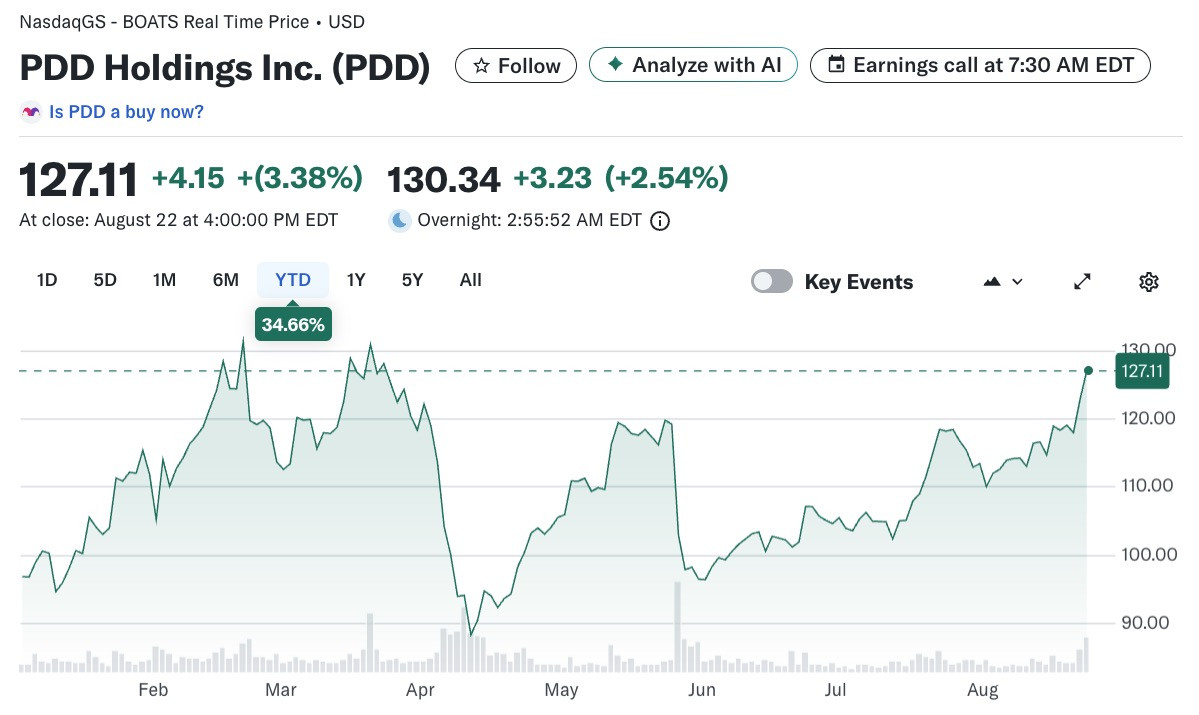
The divergence reflects a familiar split: short-term profit pressures make the near-term tricky, but long-term believers see Temu’s global expansion and PDD’s resilient user base as too compelling to ignore.
All in all, Monday’s report is less about whether PDD can deliver another quarter of revenue growth—it almost certainly will—and more about whether management can prove that growth is sustainable without burning through margins indefinitely.
Investors will want to see whether Europe and Brazil can carry the growth torch as the U.S. slows, whether domestic operations can stay competitive without spiraling subsidies, and whether the company is finally ready to start addressing shareholder return questions.
What’s Your Estimate?
PDD’s Q2 earnings are around the corner — with Temu’s global push and $13.5B revenue expected, volatility is almost guaranteed.
Predict PDD’s stock move on earnings day and win rewards.
#Q2 Earnings Hunter: Share Your Stories#$PDD Holdings Inc. American Depositary Shares(PDD)