
APAC Market Wrap - 26 Aug

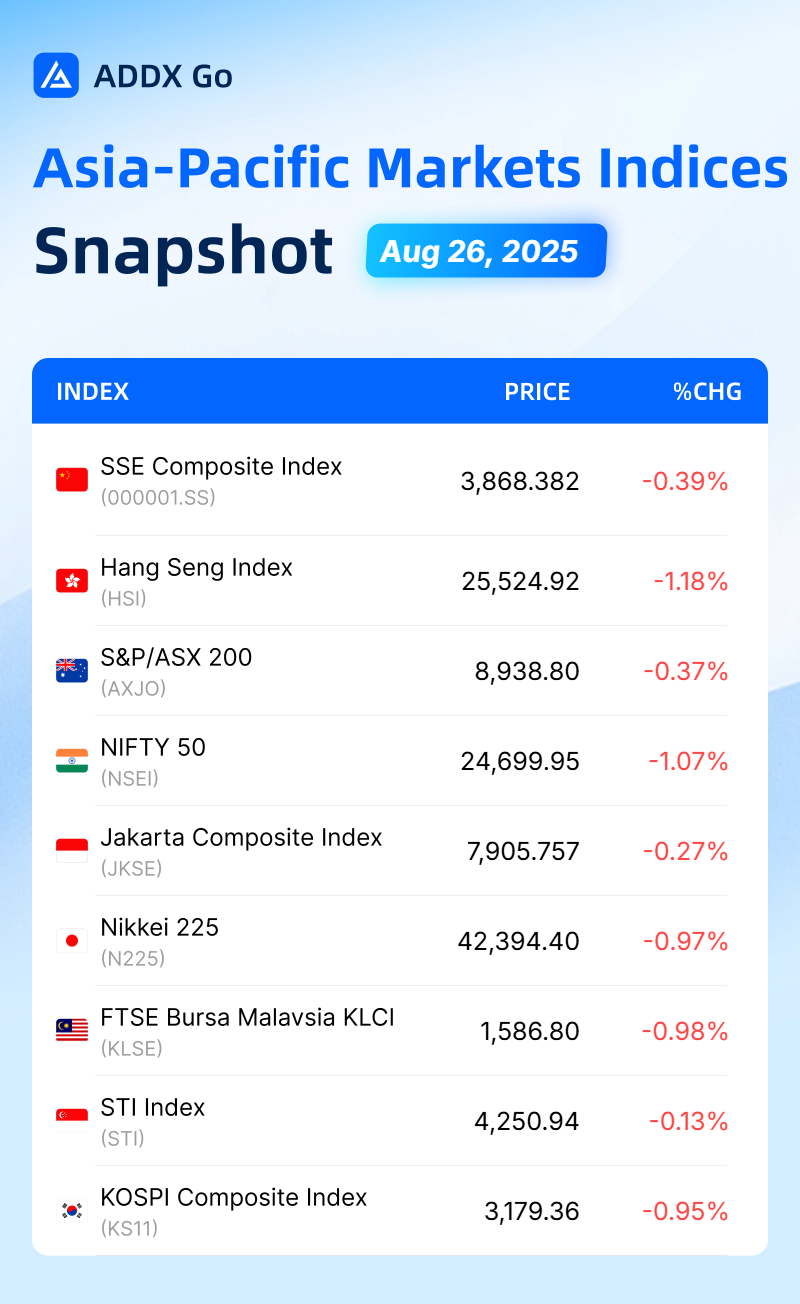
China Stock Market: The market oscillated throughout the day, with the three major indices showing mixed results. By the close, the Shanghai Composite Index fell 0.39%, the Shenzhen Component Index rose 0.26%, and the ChiNext Index dropped 0.75%.
In terms of sectors, pork, gaming, consumer electronics, and beauty care led the gains, while CRO, rare earth permanent magnets, PEEK materials, and military sectors saw the largest declines.
Hong Kong Stock Market: The three major Hong Kong indices closed lower. By the end of the day, the Hang Seng Index fell 1.18% to 25,524.92 points, the Tech Index dropped 0.74% to 5,782.24 points, and the State-Owned Enterprises Index declined 1.07% to 9,148.66 points.
Market performance showed strength in consumer electronics, gold, non-ferrous metals, and photovoltaic stocks, while pharmaceutical and brokerage stocks faced widespread pressure.
Japan Stock Market: The Nikkei 225 index fell 0.97% after three consecutive trading days, closing down 413.42 yen at 42,394.40 yen.
By industry, all 32 sectors except warehousing and transportation recorded declines, with particularly notable drops in pharmaceuticals, electronic gas, services, land transportation, and other products.
South Korea Stock Market: The Korea Composite Stock Price Index (KOSPI) declined 0.95% to 3,179.36 points.
In terms of sectors, stationery, office supplies, biotechnology, and gaming entertainment led the gains, while utilities, air freight, non-metallic minerals, and construction sectors saw the largest declines.
Australia Stock Market: The S&P/ASX 200 (XJO) fell 0.41%, closing at 8,935.600 points.
By sector, defensive retail, forestry products, and semiconductors saw slight gains, while agriculture and heavy machinery, industrial distribution, building materials, and alcoholic beverages experienced modest declines.
Singapore Stock Market: The Straits Times Index fell 0.30%, closing at 4,243.71 points.
By sector, non-alcoholic beverages, diversified media, and telecommunications services saw slight gains, while pharmaceutical manufacturers, building materials, capital markets, and education sectors recorded larger declines.
Malaysia Stock Market: The Malaysia Index dropped 1.30%, closing at 1,581.59 points.
By sector, closed-end funds saw a slight rise, while energy, industrial goods, and other sectors collectively declined.
Key Events
U.S. to Impose High Tariffs on India Exports Starting Wednesday
The U.S. Department of Homeland Security has confirmed that, starting Wednesday, an additional 25% tariff will be imposed on all goods originating from India, intensifying trade pressure on this Asian nation. Indian exporters are preparing for potential business disruptions.
Previously, U.S. President Donald Trump announced additional tariffs on India to penalize its purchases of Russian oil. As a result, Indian goods exported to the U.S. will now face a maximum tariff of 50%—among the highest rates currently imposed by the U.S.
Trump Claims South Korean President Lee Will Honor Trade and Investment Agreement
U.S. President Donald Trump insisted that, despite lobbying during his first face-to-face meeting with South Korean President Lee Jae-myung, South Korea will adhere to the terms of a recent agreement, including a commitment to invest hundreds of billions in the U.S.
Trump stated that he and Lee expressed optimistic expectations for close cooperation on North Korea, collective security, and shipbuilding collaboration during their Monday meeting, but the 15% tariff on South Korean goods exported to the U.S. will remain unchanged.
De Minimis Tariff Exemption Expires, International Postal Services Suspend U.S. Shipments
The U.S.’s complex tariff policies are further disrupting global logistics systems. With the de minimis tariff exemption set to expire on Friday, multiple international postal services have taken action, announcing a suspension of mail shipments to the U.S. as early as Monday.
DHL International Postal Service stated that August 25 will be the last day for accepting goods destined for the U.S. Austria Post announced it will stop accepting shipments to the U.S. on August 26. Singapore Post and India Post have also indicated they will temporarily halt some mail services to the U.S.
Institutional Views
Morgan Stanley: Forecasts Two Fed Rate Cuts in 2025, Four in 2026
Morgan Stanley predicts the Federal Reserve will cut rates by 25 basis points each in September and December, reversing its earlier forecast of no cuts in 2025. It also expects four additional 25-basis-point cuts in March, June, September, and December 2026, bringing the target rate range to 2.75%-3.0%.
ANZ: The Fed as We Know It Is ‘Fading from View’
ANZ Chief Economist Richard Yetsenga stated that the Federal Reserve as we know it is “fading from view.” Trump’s firing of Lisa Cook will lead markets to price in higher inflation premiums, deepening the dollar’s downward trend.
Crédit Agricole: Expects Two Fed Rate Cuts This Year, Terminal Rate at 4%
Crédit Agricole currently anticipates two Federal Reserve rate cuts this year, one in September and one in December. Unlike other institutions, it expects a much higher terminal rate, predicting a prolonged policy pause with a target rate of 4.00%. The bank believes sticky inflation will limit the Fed’s room for aggressive easing, despite a slowing U.S. economy that has not yet entered a recession.
CICC: Avoid Overinterpreting Powell’s ‘Dovish’ Stance
CICC stated that Federal Reserve Chair Jerome Powell’s speech at the Jackson Hole conference was viewed by the market as a “dovish” signal of monetary easing.
However, we believe Powell’s remarks did not provide strong guidance on the persistence or magnitude of rate cuts, but rather clarified the Fed’s “reaction function”—a tendency to lower rates when employment risks outweigh inflation concerns.
Yet, under significantly higher tariffs and tighter immigration policies, risks to employment and inflation coexist. If inflation risks surpass employment risks, Powell could use the same “reaction function” to halt rate cuts.
Thus, the market should not interpret Powell’s speech as the start of a series of easing measures but recognize the challenges monetary policy faces when employment and inflation goals conflict. If tariffs and immigration policies further exacerbate “stagflation-like” pressures, leaving the Fed in a dilemma, true monetary easing is unlikely. Market risk appetite may decline, and volatility could intensify.