
Delivery Turf War: Is Meituan Facing a Make-or-Break Q3?

Meituan has warned of a large third-quarter loss as it aggressively defends its delivery franchise. Q2 results already showed meaningful revenue growth but sharp margin compression and a spike in sales & marketing and rider incentives. The result: higher order volumes but collapsing unit profits and strained cash flow — a costly defence that leaves no obvious short-term winner.
What do the Q2 numbers actually show?
Meituan’s Q2 revenue rose 11.66% year-on-year to RMB 91.84 billion, while gross margin fell 8.09 percentage points to 33.1%.
Sales and marketing expenses surged 51.82% to RMB 22.52 billion, rising to 24.5% of revenue. Adjusted EBITDA and adjusted profit plunged 81.45% and 89.03% to RMB 2.782 billion and RMB 1.493 billion respectively.
Operating cash flow from operations dropped 74.95% to RMB 4.773 billion, a decline management attributes to competitive spending. Core local commerce profits compressed sharply: operating profit margin slid from 25.10% a year ago and 20.97% last quarter to just 5.69%.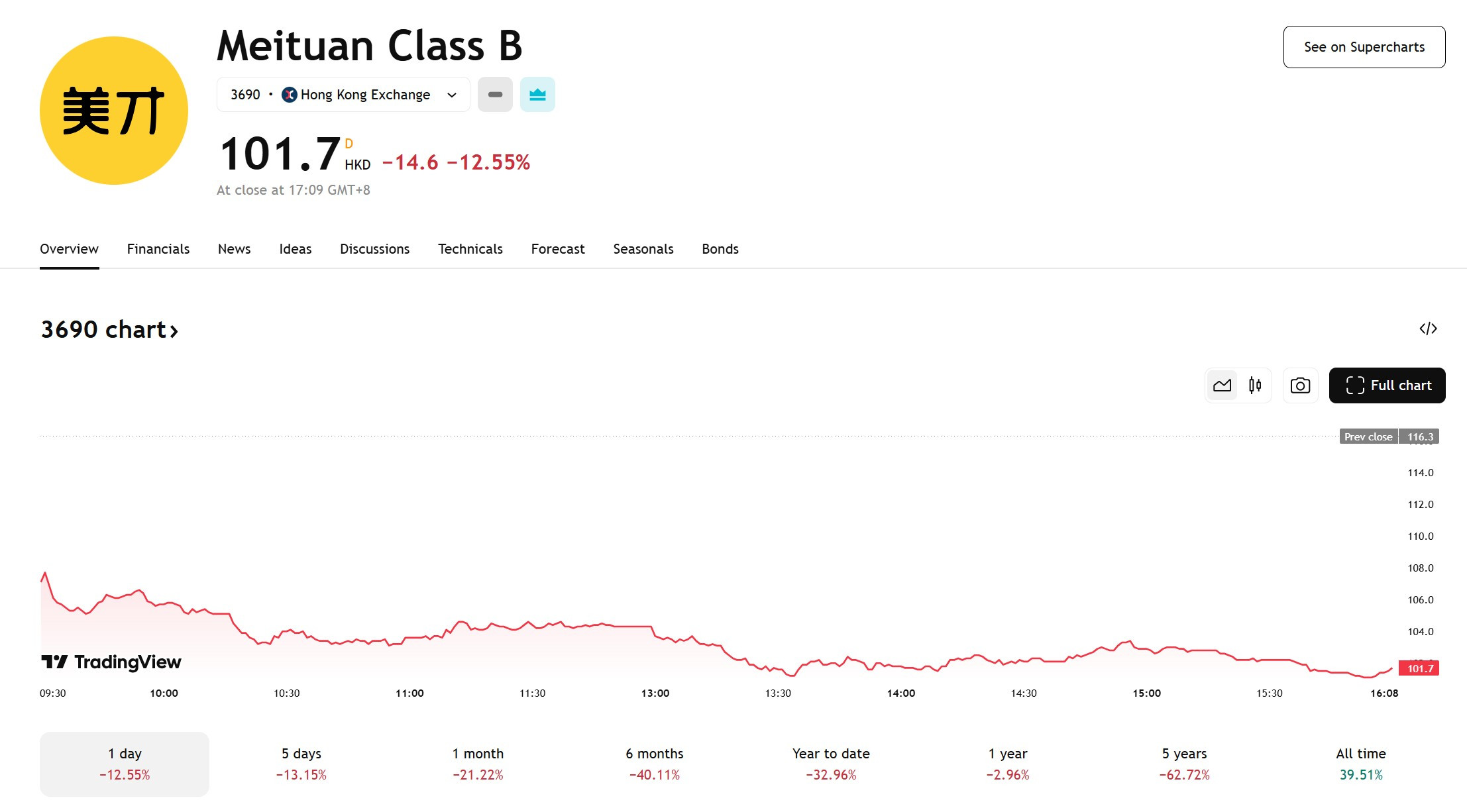
Why is Meituan choosing loss-making defence?
Management says it is prioritising service quality and market share over short-term profits to protect its long-term position.
That has meant higher rider incentives to sustain delivery reliability, heavier marketing to retain price-sensitive users, and strategic investment in instant retail growth channels. Management emphasises fundamentals — assortment, price and delivery — while acknowledging the near-term cash cost of that strategy.
Meituan reports unit economics remain superior to peers in some dimensions, but average order value (AOV) declined and gross margin compression shows how subsidy-led growth can erode per-order profitability. The company expects unit economics to recover eventually, but warns Q3 will reflect sizeable losses while the battle intensifies.
Are rivals actually denting Meituan’s moat?
This year JD and Alibaba have re-entered or expanded instant delivery aggressively, shifting the competitive dynamic. QuestMobile data show JD’s seconds-deliver module monthly active users grew from under 75 million in April to 173 million in June.
In June, daily active users rose for Taobao (+7.3%), JD (+33.2%) and Meituan (+18.2%), but platform overlap jumped 22.8% to 388 million users. That overlap means consumers are comparing prices across apps, weakening single-platform loyalty and pushing firms into subsidy wars.
Price sensitivity and platform-hopping reduce the value of traffic alone. Unless a platform converts trial users into sustainably engaged customers, subsidies will simply shuffle demand, not expand it.
Can new business lines and overseas expansion offset domestic pain?
Meituan’s new business revenue grew 22.83% to RMB 26.493 billion, driven by fresh-grocery expansion and overseas Keeta. Yet operating losses widened 43.14% year-on-year; sequentially the loss narrowed 17.24% to RMB 1.881 billion.
Management says it will prioritise growth over short-term profitability in these businesses, expecting scale and improved operating efficiency to deliver better margins later.
Keeta shows promising early traction: Meituan is market leader in Hong Kong and is scaling in the Middle East — operating in 20 Saudi cities and recently launching in Qatar. Management disclosed a long-term goal of reaching HKD 100 billion annual GMV within a decade. That international push diversifies growth, but also raises near-term cash burn.
How sustainable is the subsidy-led model?
Subsidies drive rapid user acquisition and higher GTV, but they compress margins and strain operating cash flow. Meituan warns that much of the low-price demand created by subsidies merely substitutes for offline or other online spending, rather than producing true incremental market growth.
The critical test is whether subsidies lead to lasting higher retention and improved merchant economics. If not, the industry will be trapped in a costly churn where players repeatedly spend to win transient orders.
Meituan claims it can dynamically adjust spending and restore unit economics, yet the near term will be painful: the company expects Q3 to show large losses in its core local commerce segment while it defends price and delivery leadership.
What should investors and observers watch next?
Key metrics to monitor are Q3 operating losses, changes in rider incentive levels, gross margin trends, AOV and retention metrics, and the overlap/DAU dynamics among Meituan, JD and Taobao.
Also watch new business operating efficiency — whether fresh-grocery and Keeta improve margins as volumes scale — and Meituan’s operating cash flow, which already declined sharply in Q2 due to competitive spending.
If Meituan can translate trial traffic into higher retention and lower per-order cost, it may reassert its economic lead. If competitors sustain aggressive incentives and user switching persists, margins across the sector could remain depressed for an extended period.
Bottom line: who wins the war?
There is no clear winner yet. Meituan is absorbing substantial near-term pain to protect long-term advantage, leaning on scale, logistics and product breadth. JD and Alibaba’s re-entry has generated meaningful user growth, but the big question is whether any player can convert surge traffic into durable, profitable engagement once subsidies recede.
Until the market proves it can retain users without perpetual incentives, the sector looks set for a prolonged, costly showdown — one that will test the endurance of each platform’s unit economics and the patience of shareholders.