
Global Bond Market “Bears” Emerge! German, French, UK, and Japanese Bonds Face a ‘Black August’

As German, French, UK, and Japanese bonds all weakened significantly in August without exception, the world’s major government bond markets are undoubtedly sounding a shrill alarm this summer.
It’s not hard to foresee that with a new wave of long-term bond auctions set to sweep through in September, volatility in the global bond market is likely to intensify further—adding more pressure to an already challenging year.
Market data shows that yields on 30-year German and French government bonds hit their highest levels since 2011 in August, while Japan’s 30-year bond yield reached an all-time high, and UK long-term bond yields are heading toward their largest monthly gain since December last year.
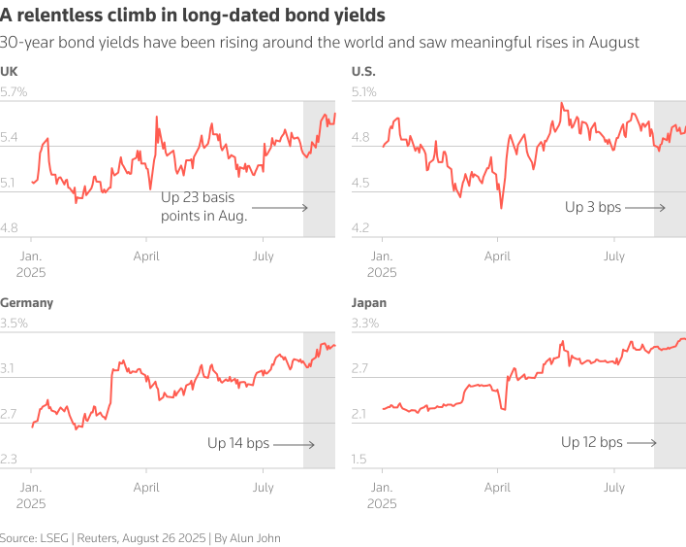
Since bond yields move inversely to prices, this rapid surge in long-term yields is undoubtedly causing headaches for governments, which are currently grappling with higher spending needs and already burdensome debt repayment costs, while also preparing to issue more bonds.
From a fundamental perspective, political uncertainty in France and concerns over Federal Reserve independence are factors keeping investors on edge; the Bank of Japan is expected to raise rates again, while other major economies, including the U.S. and UK, continue to face persistent inflation—both of which typically exert upward pressure on yields.
Justin Onuekwusi, Chief Investment Officer at St. James’s Place, said, “Long-term bonds will remain volatile, with too much uncertainty surrounding debt sustainability.”
In August, German and French long-term bond yields rose by approximately 15 and 27 basis points, respectively, poised to mark their largest monthly gains since March, when an unexpected surge in German spending triggered a bond market sell-off.
This time, the turmoil clearly stems from France. The sharp widening of French bond yield spreads against Germany this week highlights the challenges politicians face in addressing the public finance crisis. French Prime Minister François Bayrou has scheduled a confidence vote on his debt reduction plan for September 8.
Evelyne Gomez-Liechti, a multi-asset strategist at Mizuho Bank, noted that on the European market, she prefers investing in Spanish bonds given the country’s greater economic resilience.
Low Growth and High Debt
Meanwhile, a common ailment of the global bond market is that as governments issue more bonds to fund spending, the appeal of fixed-income assets continues to wane.
“The long end of the yield curve is virtually worthless,” said Idanna Appio of First Eagle, referring to fiscal constraints.
The International Monetary Fund (IMF) predicts that global economic growth will slow from 3.3% in 2024 to 3% this year, making it harder for countries to reduce their debt burdens.
Although most bond issuances for the year are complete, analysts say the next two months will remain relatively busy. Société Générale estimates that European bond issuance in September and October will exceed €100 billion (approximately $117 billion).
Reforms in the Dutch pension sector, which manages €1.7 trillion, may further dampen demand—next year, the sector will shift to a defined contribution model, reducing funds’ need to buy long-term European debt.
Kenneth Broux, head of forex and rates corporate research at Société Générale, said, “When supply increases, supply-demand imbalances can arise, pushing yields higher.”
Last week, auctions of Japanese 10-year and U.S. 30-year Treasury bonds showed signs of softening demand. Japan’s 20-year bond auction saw a bid-to-cover ratio of 3.09 times, down from 3.15 times in July.
Analysts note that while U.S. fiscal concerns have eased recently, worries about Federal Reserve independence continue to prompt investors to demand higher premiums for holding U.S. Treasuries.
In the UK market, as the autumn budget approaches, Chancellor Rachel Reeves will again face pressure to meet spending needs amid tight public finances. UK gilts led the sell-off in Tuesday’s global bond market rout. Gilles Moec, chief economist at AXA, said, “At least for the UK and Europe, it seems central banks won’t provide additional support.”
It’s no surprise, then, that IMF First Deputy Managing Director Gita Gopinath warned on Thursday that the global bond market is “in a fragile state” and expressed concern over global borrowing levels.