
From the April Bottom, Asia’s Tech Keeps Outpacing the Nasdaq-100—Can It Last?

Shearing sheep
August 29, 2025
GoGPT Summarizes Articles

It wasn’t too long ago that investors wrote off Asia’s stock markets as “uninvestable.” Weak consumer demand in China, sluggish recovery after the pandemic, and persistent trade tensions kept international capital flowing into U.S. tech giants instead. But the narrative has shifted sharply this year: since the U.S. market bottomed in early April, Asia’s tech sector has surged more than 40%, leaving the Nasdaq-100 trailing behind.
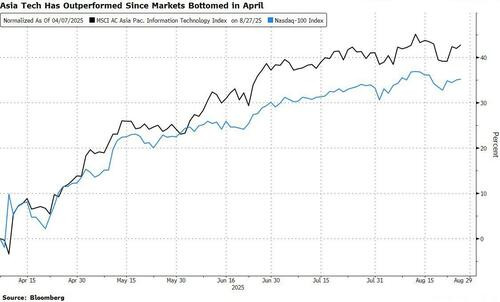
That raises the question: is this simply a hot streak, or are we witnessing a longer-term rotation of global capital from U.S. tech toward Asia?
Why Asia Is Outperforming
Several forces are fueling Asia’s run:
1. China’s AI boom
AI is no longer just a Silicon Valley story. Beijing’s push to build domestic AI ecosystems has triggered a sharp rally in Chinese chipmakers and semiconductor-related stocks. Hardware remains the backbone of AI development, and Asia controls critical links in the global supply chain—from TSMC’s advanced foundries to SK Hynix’s memory chips.
2. Relief on tariffs and trade frictions
While trade tensions haven’t disappeared, fears of escalating tariffs have eased in recent months. That has given global investors more confidence in allocating to export-oriented Asian tech companies, particularly in semiconductors and consumer electronics.
3. Valuations still look attractive
Here’s where Asia stands out. Even after a 40% rally, the MSCI Asia Information Technology Index trades at about 16.9 times forward earnings, still below its 5-year average of 17.6x. In contrast, the Nasdaq-100 sits at 26.8x, above its historical average of 25.7x. The valuation gap offers investors some margin of safety in Asia that U.S. megacaps no longer provide.
4. The weak U.S. dollar
The dollar has softened since spring, lowering the appeal of dollar-denominated assets. For yield-hunting investors, that’s another reason to look to Asian equities, especially when local currencies are strengthening.
5. Capital rotation away from U.S. tech giants
Apple ($AAPL), Microsoft ($MSFT), and Nvidia ($NVDA) are still household names, but some investors feel their valuations have stretched too far. Strategists like Charu Chanana of Saxo note that flows into Asia are not just tactical positioning—they reflect both structural advantages (supply-chain dominance) and short-term catalysts (China’s recovery and policy support).
The Heavyweights Behind the Rally
Not every Asian tech stock is moving equally. A handful of giants have been pulling the most weight:
-
Nintendo (7974.T) and Sony ($SONY) have added fuel from Japan, both hitting all-time highs this month thanks to strong gaming and entertainment revenues.
-
Meanwhile, smaller Chinese AI names like Cambricon (688256.SH) have rallied so hard that regulators themselves issued warnings about prices running far ahead of fundamentals.
This mix of large-cap stability and speculative excitement has drawn in both institutional and retail investors, boosting volumes across Asia’s markets.
What Could Slow the Momentum?
Of course, no rally lasts forever. Several risks loom in the background:
-
AI spending fatigue: Nvidia’s latest earnings guidance came in weaker than expected, sparking concerns that the global AI capex boom may be cooling. If U.S. AI budgets slow, ripple effects could hit Asia’s suppliers.
-
Valuation bubbles in pockets: While the sector overall looks reasonably priced, individual stocks like Cambricon already show signs of froth. Any correction in these high-beta names could spill over to sentiment more broadly.
-
Geopolitical uncertainty: A resurgence of tariff disputes or export restrictions on advanced chips could quickly reverse the current optimism.
-
China’s domestic demand: While Beijing has rolled out targeted support, questions remain about whether consumer demand and corporate investment can sustain the momentum long term.
The Bigger Picture: A Structural Shift?
Despite the risks, a growing number of strategists argue that Asia’s tech outperformance isn’t just a temporary bounce. Instead, it reflects a deeper structural rebalancing of global tech leadership:
-
Hardware dominance: AI is hardware-intensive, and Asia owns the lion’s share of chip foundries and memory manufacturing.
-
Diversification of capital flows: Global investors are increasingly uncomfortable holding only U.S. megacaps. Diversification into Asia provides exposure to different growth drivers at cheaper valuations.
-
China’s gradual recovery: Even if growth is uneven, China’s policy environment is increasingly supportive of strategic industries like semiconductors, cloud, and AI.
As VanEck strategist Anna Wu puts it, “For investors already heavily exposed to the U.S. Big Seven, Asia is emerging as the next obvious choice—particularly in hardware and AI supply chains.”
Bottom Line
Asia’s tech sector has enjoyed a powerful run since April, handily beating the Nasdaq-100. Strong fundamentals in AI hardware, easing trade headwinds, cheaper valuations, and a weaker dollar have all combined to attract global capital.
The rally isn’t without risks—AI spending could decelerate, and some stocks may be running ahead of their fundamentals. But overall, this feels less like a short-term trade and more like a sign of global capital rotation.
Whether Asia can extend its lead will depend on two things: how resilient AI investment proves in the next few quarters, and how stable the policy and trade environment remains. For now, though, Asia’s tech stars are shining brighter than their U.S. peers—and investors are paying attention.

#Chinese Equity Markets: Insights, News & Trading Signals#$Taiwan Semiconductor Manufacturing Company Ltd.(TSM)#$Alibaba Group Holding Limited American Depositary Shares each represents eight Ordinary Shares(BABA)#$Sony Group Corporation American Depositary Shares (Each Representing One Share of Dollar Validated Common Stock)(SONY)#$Apple Inc.(AAPL)#$Microsoft Corp(MSFT)#$Nvidia Corp(NVDA)