
Alibaba’s Big Gamble: Can Instant Retail and AI Deliver a New Era of Growth?

Alibaba reported a mixed but strategically charged quarter: revenue rose only 2% year-over-year, yet net profit jumped 76% to RMB 424 billion (driven largely by fair-value gains). At the same time management doubled down on a high-stakes plan — massive capex and heavy investment in “instant retail” (Taobao Flashsale) and AI/cloud — that is already reshaping user metrics but is pressuring near-term profitability and cash flow.
Key Points
- Quarterly revenue: RMB 2,476.5 billion (+2%), below consensus RMB 2,531.7 billion.
- Reported net profit: RMB 424 billion (+76%), largely from fair-value gains on investments.
- Adjusted EBITA: RMB 388 billion (−14% YoY). Free cash flow: net outflow RMB 188 billion (versus prior inflow RMB 174 billion).
- Capex this quarter: ~RMB 387 billion; management reaffirms RMB 3,800 billion three-year AI/cloud capex plan.
- China commerce: revenue +10%; CMR +10% to RMB 893 billion. Cloud: +26% (~RMB 334 billion); AI revenue triple-digit growth, now >20% of external cloud revenue.
- Instant retail: Q1 instant retail revenue RMB 147.84 billion (+12% YoY); management cites ~300 million monthly buyers for Flashsale and peak daily orders of 120 million. AIDC revenue +19% to RMB 347 billion; adjusted EBITA loss narrowed sharply.
What do the headline numbers really tell us?
The top line shows limited growth (+2%), but the quarter’s story is strategic. Reported net profit leapt because of investment-valuation gains, not core operating improvement.
Meanwhile adjusted operating profit and free cash flow worsened, driven by heavy investing in cloud infrastructure and the instant-retail push. In short: growth is being bought, not yet fully earned.
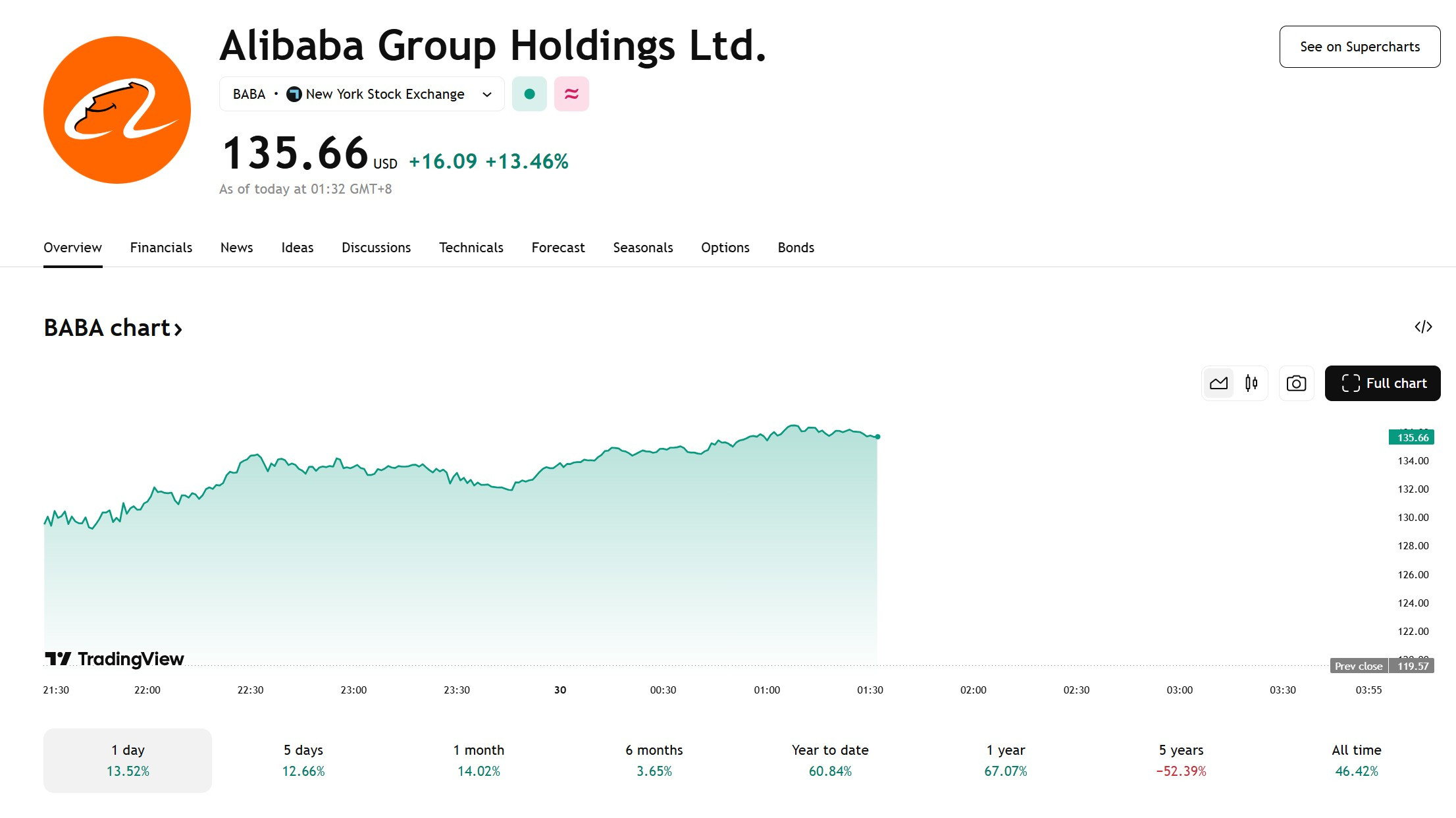
Market reaction captured that split: shares softened, then rebounded during the session — evidence that investors are willing to reward a credible growth story despite near-term margin tradeoffs.
Why pump billions into instant retail and cloud: what’s the logic?
Management frames this as two simultaneous, historic opportunities: (1) build a one-stop consumption platform to increase shopper frequency and monetize the ecosystem; and (2) capture AI-driven cloud demand that multiplies compute, storage, and product revenue.
Instant retail (Taobao Flashsale) aims to lift app engagement and order frequency, which feeds advertising and CMR monetization. Cloud investments are meant to secure leadership in AI infrastructure and monetize both training and inference workloads as customers deploy models.
Alibaba said it has diversified chip supply contingency plans to shield the capex schedule from supply or policy shocks.
Is Taobao Flashsale already working — or is it costing too much?
Taobao Flashsale delivered early scale: management reported ~300 million monthly transacting buyers, daily orders spiking to 120 million at peak, and daily active riders rising to 2 million (threefold since April). Taobao monthly active consumer counts rose strongly in August, and 88VIP membership surpassed 53 million.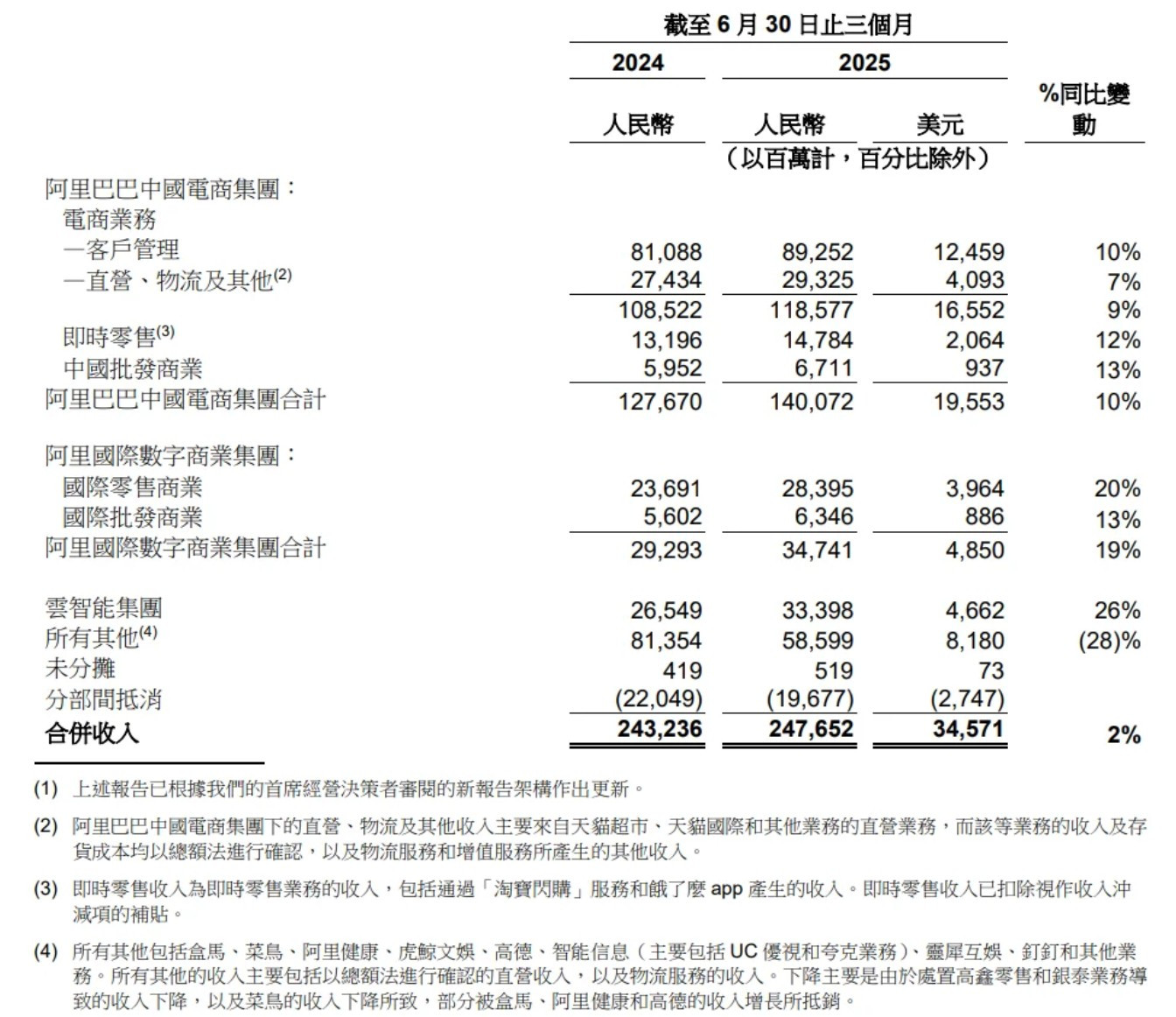
Those gains have lifted platform engagement and should boost advertising and CMR. But the cost is meaningful: China commerce adjusted EBITA fell as Alibaba front-loaded marketing, merchant subsidies, logistics and rider investments to scale Flashsale. Management argues this is a staged investment: build scale and user mindshare now, optimize unit economics as density and order mix improve.
Cloud & AI: is growth real and sustainable?
Alibaba Cloud grew 26% this quarter (≈RMB 334 billion), with AI-related sales keeping triple-digit growth for the eighth consecutive quarter.
Management said customers are increasing both inference and training workloads — fine-tuning proprietary models and deploying domain-specific agents.
Cloud adjusted EBITA rose in tandem with revenue. New product rollouts (upgraded Qwen 3, Agent Bay sandboxes, strategic partnerships like SAP) suggest Alibaba is moving beyond basic IaaS to AI infrastructure and platform services.
Management argues AI will increase market concentration in favor of full-stack providers, and Alibaba’s ecosystem integration is a competitive edge.
Cash flow, capex and the short-term tradeoffs
Free cash flow turned negative — RMB 188 billion outflow — reflecting the capex surge and instant-retail investments. Quarterly capex jumped to ~RMB 387 billion, aimed at cloud infrastructure and logistics.
Management is willing to accept temporary cash outflows, citing a strong balance sheet, buyback capacity, and a view that AI/cloud plus domestic consumption are multi-year, high-return opportunities. Still, investors will want to see a path back to free cash flow positivity as capex normalizes and monetization improves.
What management emphasized on the call
Flashsale scale and trajectory: first-phase results exceeded targets in buyers, merchant supply and rider capacity; expectations of 1 million offline stores joining; RMB 1 trillion incremental GMV from flashsale/instant retail over three years.
AI capex commitment: reaffirmed RMB 3,800 billion over three years; supply-chain contingency plans for AI chips.
AI monetization: AI now accounts for >20% of cloud external commercial revenue and is driving broader compute and storage demand.
Profitability stance: the company is prioritizing growth and market share for strategic initiatives while expecting unit economics to improve over time.
What to watch next
- Instant retail unit economics: metrics such as gross margin per order, rider cost trends, and buyer retention will show whether scale is translating to profitability.
- Cloud revenue mix and margins: sustained AI revenue growth plus margin expansion would validate the capex push.
- Free cash-flow path: whether capex moderates or monetization accelerates to reverse cash outflow.
- Chip supply and execution: delivery of diversified suppliers will be critical to hit the three-year buildout timeline.
Alibaba’s latest quarter is a study in deliberate tradeoffs. The company is sacrificing near-term profit and cash flow to accelerate two strategic bets: building a denser, higher-frequency consumer platform via instant retail, and scaling cloud infrastructure for AI commercialization.
Early engagement signals for Flashsale and accelerating cloud revenue are encouraging, but the test will be sustained improvement in unit economics and cash generation as the capex cycle matures.
The key question remains: will scale, ecosystem integration, and AI-driven monetization ultimately reward this capital-intensive push — or will short-term margin pressure test stakeholder patience?