
Big Bet, Bigger Question: Is Alibaba Burning Cash to Build an AI + Instant-Commerce Empire?

$BABA ’s latest quarter reads like a manifesto: enormous capital spending, aggressive bets on instant commerce and AI, and early—but striking—signals of payoff.
The company spent ¥38 billion in a single quarter (a 57% quarter-on-quarter jump and more than double year-over-year), directed roughly ¥11 billion into its instant-commerce push this quarter, and warned that losses in that unit could peak at ¥22 billion next quarter.
Yet daily instant-commerce orders are already about 80 million, Taobao’s monthly active buyers jumped 25% in early August, and management says cloud demand—fueled by AI—is outpacing expectations. Investors face a straightforward dilemma: are these losses the price of a new growth frontier or a risky, expensive experiment?
The headline up front: why this quarter matters
Alibaba is deliberately trading short-term profit for strategic expansion.
Capex surged to ¥38 billion, largely to scale AI and cloud infrastructure.
Instant commerce received about ¥11 billion this quarter and may lose ¥22 billion next quarter.
Nomura calls it an “all-in” bet and keeps a buy rating with a $152 target.
What’s the wager — and how deep is the hole?
$BABA ’s new China E-commerce Group (CEG) saw adjusted EBITDA fall by about ¥10 billion, a direct consequence of the big push into instant commerce. That unit drew roughly ¥11 billion of investment this quarter, and management expects losses to widen to about ¥22 billion in the coming quarter. The ¥38 billion single-quarter capex — up 57% q/q and 2.2x y/y — signals the scale of the commitment to both instant delivery and AI/cloud infrastructure.
Are the early returns real or just noise?
Early operational metrics look encouraging.
Instant commerce is reporting roughly 80 million daily orders, narrowing the gap with Meituan’s estimated >90 million.
Notably, beverage orders — the classic low-ticket traffic driver — account for less than 30% of the mix, implying healthier order economics.
Instant commerce appears to be lifting the core business: Taobao’s monthly active buyers rose 25% year-over-year in the first three weeks of August.
How is the investment structured — who pays the bill?
$BABA is prioritizing growth over buybacks.
The company repurchased about $1.4 billion in the first half of 2025 but still has roughly $19.3 billion of authorization remaining; management suggested capital may be reallocated toward growth rather than aggressive repurchases.
The ¥38 billion capex includes large cloud investments to meet rising AI demand — a direct bet that cloud scale today buys AI market share tomorrow.
What are analysts saying — did the market buy it?
Nomura interprets Alibaba’s strategy as “spend now to dominate later,” keeping a buy rating and a $152 price target.
Investors seemed to reward the message: Alibaba’s shares jumped nearly 13% after the earnings release.
Still, sell-side caveats remain: short-term profit erosion and the scaling losses in instant commerce could cause volatility while the company chases market share.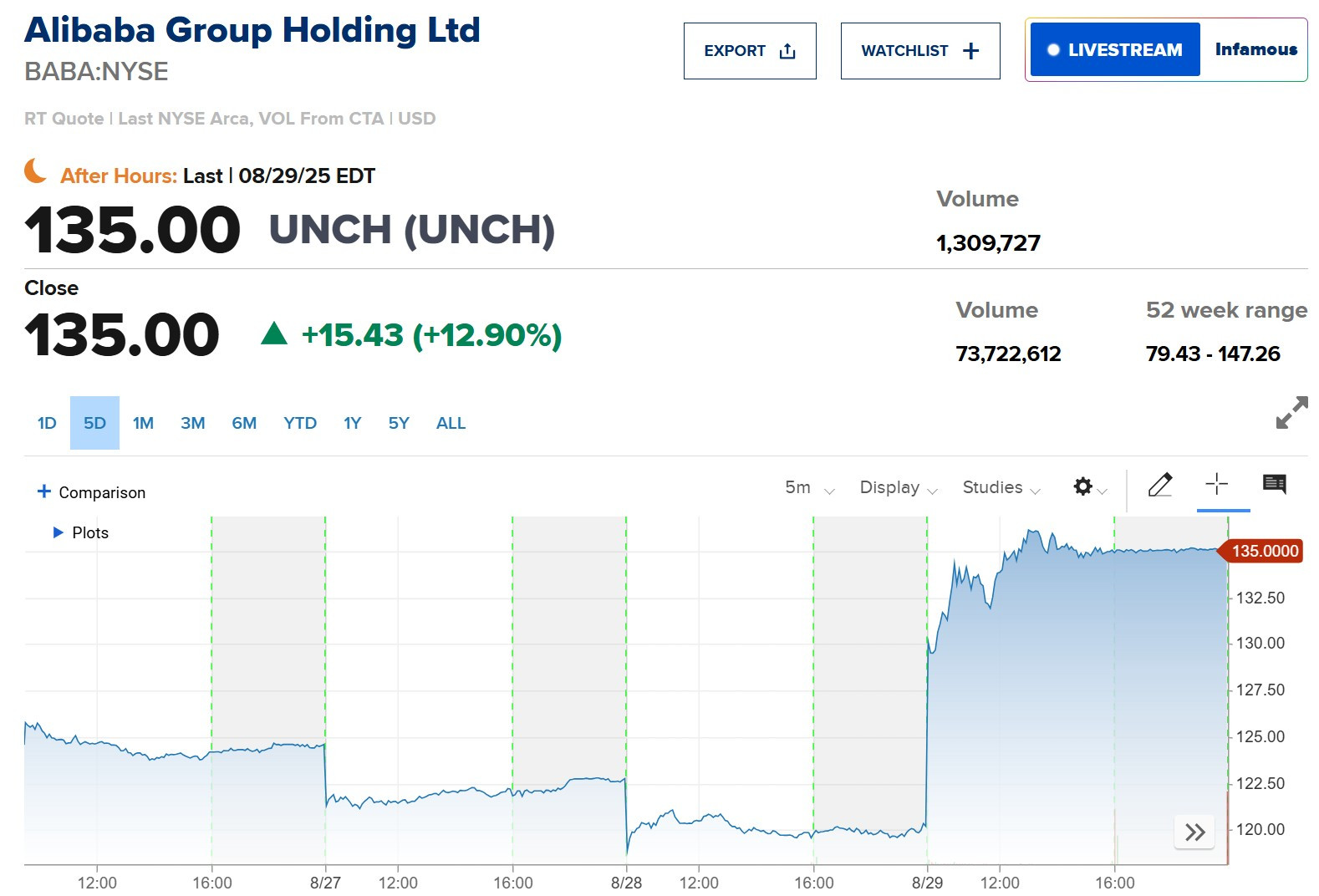
Why NVIDIA’s results matter to Alibaba’s story?
The broader AI hardware and software cycle validates Alibaba’s timing.
$NVDA reported Q2 revenue of $46.743 billion, up 56% year-over-year and 6% sequentially; net income reached $26.422 billion (up 59% y/y) with adjusted net income around $25.783 billion.
Those numbers underscore that AI demand — from chips to cloud services — is real and accelerating.
For Alibaba, strong vendor results like NVIDIA’s provide an external signal that heavy cloud and AI capex can find genuine market demand, not just theoretical promise.
What’s the scale of the prize Alibaba is chasing?
Management has set an audacious target: instant commerce contributing roughly ¥1 trillion in GMV by 2028.
If achieved, that would add an incremental growth engine equivalent to roughly 10% of Alibaba’s existing e-commerce scale.
The company argues it is not merely burning cash blindly; it expects per-order losses to narrow by about half within a few quarters as scale and operational efficiencies improve.
Short-term pain, long-term thesis: which side are you on?
Shareholders are being asked to finance a growth runway.
Near term, headline profitability and adjusted EBITDA will look worse as Alibaba expands delivery capacity, subsidizes orders, and invests in cloud AI.
Medium to long term, management projects cost declines per order and a scalable AI/cloud stack that could compound revenue growth across the ecosystem.
Three tight facts you should remember
1.Consolidated quarterly capex: ¥38 billion (q/q +57%, y/y +2.2x).
2.Instant commerce: ~¥11 billion invested this quarter; expected loss ~¥22 billion next quarter; ~80 million daily orders.
3.Market reaction and endorsement: Taobao MAU +25% (early August); stock jumped nearly 13% after results; Nomura maintains buy with $152 target.
Risks the market should not ignore
Losses may persist longer than management forecasts if order economics don’t improve.
Competition in instant commerce is fierce and capital-intensive; narrowing the gap with incumbents depends on logistics efficiency and sustained customer retention.
Shifting capital away from buybacks reduces a clear shareholder return mechanism and may disappoint yield-focused investors.
Final read: bold strategy, plausible runway
Alibaba has chosen a high-stakes path: marry instant logistics with an AI-powered cloud backbone and accept near-term margin compression to seize a potentially huge long-term opportunity.
Early evidence—robust order volumes, improving order mix, strong Taobao engagement, and external validation from AI demand—gives the strategy air cover. But the math will be unforgiving: execution risk, competitive intensity, and the timing of margin recovery will decide whether the gamble creates a new growth horizon or a prolonged drag on earnings.
For now, the market’s near-term vote—an almost 13% bounce—says investors are willing to give Alibaba the runway. The next quarters will tell whether that confidence was warranted.