
Record-Breaking Funding Emerges in Fusion Sector This Year

The fusion energy sector has witnessed another massive single-round financing.
Recently, U.S.-based fusion energy startup Commonwealth Fusion Systems (CFS) announced the completion of an $863 million funding round.
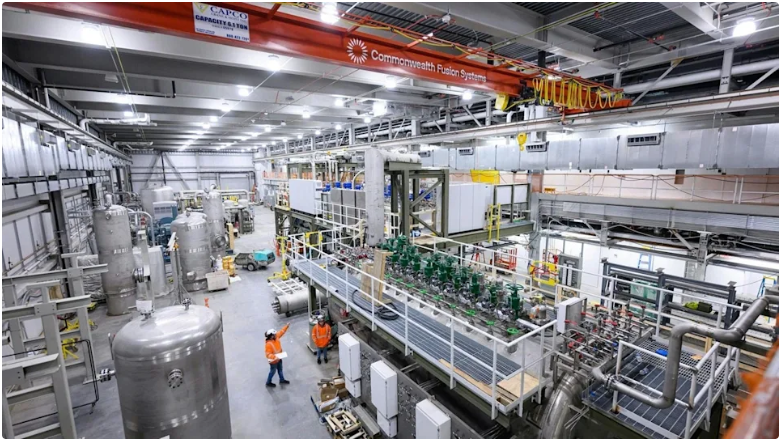
This marks the largest single-round investment in the fusion sector this year and the biggest equity financing in the deep tech/energy field for CFS since its $1.8 billion Series B in 2021.
Nvidia, Tiger, Google Among Investors; Valuation More Than Doubles Since Series B
According to a CFS statement, this round had no single lead investor, qualifying as an “oversubscribed” club round, and brought in major new backers, including Nvidia’s venture arm NVentures, Morgan Stanley, Counterpoint Global, hedge fund Brevan Howard, and Japan’s Mitsui-Mitsubishi consortium.
Existing investors such as Alphabet/Google’s parent company, Khosla Ventures, Breakthrough Energy Ventures, Italy’s Eni, and Tiger Global continued to increase their stakes.
CFS did not disclose its post-money valuation for this round. However, PitchBook’s latest records suggest a valuation range of $7-8 billion, more than doubling the $2.8-3.5 billion post-money valuation from its Series B three years ago.
CFS plans to allocate the funds across three key areas:
- Completing the remaining 35% of the SPARC demonstration device’s engineering between 2025 and 2027, aiming for a “scientific energy gain ≥1.”
- Initiating detailed design and site preparation for the ARC commercial fusion power plant in Chesterfield County, Virginia, in 2027.
- Expanding high-temperature superconducting magnet production capacity—its subsidiary, CFS Superconductors, has increased annual REBCO tape production to 1,500 km this year, still sufficient for only 3-4 SPARC-scale devices.
Public records show CFS is a U.S. clean energy company founded in 2018 by the Plasma Science and Fusion Center team at MIT, headquartered in Massachusetts. The company uses high-temperature superconducting magnet technology to develop tokamak devices, with flagship projects including the SPARC demonstration reactor and the ARC commercial fusion power plant.
Since its inception, CFS has raised approximately $3 billion cumulatively, accounting for about one-third of the global fusion energy sector’s total financing.
Private Fusion Dominated by U.S. and European Players; China Has Just 2 Funded Firms
Currently, there are very few companies globally venturing into controlled fusion, with private startups predominantly led by U.S. and European players.
According to the *Global Fusion Investment Report released by the UK Fusion Industry Association (FIA) in July 2025, there were only 37 equity financing deals in the global private fusion sector between 2023 and 2025, with just 9 exceeding $50 million (≈¥360 million) per round.
The largest single rounds include Germany’s Proxima Fusion, which raised a record €130 million (≈$148 million, or over ¥1 billion) in its Series A; the UK’s Tokamak Energy, which secured $125 million in its Series C in July 2024; and North America’s Helion Energy, which raised $425 million in its Series E in May 2024.
In contrast, China appears to have only two publicly funded fusion firms. In early August, Nova Fusion announced a ¥500 million angel round, achieving a post-money valuation of ¥2 billion and setting a new record for China’s private fusion startups. This is also the largest equity financing outside the U.S. and Europe in the private fusion sector.
The other, Energy Singularity, completed a Pre-A round of nearly ¥400 million in April 2023, backed by miHoYo, Shuhai Investment, Heimen Investment, and Yunhe Fangyuan, and an angel round of nearly ¥400 million in February 2022, supported by Blue Lake Capital, miHoYo, Sequoia China Seed Fund, and NIO Capital.
With identical amounts across two rounds totaling nearly ¥800 million, its latest valuation stands at approximately ¥16 billion.