
APAC Market Wrap - 1 Sep

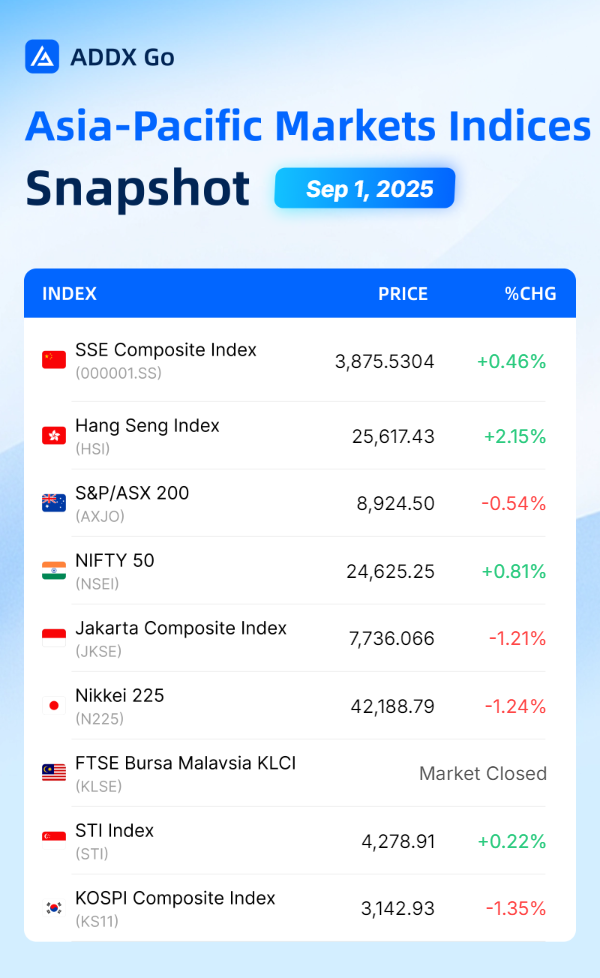
China Stock Market: The A-share market experienced volatility and divergence throughout the day, with the ChiNext Index leading gains and the Shanghai Index showing narrow fluctuations. Total turnover for the Shanghai and Shenzhen markets was ¥27.5 trillion, down ¥48.3 billion from the previous trading day.
By the close, the Shanghai Index rose 0.46%, the Shenzhen Component Index gained 1.05%, and the ChiNext Index climbed 2.29%. Sector-wise, gold concepts, CPO, innovative drugs, and storage chips led the gains, while insurance, securities, military, and banking sectors saw the largest declines.
Hong Kong Stock Market: Hong Kong stocks kicked off September with a strong opening. By the close, the Hang Seng Index rose 2.15% to 25,617.42 points, the Tech Index gained 2.20% to 5,798.96 points, and the State-Owned Enterprises Index increased 1.95% to 9,121.87 points.
Market performance saw cryptocurrencies, gold, and non-ferrous metal stocks leading the gains, while auto and infrastructure stocks underperformed.
Japan Stock Market: The Nikkei 225 continued its significant decline, falling 1.24%. The index closed at 42,188.79 yen (estimated trading volume of 1.72 billion shares), down 529.68 yen.
By sector, 18 industries, including electric power and gas, pharmaceuticals, land transport, fisheries, agriculture, and forestry, saw gains, while 15 sectors, such as non-ferrous metals, securities products, futures, electronic equipment, and machinery, declined.
South Korea Stock Market: The KOSPI fell 1.35% to 3,142.93 points. Sector-wise, stationery, integrated utilities, property insurance, and aerospace led the gains, while healthcare management, communication equipment, energy equipment, and venture capital sectors lagged.
Australia Stock Market: The S&P/ASX 200 (XJO) dropped 0.51% to close at 8,927.700 points. Sectors like education, independent power, and other energy rose, while furniture, semiconductors, and diversified finance saw slight declines.
Singapore Stock Market: The Straits Times Index rose 0.15% to close at 4,276.07 points. Sectors such as credit, cyclical retail, and asset management saw modest gains, while non-alcoholic beverages, auto and parts, and building materials experienced larger declines.
Malaysia Stock Market: Closed today.
Key Events
South Korea’s August Export Growth Slows, U.S. Exports Plummet
Preliminary data from South Korea’s trade ministry on Monday showed August exports grew just 1.3% year-over-year to $58.4 billion, well below July’s revised 5.8% growth and market expectations of 3.7%. Ongoing U.S. tariff policies were cited as a major pressure point. Imports fell 4.0% year-over-year to $51.89 billion, with a trade surplus of $6.51 billion, slightly down from the prior month.
Australia’s Inflation Expectations Cool, Reinforcing Central Bank’s Dovish Stance
Melbourne Institute data showed Australia’s monthly inflation indicator dropped 0.3% month-over-month in August, with year-over-year growth slowing from 2.9% in July to 2.8%. The seasonally adjusted monthly indicator fell 0.2%, with year-over-year growth easing from 2.6% to 2.4%, slightly below the Reserve Bank of Australia’s 2%-3% target midpoint.
This data will please RBA Governor Michelle Bullock, who will deliver a public policy speech on Wednesday.
New Zealand to Allow Wealthy Golden Visa Holders to Buy Luxury Homes
New Zealand will ease its foreign buyer ban, opening the door for high-net-worth investors with golden visas to purchase luxury homes, part of Auckland’s efforts to boost its sluggish economy.
The government announced on Monday that holders of so-called golden visas can buy properties worth at least NZ$5 million (about $3 million USD), creating a loophole in the overseas buyer ban effective since 2018. Prime Minister Christopher Luxon said the new rules will take effect after the Overseas Investment Act revision passes by year-end.
Political Risks Escalate in Indonesia and Thailand, Clouding Southeast Asia’s Emerging Markets
Rising protests in Indonesia and leadership turmoil in Thailand are heightening political risks over these two Southeast Asian emerging markets. Indonesia’s benchmark stock index fell 1.5% on Friday, the largest drop among Bloomberg-tracked global indices, with the central bank hinting at stabilizing the rupiah.
Thailand’s stock market also dropped 1.1%, among the worst performers, with the baht weakening. Deadly riots in Indonesia over rising living costs and inequality saw protesters attack the finance minister’s and several lawmakers’ homes.
In Thailand, the Constitutional Court removed Prime Minister Paetongtarn Shinawatra, sparking a power struggle for the next government. These risks emerge as stock valuations decline and potential rate cuts might draw global funds to Southeast Asia, though political instability increases the risk of capital outflows and currency pressure.
Institutional Views
Citi, UBS Raise U.S. Stock Targets, Bullish on Future Performance
Citi and UBS Global Research raised their year-end S&P 500 targets. Citi lifted its target from 6,300 to 6,600 points, while UBS raised its target from 5,500 to 6,100 points. UBS expects a short-term dip, with the S&P 500 falling to 5,900 by the end of Q3, recovering to 6,100 by year-end 2025.
Citi analysts noted that the drag from U.S. tariff expectations on economic fundamentals is set, but tax benefits from Trump’s spending bill should improve corporate earnings, and the “Magnificent Seven” tech giants’ strong performance has restored investor confidence in AI-driven rallies.
JPMorgan Upgrades Vietnam Stock Rating, Sees Bright Outlook
JPMorgan upgraded Vietnam’s stock market to “overweight” and raised its year-end Ho Chi Minh Index target to a maximum of 1,600 points. With the U.S.-Vietnam trade agreement reducing tariffs on Vietnamese goods from 46% in April to 20%, JPMorgan sees sustained capital inflows.
A weaker dollar, high U.S. stock valuations, and potential FTSE upgrades could also drive more international capital to Vietnam.
UBS: Southeast Asia Competition to Return to Pre-Tariff Levels
UBS analyst Jen-Ai Chua stated that the tariff outcome removed a key barrier for Southeast Asia, with ASEAN trade and capital competition expected to revert to pre-tariff levels as no country gains a relative advantage.
However, semiconductor tariffs could impact Malaysia, Thailand, and Singapore, where semiconductors form a large share of U.S. exports. UBS maintains a neutral stance on Malaysia’s stock market and a negative outlook on Thailand’s.