
Broadcom Q3 Earnings Preview: Can $5B in AI Revenue Keep the Momentum Going?

Shearing sheep
September 3, 2025
GoGPT Summarizes Articles
Broadcom ($AVGO) will report its fiscal Q3 2025 results after the U.S. market closes on September 4, and expectations are running high. The stock has been one of the clearest beneficiaries of the AI boom, with custom accelerators and networking solutions now making up a meaningful chunk of its revenue. But as the bar keeps rising, investors are asking the obvious question: can AI alone sustain Broadcom’s momentum, or will we start to see cracks elsewhere?
The Street’s Numbers
Analysts see Broadcom posting revenue of about $15.82 billion, up 21% year-on-year, with adjusted EPS around $1.66, a healthy 34% gain compared to last year. That growth is largely powered by one engine: AI.
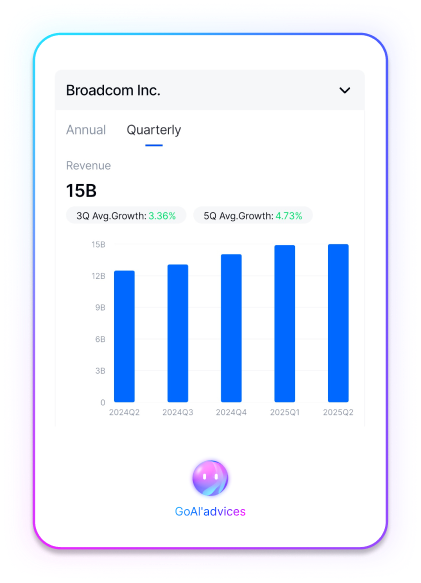
The company’s AI semiconductor revenue reached $4.4B last quarter, up 46% YoY, and management has guided for this to rise to $5.1B in Q3. If that plays out, AI will account for roughly one-third of total revenue—a milestone that would mark the tenth straight quarter of annual growth.
Margins will also be closely watched. Broadcom has consistently delivered industry-leading profitability, with non-GAAP gross margins of about 79% and EBITDA margins near 67% last quarter. For Q3, management hinted margins could dip to 66%, a small change but one that might fuel the “AI growth has peaked” narrative if investors are already looking for weaknesses.
AI: The Star of the Show
The heart of Broadcom’s growth story is its custom AI chips and networking gear.
-
Google’s TPUv6 “Ironwood” (3nm) is ramping up production and is expected to contribute heavily this quarter. JPMorgan estimates that over its lifecycle, this chip could deliver $15B+ in revenue for Broadcom.
-
Meta’s MTIA inference accelerator has begun shipping, adding another growth vector.
-
Networking products like Tomahawk 5 and Jericho3-AI remain in high demand, and the next-gen Tomahawk 6 is already in mass production.
Put together, analysts at JPM believe Broadcom’s AI semiconductor revenue could hit $20B+ in FY2025, up 60% YoY, and surpass $33B in FY2026. Citi’s forecasts are in the same ballpark, expecting $19.5B in 2025 and $26.7B in 2026. Either way, the trajectory points to sustained double-digit growth.
That scale would solidify Broadcom as the second-largest AI semiconductor supplier globally, behind only Nvidia, while dominating the market for custom ASICs—a segment hyperscalers increasingly prefer to Nvidia’s general-purpose GPUs for cost and efficiency reasons.
Software: VMware as the Second Engine
While AI gets the headlines, Broadcom’s software arm (mainly VMware, acquired for $69B) is the other pillar investors should watch.
VMware revenue is expected to come in at around $6.7B, up 16% YoY, with momentum from:
-
Subscription conversions to VMware Cloud Foundation (VCF),
-
Strong renewal activity among large enterprise clients,
-
A shift to higher-ASP products.
If VMware can maintain steady double-digit growth and margin improvement, it provides Broadcom with a more stable, recurring revenue base, balancing the cyclicality of semiconductors.
Non-AI Chips: Still Waiting for a Turnaround
Outside AI, the picture is more mixed. Broadcom’s traditional semiconductor businesses—enterprise storage, broadband, wireless—are still lagging. There are signs of stabilization, particularly in broadband and storage, but no broad-based rebound yet.
This matters because if AI demand ever slows, Broadcom needs these segments to cushion the blow. For now, though, the AI narrative is powerful enough to overshadow weakness elsewhere.
Cash Flow Strength
One area where Broadcom continues to shine is free cash flow. Last quarter, FCF came in at $6.4B, about 40% of revenue, more than covering dividends and leaving room for debt reduction post-VMware. Strong cash generation gives management flexibility for buybacks and balance sheet repair, which investors will appreciate given the heavy leverage from the VMware deal.
Valuation: The Elephant in the Room
Here’s where it gets tricky.
Year-to-date, Broadcom has risen 28% and trades at around 37–42× forward earnings—well above its historical average and richer than peers like AMD. Nvidia also looks expensive, but it benefits from a GPU monopoly halo, whereas Broadcom’s valuation implies near-perfect execution in both AI and software.
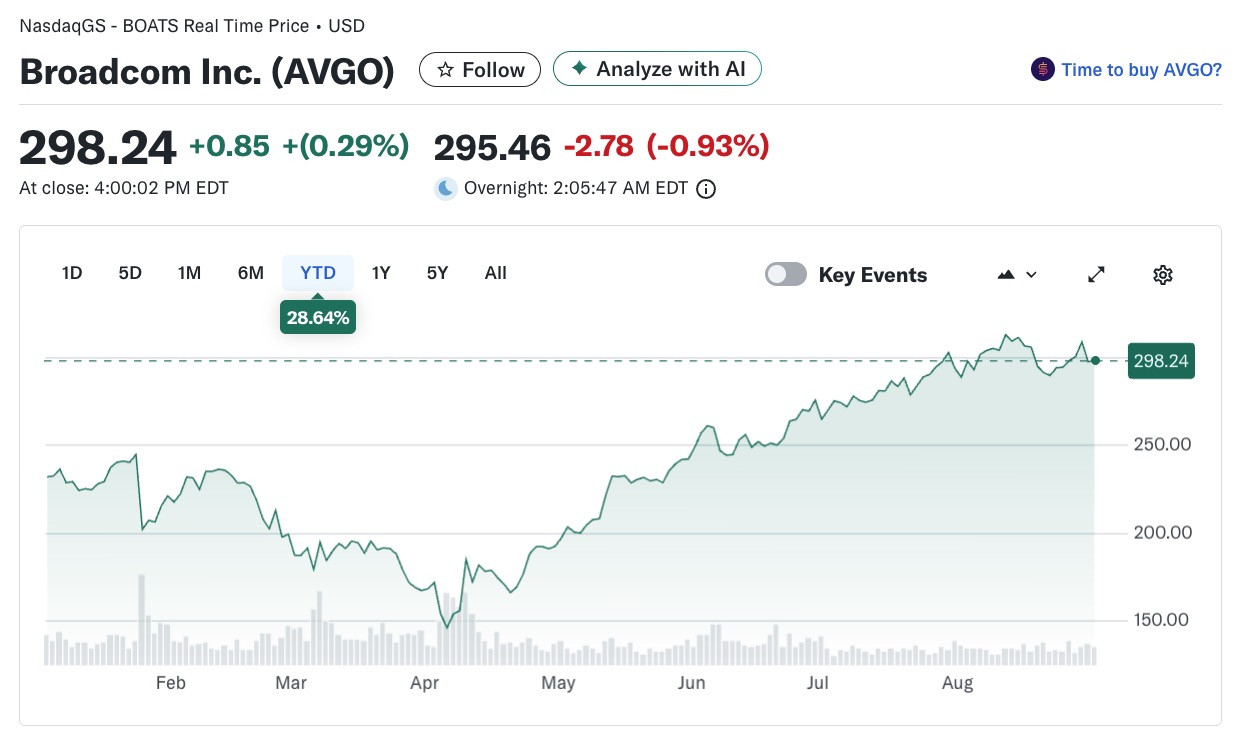
If Q3 numbers are strong but guidance is merely in line, the stock could struggle to extend gains. On the flip side, an AI revenue beat or stronger-than-expected Q4 guide (some expect as high as $17B in sales) could justify the premium.
What Investors Should Watch on Sept 4
1. AI Revenue – Does it hit or beat the $5.1B mark?
2. Q4 Guidance – Analysts want signs of sequential growth, ideally toward $17B revenue.
3. VMware Trends – Subscription mix, margin expansion, and renewal rates.
4. Margins – Can Broadcom hold EBITDA at 66% despite AI mix shifts?
5. Non-AI Chips – Any hints of a turnaround in enterprise or broadband?
My Take
Broadcom has executed extremely well in riding the AI wave, carving out a profitable niche in custom accelerators and networking. The VMware integration gives it a second growth engine, though it’s less flashy.
The real risk isn’t that AI demand disappears—it’s that expectations are already so high that anything short of an upside surprise could disappoint. With the stock trading at a hefty multiple, the margin for error is slim.
That said, if Broadcom does deliver on the $5B AI revenue milestone and points to further growth in Q4, it’s hard to argue against the company’s long-term positioning. For investors, this report will be less about today’s numbers and more about whether Broadcom can convince the market it has the staying power to keep riding the AI wave well into 2026.
#Q2 Earnings Hunter: Share Your Stories#$Broadcom Inc. Common Stock(AVGO)