
Euro Debt Crisis? Global Bond Market Plummets, Long-Term Yields Likely to Keep Rising

In recent days, the yield on the US 30-year Treasury note has once again come under pressure, nearing 5%.
Even more concerning is the situation in the European bond market. The UK 30-year gilt yield briefly hit 5.69%, the highest since 1998; Germany’s 30-year bond yield rose to 3.40%; France’s 30-year bond yield broke above 4.5%, a level not seen since 2011; and Spain’s 30-year bond yield reached 4.297%, the highest since November 2023.
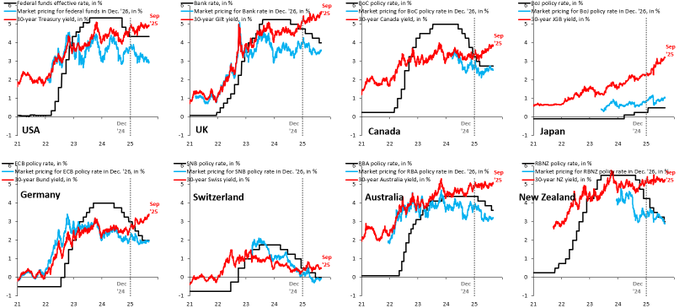
Entering September, both Japan and the US plan to issue a large volume of long-term bonds early in the month. Combined with Europe’s concentrated supply window from September to October, market concerns about a “supply peak plus long-end repricing” are intensifying.
Rising Long-End Rates and Widening Spreads
In the just-concluded month of August, Germany and France’s 30-year bond yields rose by approximately 15 and 27 basis points, respectively, potentially marking their largest monthly gains since March.
France has become a focal point. French Prime Minister François Bayrou has announced a confidence vote on a debt reduction plan for September 8.
Guillaume Rigeade, Co-Head of Fixed Income at asset manager Carmignac, warned: “If the political crisis in France worsens, the France-Germany yield spread could widen to 100 basis points for the first time since 2012.”
French Finance Minister Eric Lombard cautioned this week that seeking fiscal aid from the International Monetary Fund (IMF) is “a risk on the table.”
This scenario recalls the Greek debt crisis following 2009, a hallmark of the first eurozone debt crisis. In 2010, as a batch of Greek bonds matured on May 19, the country urgently needed to raise €8.5 billion. Unable to secure sustainable financing, it turned to the EU and IMF for bilateral fiscal aid.
Over the following years, Greece received three bailout packages totaling €326 billion, though at the cost of painful austerity measures and structural reforms.
Thus, a nation only seeks IMF assistance as a last resort, as it often signals a loss of economic sovereignty.

France’s economic troubles run deep. Over the past 20 years, its government debt has accumulated at a rate of €12 million per hour. The European Commission estimates that France’s government debt will reach 116% of GDP this year. Last year, welfare state policies consumed 51.4% of GDP, while also crowding out defense spending.
The EU’s Stability and Growth Pact requires member states to keep their fiscal deficit below 3% of GDP, with only temporary, slight exceedances allowed in exceptional cases. However, these rules often prove ineffective against political realities.
The EU lacks a unified fiscal union, with most decisions on taxation and spending still made at the national level. France’s 10-year bond yield is now among the highest in the eurozone, surpassing even Greece and Portugal, once at the heart of the euro debt crisis. This market behavior reflects deep investor concerns about France’s fiscal health.
France’s predicament is not an isolated case but a microcosm of a brewing crisis in the global long-term bond market.
The International Monetary Fund projects global economic growth to slow from 3.3% last year to 3% in 2025. Under a “low growth + high debt” scenario, countries face increasing difficulty in reducing debt, with limited fiscal room to maneuver.
Supply Peak Approaching
The next two months will see a supply peak in the Euro-American bond markets. Société Générale estimates that European sovereign bond issuance in September and October will exceed €100 billion (approximately $117 billion). Weak demand observed in recent Japanese 10-year and US 30-year Treasury auctions has heightened concerns about supply-demand imbalances.
Kenneth Broux, Head of FX and Rates Research at Société Générale, commented: “When supply surges, investors demand higher yields as compensation, which will likely amplify market volatility.”
Paul Mielczarski, Macro Strategist at Brandywine Global, said: “With inflation running high, investors need greater compensation to offset risks.”
The UK is also under pressure. UK Chancellor Rachel Reeves is preparing an autumn budget to meet rising public spending needs. Gilles Moec, Chief Economist at AXA, analyzed: “Additional support from central banks seems unlikely, at least for the UK and eurozone.” He warned that without central bank backing, fiscal discipline risks will further drive up financing costs.
Meanwhile, concerns over US fiscal sustainability and Fed independence are pushing up risk premiums on US Treasuries. Analysts suggest that if inflation pressures persist and the Fed eases policy too quickly due to political pressure, it could trigger another surge in long-end yields, intensifying bond market volatility.
Global Bond Market’s ‘September Curse’
Notably, September is widely regarded as the most treacherous month for US stocks, and a similar “September curse” phenomenon exists in global bond markets.
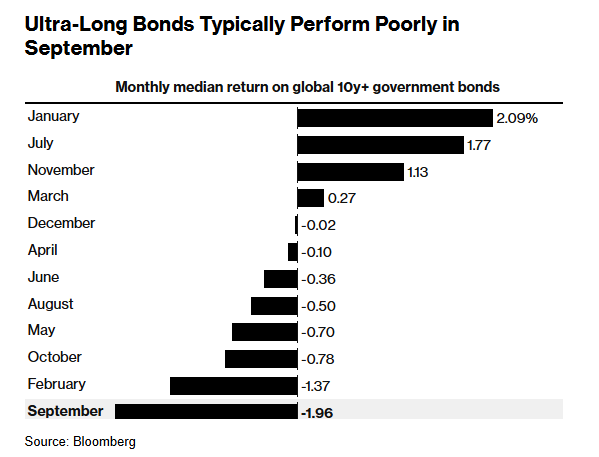
According to industry-compiled data, over the past decade, government bonds with maturities of 10 years or more have posted a median decline of 2% in September, making it the worst-performing month of the year.
Chris Weston, Head of Research at Pepperstone Group, noted that the rise in bond issuance in September is a typical reason for the seasonal weakness of long-term bonds.
Mohit Kumar, Chief European Strategist at Jefferies International, agreed, stating that September’s seasonality “is mainly tied to issuance volume.” “Issuance is light in July and August, and also sparse after mid-November.”
This seasonal weakness has left many industry insiders increasingly anxious.
“The market feels very grim right now,” said Hideo Shimomura, Senior Portfolio Manager at Fivestar Asset Management in Tokyo. “September is typically a month of sharp monetary policy shifts and expected market movements.”
Michael Cudzil, Senior Portfolio Manager at PIMCO, noted: “The ‘September phenomenon’ of rising long-term yields has indeed occurred in the past, and the current massive corporate bond issuance—potentially reaching $160 billion this month—is clearly fueling this trend.”
John Briggs, North America Rates Strategist at Société Générale, pointed out: “The 30-year US Treasury yield pausing near 5% will likely be brief. This isn’t a magical number, and I’ve had serious concerns about the global long-term bond market for the past couple of weeks.”
Briggs added that in a high-inflation environment, rate cuts could “easily lead to a steepening yield curve.”
Some Thoughts
Currently, European countries are ramping up fiscal spending to address geopolitical security and economic recovery, resorting to aggressive borrowing.
Markets are beginning to question the sustainability of government debt.
Attention has turned to the collective surge in 30-year euro bond yields. In the past, a rise in 30-year yields signaled economic recovery, but today, it points to a sovereign currency trust crisis in Europe.
Previously, during economic downturns, rate cuts and liquidity injections could stimulate growth. But if current conditions suggest a willingness to cut rates or inject fiscal stimulus, I suspect euro bond yields will rise further. Such stimulus under rising yields would clearly exacerbate fiscal burdens, rendering it unsustainable.
On one hand, economic growth continues to slow; on the other, irreducible welfare spending and aid to Ukraine have left European nations in a bind.
To be honest, I’ve long believed that Europe’s current economic reality is mismatched with its high welfare standards.
Now, the global leadership in technology and military fields belongs to the US, yet the everyday welfare benefits for ordinary Americans are actually inferior to those of most Europeans.
This euro debt crisis might usher in another wave of societal transformation.