
APAC Market Wrap - 3 Sep

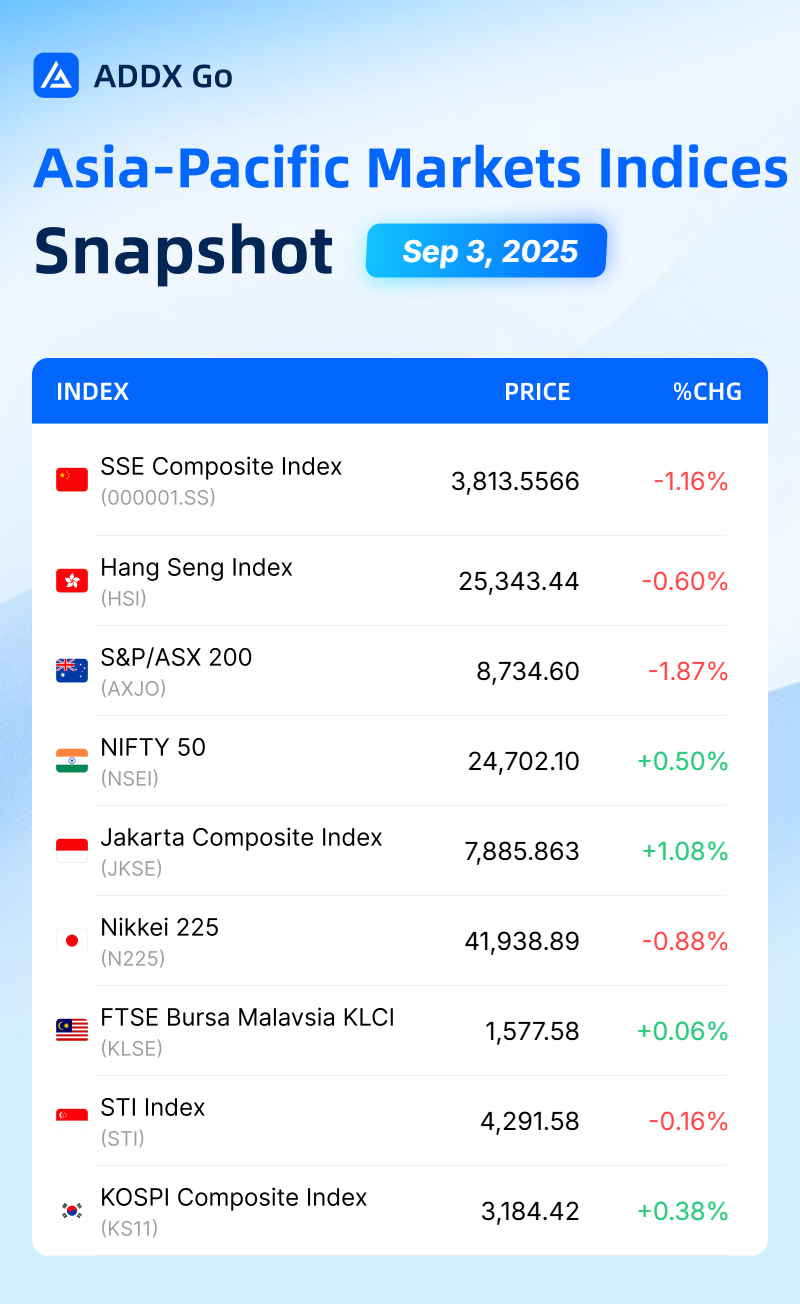
China Stock Market: The market oscillated with mixed performance throughout the day, with the major indices showing varied results. By the close, the Shanghai Composite Index fell 1.16%, the Shenzhen Component Index dropped 0.65%, and the ChiNext Index rose 0.95%.
In terms of sectors, photovoltaic, precious metals, and gaming led the gains, while minor metals, securities, software development, and agriculture saw the largest declines.
Hong Kong Stock Market: All three major Hong Kong indices closed lower today. At the close, the Hang Seng Index fell 0.60% to 25,343.43 points; the Tech Index dropped 0.78% to 5,683.74 points; and the State-Owned Enterprises Index declined 0.64% to 9,050.02 points.
Market performance showed strength in innovative drugs, gold, and semiconductor stocks, while brokerage and banking stocks weakened.
Japan Stock Market: The Nikkei 225 Average fell 0.88%. It closed down 371.60 yen at 41,938.89 yen.
By sector, nine industries, including pulp and paper, rubber products, land transport, and fisheries/agriculture, saw gains. Conversely, 24 industries, including banking, insurance, shipping, and securities/commodities futures, posted declines.
South Korea Stock Market: The KOSPI index rose 0.38% to 3,184.42 points.
By sector, non-metallic minerals, communication equipment, life sciences, and hospitality led the gains, while food, life insurance, and IT services saw the largest drops.
Australia Stock Market: The S&P/ASX 200 (XJO) fell 1.82%, closing at 8,738.800 points.
Sectors like aerospace, home construction, and pharmaceutical manufacturers rose, while medical diagnostics, semiconductors, and software experienced significant declines.
Singapore Stock Market: The Straits Times Index dropped 0.21%, closing at 4,289.33 points.
By sector, medical devices, non-alcoholic beverages, and education saw slight gains, while restaurants, furniture, and alcoholic beverages recorded larger declines.
Malaysia Stock Market: The FTSE Malaysia KLCI rose 0.12% to 1,578.52 points.
Sectors such as industrials, technology, and healthcare saw modest gains, while closed-end funds, real estate trusts, and financial services declined.
Key Events
Global Bond Sell-Off Intensifies, Long-Term Bonds Lead the Decline
Fueled by concerns over inflation, bond issuance, and fiscal discipline, investor sentiment toward bonds—once considered one of the safest assets globally—has soured, triggering a new wave of selling pressure.
On Wednesday, US Treasury yields rose, with the benchmark 30-year yield approaching the closely watched 5% mark. The UK 30-year gilt yield climbed to 5.75%, the highest since 1998, while Japan’s 20-year bond yield reached a high for this century.
Australia’s 10-year bond yield hit its highest level since July. Earlier Wednesday, eurozone bonds bucked the global trend, with benchmark borrowing costs ending a three-day upward streak.
Overall, this sell-off reflects traders’ worries about heavy government spending and potential inflation consequences worldwide. Tuesday’s surge in corporate bond issuance, coupled with uncertainty over Fed independence, further intensified the pressure.
Japan Stock Market Hits Near-Four-Week Low, Bank Stocks Plunge on Diminished Rate Hike Expectations
Japan’s stock market closed at a near-four-week low on Wednesday, dragged down by a drop in bank stocks after a senior Bank of Japan official’s remarks lowered expectations for an early rate hike.
Bank of Japan Deputy Governor Shinichi Uchida said on Tuesday that the central bank should continue raising rates but warned of high global economic uncertainty, suggesting no rush to lift the still-low borrowing costs. “Market expectations for a Bank of Japan rate hike weakened after Uchida’s remarks, as he remains cautious about tariff impacts,” analysts noted.
US Tariffs Hit Ancient Industry, India’s Cotton Faces Demand Crisis
India’s cotton market and textile industry are at a crossroads, facing risks from US tariffs, government intervention, and shifting global trade patterns.
Industry insiders reveal that Indian cotton farmers are under immense pressure this upcoming harvest season due to domestic cotton facing price competition from imports and weakened local demand from high US tariffs on textile exports.
Atul Ganatra, Chairman of the Cotton Association of India, said the demand slowdown has hit the cotton industry hard. In this market environment, farmers are unlikely to fetch desirable cotton prices, meaning the Indian government may need to step in to buy a record amount, approximately 14 million bales.
World Gold Council Seeks to Launch Digital Gold
World Gold Council CEO David Tait told media that this new initiative will mark the first time “gold is transferred digitally within the gold ecosystem as collateral.”
The new digital unit, called “pooled gold interest,” will allow banks and investors to trade fractional ownership of physical gold held in separate accounts. Testing with commercial participants is set for the first quarter of 2026 in London.
Tait noted that digitizing gold is essential to expand its market reach.
Institutional Views
Analysts: Singapore Dollar Likely to Continue Rising Against USD
According to a report by Maybank analysts, the Singapore dollar is poised to keep strengthening against the US dollar. US economic “exceptionalism” is fading, and the global shift of funds away from the dollar toward diversified high-quality assets continues unabated.
The report highlights that the Singapore dollar has proven to be a reliable “safe-haven” currency in the region. “Few countries can maintain robust fiscal surpluses while announcing expansionary budgets,” analysts said. They argue that this year’s Singapore budget case again underscores a key advantage of the dollar: “In uncertain times, it becomes a relatively attractive holding currency.”
Broker Philip Nova: Gold Prices May Hit $3,600-$3,900 Range in Coming Months
Analyst Priyanka Sachdeva from Philip Nova stated in a report that if spot gold prices continue to break above $3,500, gold could reach $3,600-$3,900 per ounce in the coming months. She noted that the US’s aggressive tariff stance has heightened geopolitical risks, boosting safe-haven investments.
Factors like rate cut expectations, political unrest, and strong ETF demand have turned gold from a tactical hedge into a strategic must-have for many investors. Sachdeva believes $3,800 per ounce could be the first clear psychological barrier if gold breaks its current highs.
ING: Oil Price Risk Lies in OPEC+ Decision to Reimpose Cuts
ING commodity experts Ewa Manthey and Warren Patterson pointed out that market attention is increasingly focused on this weekend’s OPEC+ meeting. In line with broad expectations, they believe the group will maintain October production levels.
Given the scale of global crude oversupply next year, OPEC+ is unlikely to increase market supply further. However, with concerns about oversupply, the bigger risk is that OPEC+ might decide to reimpose production cuts.