
Google’s rebound: the verdict, the AI win, and what investors need to know

On September 2, 2025, U.S. District Judge Amit Mehta issued a ruling that stopped short of the most drastic structural remedies sought by the government. $GOOGL keeps Chrome and avoids a forced breakup, but the decision bans exclusive search contracts and requires certain data-sharing.

Markets cheered: $GOOGL rallied roughly 7% in after-hours trading, and $AAPL rose about 3%. Combined with renewed AI momentum — notably the August 27 launch of Nano Banana (Gemini 2.5 Flash Image) — and reports of strong ASIC performance in data centers, the ruling has created a plausible pathway for $GOOGL ’s valuation to be re-rated upward.
Key Points
- Judge Amit Mehta’s Sept. 2, 2025 ruling rejected forced divestitures (Chrome/Android) but banned exclusive search contracts and ordered limited search-data sharing.
- Market reaction: $GOOGL rose ~7% after hours; Apple gained ~3% as its default-search revenue was preserved.
- $GOOGL will appeal, so legal uncertainty remains.
- $GOOGL launched Nano Banana (Aug. 27) — rapid, multi-round image editing with reported high first-try success.
- Morgan Stanley notes TPU v6e’s strong data-center performance; $TSM expected to supply ~90% of Google’s advanced-process needs by 2026.
What the Sept. 2 ruling actually changes — and what it doesn’t
Judge Mehta declined to impose structural remedies that would have broken apart $GOOGL ’s core assets. That spared $GOOGL from “death by divestiture,” meaning Chrome and Android remain intact for now.

But permanence comes with new guardrails. The court forbids exclusive search contracts that lock rivals out of key channels, and it compels Google to permit access to certain search data.
So $GOOGL preserves the cash flows that bankroll AI and cloud investments, yet faces new competitive openings. Rivals can theoretically access channels and data previously constrained by contractual exclusivity — a meaningful shift in the competitive mix.
Why Apple also breathed easier — and why investors noticed
$AAPL ’s default-search pact with $GOOGL was central to the dispute. Google reportedly pays Apple over $26 billion annually to remain the default on Safari — a sum that materially contributes to Apple’s profit mix.

Keeping that payment stream largely intact explains Apple’s roughly 3% post-ruling lift. The ruling removes exclusivity but does not sever the underlying commercial tie that supplies both companies with a stable revenue source.
For Apple, the ruling reduces immediate financial disruption while adding some long-term competitive nuance.
For investors, the result is a retained cash-flow story for both firms, but with a clearer path for increased competition over time.
Nano Banana: product win or market signal?
Google’s August 27 rollout of Nano Banana (Gemini 2.5 Flash Image) has been presented as a step-change in image-editing AI.
Reported advantages include sub-two-second latency, robust multi-round editing that preserves style and character, and high first-attempt success.
These product-level improvements matter for several reasons. First, better, faster tooling increases user engagement and monetizable use cases in commerce and advertising creative flows. Second, the product’s performance in head-to-head benchmarks (LMArena’s “Battle Mode”) signals that Google can close functional gaps with leading models.
That creates pressure on rival offerings and feeds the market narrative that Google’s AI stack is competitively credible.
Chips and data centers: TPU v6e and the cloud margin story
Morgan Stanley’s research, as referenced, highlights Google’s TPU v6e pod as a high-performing ASIC solution in the data center.
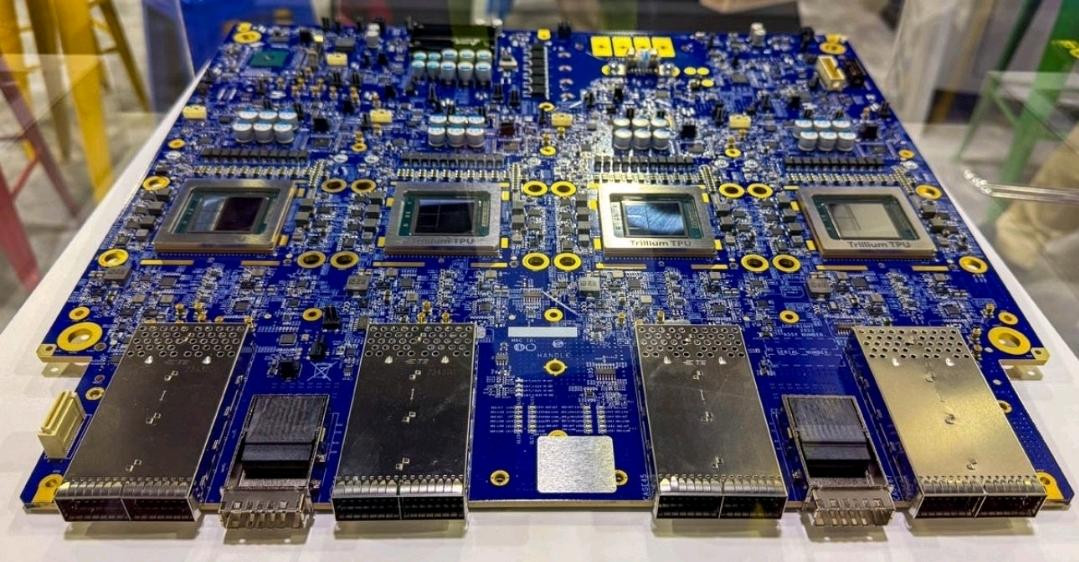
Reportedly, it ranks second to Nvidia’s GB200 on performance metrics while delivering excellent energy efficiency and scalability. Operational implications are straightforward: better ASICs reduce cloud providers’ unit costs and improve margins.
If Google can run AI workloads more cheaply and at scale, Google Cloud’s competitiveness improves — and the company’s capacity to monetize AI services strengthens.
The supply side matters too: the note expects TSMC to supply roughly 90% of Google’s advanced process needs by 2026, reducing manufacturing uncertainty for Google’s ASIC roadmap.
The investor view: why valuation may be due for a rethink
Investors disappointed by regulatory overhang may now re-evaluate Google’s risk-reward profile.
The Sept. 2 ruling removes the specter of an immediate, disruptive breakup and secures near-term cash flows that fund AI and cloud investment. At the same time, the ban on exclusives and the requirement to share data inject new competition into search and advertising.
That creates a mixed scenario: stable cash flows plus structural competitive pressure that could compress margins over time. Product wins like Nano Banana and improved ASIC economics strengthen Google’s growth narrative.
If Google converts AI lead into durable monetization — in search, ads, and cloud — the current “low relative valuation” argument gains traction.
What to watch next — timing, appeals, and execution
Google has signalled it will appeal.
An appeal could delay implementation of remedies and prolong legal uncertainty; markets often price on the path, not just the headline.
Watch regulatory developments and enforcement timelines closely. Also watch adoption metrics for Nano Banana and related AI features: business uptake for image generation in e-commerce and advertising will materially influence monetization expectations.
Finally, monitor Google Cloud margins and TPU deployment: if ASIC economics improve cloud profitability meaningfully, analyst models may shift materially upward.
Final verdict: cautious optimism, not a clean sweep
Sept. 2’s courtroom result is a win for Google — a reprieve from the most severe structural outcomes and a preservation of core cash flows.
But it is not a legal endgame: exclusivity bans and data-sharing mandates alter the competitive battlefield.
Layer on top of that Google’s recent AI product advances and promising ASIC performance, and you have a plausible, multi-angle case for valuation reappraisal.
That case depends on execution: turning AI research into durable revenue is still the central task. If Google does that while navigating new competitive rules, its “comeback” narrative gains weight; if not, the ruling will have merely bought time.