The Global ‘Post-Modern Cycle’ Begins! One Article to Understand: Is Your Investment Strategy Keeping Up with the Times?

According to the latest views of Goldman Sachs’ Global Equity Strategist, global markets are entering a new “Post-Modern Cycle.”
Peter Oppenheimer, Goldman Sachs’ Global Equity Strategist, stated that in this cycle, stock market investors who can keenly identify winners and losers may reap substantial returns, while those clinging to past successful strategies (such as simply buying and holding index funds) may face disappointment.
In fact, nearly a year ago, Goldman Sachs’ Chief US Equity Strategist David Kostin boldly predicted that the S&P 500 would achieve only a 3% annualized return over the next decade. He pointed out that in a persistently high-interest-rate environment, excessive market concentration, elevated valuations, and fierce competition from other asset classes like bonds would collectively drag down stock performance.
Oppenheimer reiterated this low-return perspective this week, proposing that the stock market will enter a new “Post-Modern Cycle” framework. In this cycle, “alpha returns” may become more attainable than “beta returns”—that is, outperforming the market average through active stock picking, selective industry or factor strategies (alpha returns) will offer more opportunities and importance than relying solely on overall market gains (beta returns).
The New ‘Post-Modern Cycle’
Several years ago, Oppenheimer and his team first introduced the concept of the “Post-Modern Cycle.” On Wednesday, they updated their original theory, delving into how global macroeconomic changes are permeating the stock market—creating a new landscape for investors to navigate.
Oppenheimer’s team believes the stock market exhibits both cyclical fluctuations and long-term trends.
Since World War II, the market has experienced three long-term bull markets, each followed by extended periods of subdued returns.
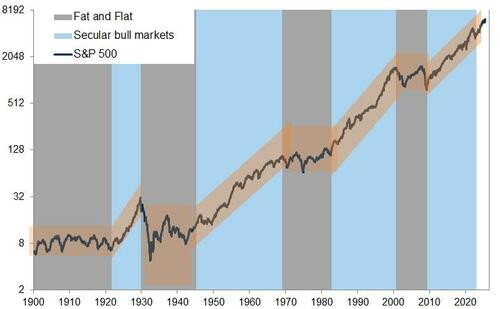
These “super cycles” typically begin in low-valuation environments and are driven by declining inflation, falling interest rates, rising profit margins, and globalization. Understanding the drivers of different long-term market environments helps investors grasp the constraints and opportunities they face today.
For instance, the previous paradigm, dating back to the early 1980s, was characterized by slowing inflation, declining interest rates, and an accelerated globalization process. A wave of supply-side economic reforms, including tax cuts and deregulation during President Reagan’s tenure in the 1980s, also helped boost corporate profits and stock returns.
The most recent high-return “super cycle” for stocks can be traced back to 2012, when Oppenheimer published a report titled “Long-Term Buying Opportunity: A Case for Stock Investing.” At the time, he noted that with elevated stock risk premiums and overly pessimistic market growth expectations, a decade-long period of stock valuation compression was nearing its end.
However, Oppenheimer now believes we have entered a “Post-Modern Cycle.” President Trump’s tariff plans and supply chain disruptions from the COVID-19 pandemic have altered this trajectory. The decades-long process of globalization is now reversing.
In the coming years, a heavy government debt burden may keep bond yields above post-2008 financial crisis levels. Consumer goods and service price increases will likely exceed historical norms. An aging population may also complicate the relationship between corporate profits and economic growth.
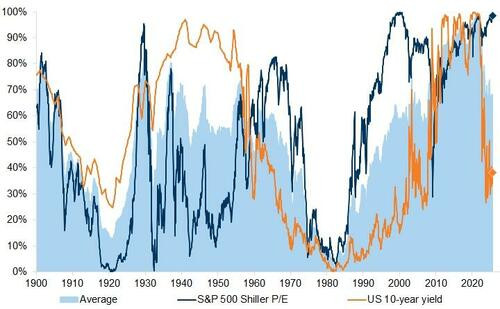
Past experience shows that the strongest stock returns often follow periods of relatively low valuations.
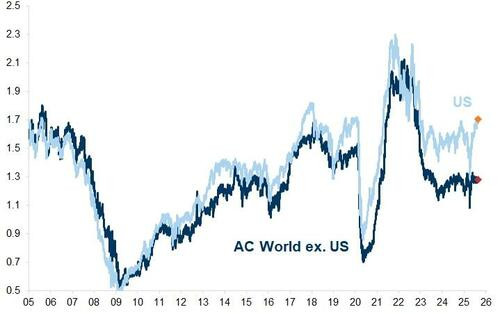
However, current valuations based on mainstream indicators for US stocks generally show signs of expansion. While European and Asian stock markets appear undervalued compared to the US, this may not hold true when compared to their own historical levels.
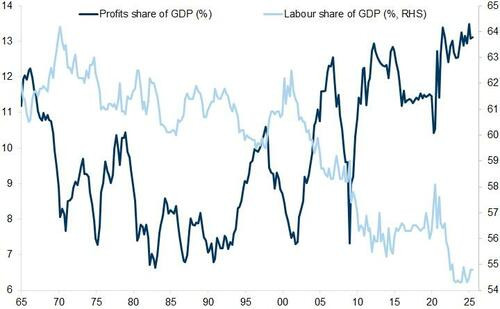
Measured as a share of GDP, corporate profit margins also exhibit an expansionary trend.
Moreover, there is little room for interest rates to decline—thus absolute returns may be lower.
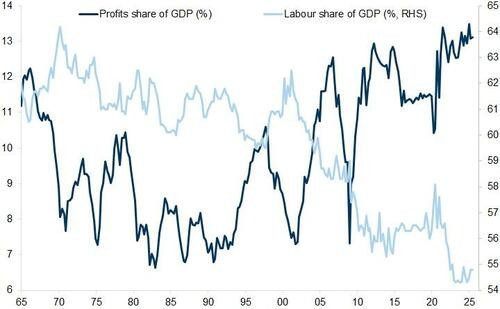
For these reasons, Oppenheimer and his team believe that future returns from broad market indices like the S&P 500 may be disappointing.
“Overall, while we believe the current high valuations in the market are justified, there is limited room for price-to-earnings expansion to contribute to returns. We expect annualized returns at the index level to be more muted compared to the super cycles of 1945-1968, 1982-2000, and 2009-2022,” Oppenheimer wrote in the report.
The ‘Fertile Ground’ for Alpha
However, Oppenheimer also believes the current environment is fertile ground for generating excess returns, as the gap between winners and losers within industries and factors continues to widen.
Although the key drivers of past super cycles are turning into headwinds, other macroeconomic trends are building, creating significant opportunities for investors and offering a broader space for diversification and differentiated investing.
These trends are likely to produce marked return disparities between winners and losers (as seen in the last cycle), but the range of factors, industries, and stocks available for selection will be even wider.
Specifically, tech stocks remain a strong growth engine, but their influence on the market is evolving. Over the past few decades, global stock market returns have been dominated by US information technology stocks and companies typically classified as big tech, such as Amazon and Meta.
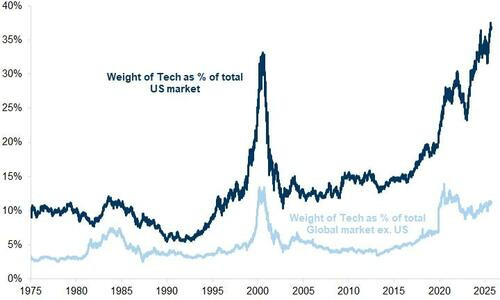
However, Oppenheimer suggests this may change as the AI revolution begins to bear fruit.
More companies are starting to leverage this technology to boost productivity. Soon, the gap between winners and losers across industries, investment styles, and regions could become even more pronounced.
AI is driving innovation, but its potential release increasingly depends on infrastructure upgrades—creating opportunities for digital and physical assets within both growth and value stocks.
Furthermore, the prospect of improved productivity may bring opportunities to the service and manufacturing sectors.
Opportunities for market diversification are increasing. In this “free-combination” market, investors’ focus may need to extend beyond the highly concentrated areas of the past.
In recent years, the success of new-generation US stock market leaders like Nvidia and Microsoft has led to increasing concentration in global stock markets.
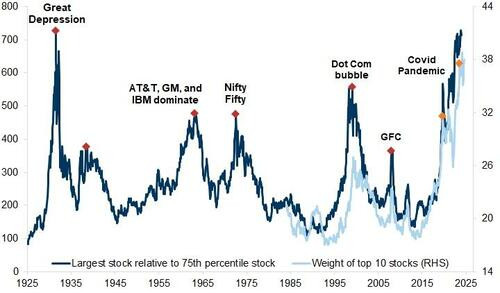
High concentration may not stem from unsustainable bubbles but could result from a few giant companies successfully monopolizing specific sectors—as seen in the recent US tech industry. However, rising concentration does increase the individual stock risk faced by investors.
Given the diminishing opportunities for diversification through bond allocations, the Goldman team believes stock investors should focus on diversification both within the tech sector and across industries.
As alpha opportunities improve, regional, industry, and factor diversification strategies are poised to deliver returns.
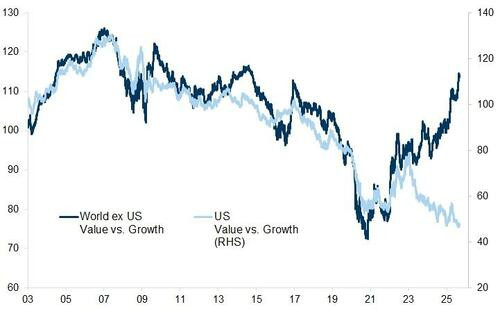
In the decade following the financial crisis, the dominance of growth factors over value factors will gradually fade.
Oppenheimer also noted that the current market environment is becoming more diverse, with multiple investment factors operating simultaneously. Investors should consider expanding their stock selection beyond the US.
As companies invest more in long-term assets to enhance productivity and innovation, Europe may harbor some particularly attractive opportunities.