
APAC Market Wrap - 4 Sep

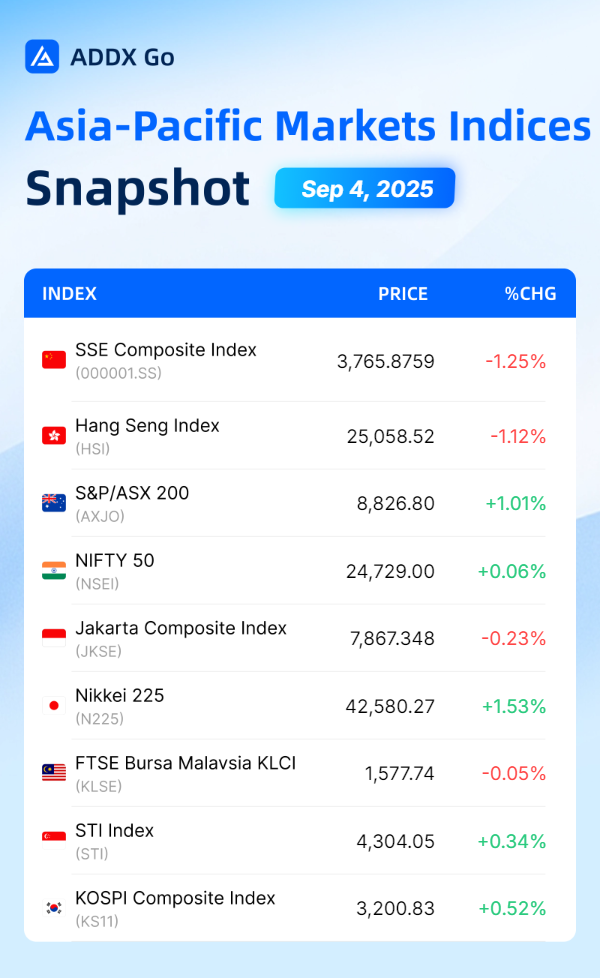
China Stock Market: The market oscillated downward throughout the day. At the close, the Shanghai Composite Index fell 1.25%, the Shenzhen Component Index dropped 2.83%, and the ChiNext Index declined 4.25%.
By sector, retail, food, paper, and photovoltaic sectors led the gains, while CPO, semiconductors, components, and military industries saw the largest declines.
Hong Kong Stock Market: The three major Hong Kong indices continued their downward trend. At the close, the Hang Seng Index fell 1.12% to 25,058.51 points; the Tech Index dropped 1.85% to 5,578.86 points; and the State-Owned Enterprises Index declined 1.25% to 8,937.09 points.
Market performance showed most auto, pharmaceutical, and semiconductor stocks weakening, while energy storage stocks bucked the trend with gains.
Japan Stock Market: The Nikkei 225 Average rebounded sharply by 1.53%, closing at 42,580.27 yen , up 641.38 yen. By sector, 29 sectors including banking, non-ferrous metals, insurance, information, and telecommunications rose, while mining, rubber products, textiles, and chemicals fell.
South Korea Stock Market: The KOSPI index rose 0.52% to 3,200.83 points. Sectors such as department stores, oil and gas, healthcare management, and hotels led the gains, while electrical equipment, shipping, and banking sectors lagged.
Australia Stock Market: The S&P/ASX 200 (XJO) rose 1.00%, closing at 8,826.500 points. Sectors including semiconductors, aerospace, and diversified financials advanced, while medical distribution, packaging and containers, apparel, and education saw significant declines.
Singapore Stock Market: The Straits Times Index rose 0.17%, closing at 4,296.83 points. By sector, business services, credit, and waste management saw slight gains, while auto and parts, diversified financials, and cyclical retail experienced larger declines.
Malaysia Stock Market: The FTSE Malaysia KLCI fell 0.02% to 1,578.15 points. By sector, financial services and real estate investment saw modest gains, while healthcare, energy, and business trusts declined.
Key Events
Japan 30-Year Bond Auction Disappoints, When Will Global Long-Bond Sell-Off End?
The bid-to-cover ratio for Japan’s 30-year bond auction was 3.31, slightly below the 12-month average of 3.38, aligning roughly with the average and providing temporary relief to the global bond market recently hit by surging government spending.
However, analysts warn this is merely a tactical respite, not a trend reversal. Analyst Spencer Hakimian predicts more global bond selling tonight, with yields likely to rise further.
This week, global long-term bonds have remained under pressure, with long-term yields in developed markets like the US, UK, Japan, and France hitting multi-year highs. The UK 30-year bond yield reached its highest since 1998 on Tuesday, the US 30-year Treasury yield briefly touched 5%, and Japan’s latest 30-year bond auction also underperformed.
On Thursday, Japan’s 30-year bond auction bid-to-cover ratio was 3.31, slightly below the 12-month average of 3.38, aligning with the average and offering a brief respite to the global bond market strained by increased government expenditure.
The auction results triggered buying across Japan’s bond maturities, with long-term bond yields retreating from multi-decade highs, but analysts caution this is only a tactical relief, not a shift in trend.
Japan, US Nearing Deal to Lower Auto Tariffs, Sources Say
A Japanese government source revealed that Japan and the US are in the final stages of negotiations, planning to implement lower tariffs on Japanese cars exported to the US within 10 to 14 days of the US president signing an executive order.
The source indicated that this would reduce the current 27.5% tariff on Japanese cars to 15%, with the new rule expected to take effect by the end of this month. As this matter remains undisclosed, the source requested anonymity.
The source noted that the exact effective date in the executive order is still under discussion, with final authority resting with US President Donald Trump.
Malaysia Central Bank Holds Rates Steady, Assesses Tariff Growth Risks
Malaysia maintained its benchmark interest rate unchanged, with the central bank weighing the impact of recent easing policies and growth risks from US tariffs.
The central bank kept the overnight policy rate at 2.75% on Thursday, with 22 of 24 economists surveyed by institutions expecting no change. The remaining economists anticipated a further 25-basis-point cut following July’s rate reduction.
India Lowers Consumption Tax to Counter Tariff Impact, Exporters Seek Currency Support
As US tariffs heighten economic risks for India, policymakers have decided to lower the national consumption tax to boost domestic demand, while exporters are reportedly seeking currency support suggestions from the Reserve Bank of India.
A panel of federal and state finance officials decided on Wednesday to reduce consumption taxes on most daily goods, insurance fees, and vehicles. However, taxes on cigarettes, chewing tobacco, and certain luxury cars were raised to 40%.
According to an official statement, the Goods and Services Tax Council agreed to adjust the existing four-tier tax structure to two rates of 5% and 18%. The new rates will take effect on September 22, excluding cigarettes and chewing tobacco.
Institutional Views
Goldman Sachs: Fed Credibility Loss Could Push Gold to $5,000/oz
Goldman Sachs stated that if the Federal Reserve’s credibility is damaged, investors shifting a small portion of US Treasuries into gold could drive prices to nearly $5,000 per ounce.
Analysts, including Samantha Dart, noted in a report: “A loss of Fed independence could lead to rising inflation, falling stock and long-bond prices, and erosion of the dollar’s reserve currency status. In contrast, gold is a value store independent of institutional trust.”
The report outlined a range of gold price scenarios, with a base case of $4,000/oz by mid-2026, a tail-risk case of $4,500/oz, and a potential $5,000/oz if 1% of private US Treasury funds flow into gold.
JPMorgan: Gold Price to Hit $3,675/oz by Year-End
JPMorgan analyst Patrick Jones indicated that Fed rate cuts meeting or exceeding expectations should drive further inflows into gold ETFs, pushing gold prices to around $3,675 per ounce by year-end. Based on this, prices could reach $4,000 in Q2 next year and surge to $4,250 by the end of 2026, especially if the Trump administration succeeds in removing Fed Governor Cook.
HSBC: Raises S&P 500 Year-End Target to 6,500
HSBC issued a report raising its S&P 500 year-end target from 6,400 to 6,500, marking the second upward revision in less than a month, driven by better-than-expected Q2 corporate earnings. HSBC highlighted strong momentum in tech and financial stocks, with companies reporting mild tariff impacts.
The bank expects a Fed rate cut in September, totaling a 0.75% reduction by 2026, compared to the market’s consensus of over 1.25%. HSBC also raised its S&P 500 earnings-per-share growth forecast for the year from 9% to 12% (market average 11%), adjusting the year-end target accordingly, with a bull case of 7,000 and a bear case of 5,700.
Goldman Sachs: Brent Crude to Fall to $50/bbl Next Year Due to Oversupply
According to Goldman Sachs, global oil oversupply will drive the Brent crude benchmark price to just above $50 per barrel next year. Analysts, including Samantha Dart, reported that the current petroleum market’s surplus is intensifying.
They stated: “We expect strong non-OPEC supply growth outside the US to create a global market surplus of 1.8 million barrels per day in 2026, ultimately pushing Brent to just above $50 per barrel by year-end.” However, with OPEC+ spare capacity declining, the oil market remains vulnerable to price spikes from supply disruptions.
Scotiabank: USD/JPY Momentum Turns Bullish
Scotiabank Chief Forex Strategist Shaun Osborne and Eric Theoret noted that Tuesday’s global bond market volatility appears to have eased, but high yields remain a risk for the yen and a core concern for the Bank of Japan—similar to conditions in April, which prompted the BOJ to pause its tightening cycle.
For USD/JPY, the pair has broken above its 200-day moving average (148.86), forming a bullish breakout, suggesting potential to test the 150 level and recent highs near 151. The current USD/JPY momentum is bullish, with a Relative Strength Index (RSI) of 57.
RBC: Rising Japanese Yields Signal ‘Seismic Shift’ for Domestic Investors
RBC Capital Markets highlighted that as rising Japanese yields attract domestic investors to keep funds at home rather than in foreign assets, global currency and interest rate markets are undergoing a major transformation.
“In the near future, Japanese investors’ attitudes toward buying bonds at any point on the Japanese yield curve will align with their approach to US Treasuries,” the bank said. Since the Bank of Japan abandoned its ultra-loose monetary policy a year ago, the sustained rise in Japanese government debt yields has been a focal point for global investors—also flagged as a risk to US bond demand.
Despite this, foreign demand for US Treasuries remains resilient, though the recent surge in Japanese long-term yields, outpacing major peers, has dragged down returns on these securities.