
US-Japan Trade Agreement Finalized, Trump Signs Executive Order!

On Thursday local time, the White House announced that US President Trump signed an executive order to formally implement the US-Japan trade agreement, imposing a maximum 15% tariff on most Japanese goods exported to the US, including automobiles and parts.
According to reports, the executive order will clarify tariff adjustment measures, ensuring that Japanese imports previously subject to higher tariffs are not double-taxed, while goods previously taxed below 15% will be adjusted to the new rate.
Additionally, the White House stated that Japan is committed to accelerating a plan to increase US rice purchases by 75%.
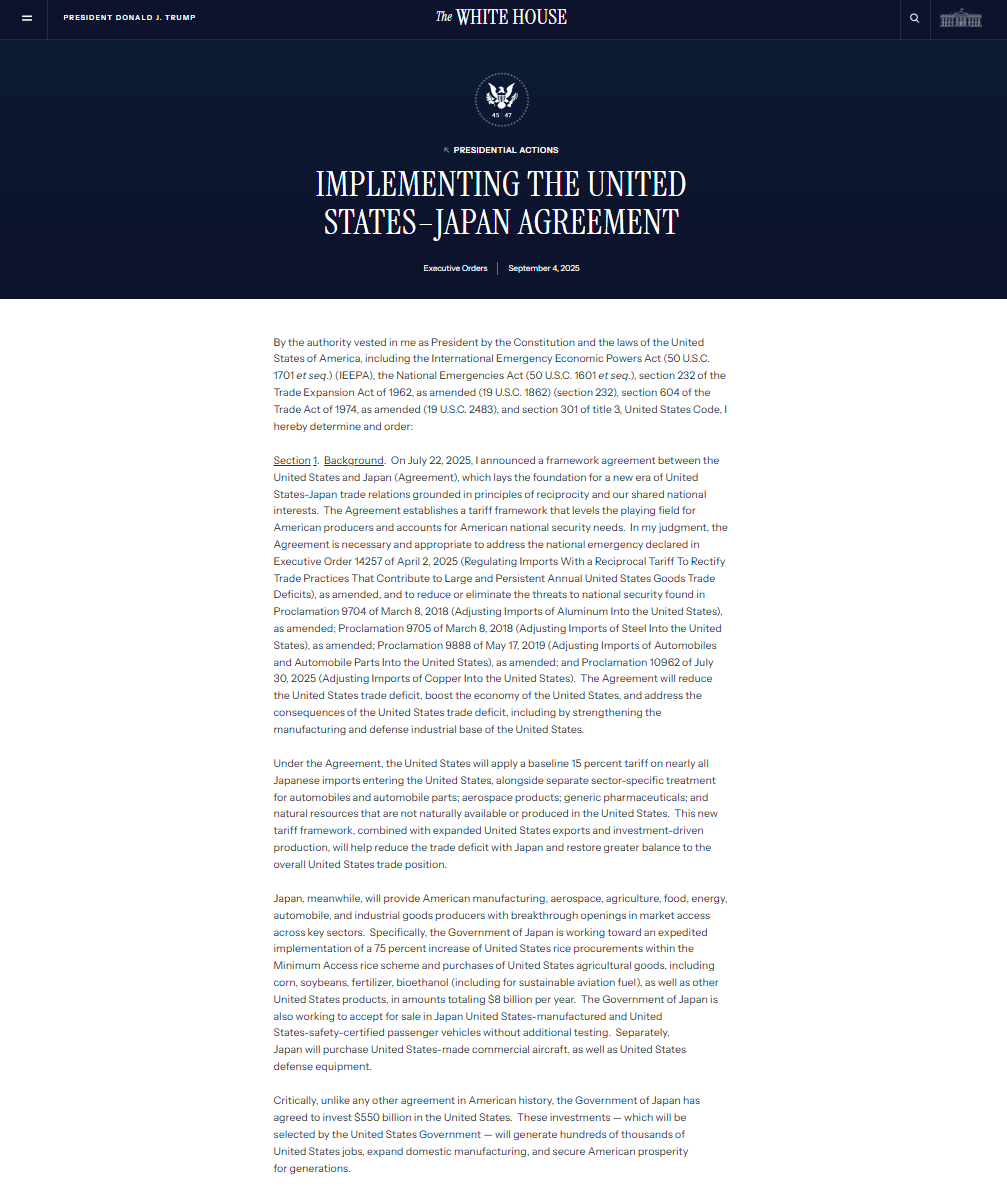
The executive order states: “Under this agreement, the US will impose a baseline 15% tariff on nearly all Japanese imports entering the country, with separate industry-specific treatments for automobiles and auto parts, aerospace products, generic drugs, and natural resources that the US cannot naturally obtain or produce.”
Meanwhile, the White House noted that Japan will provide breakthrough market access in key sectors for US manufacturers, aerospace, agriculture, food, energy, automotive, and industrial goods producers.
Specifically, the Japanese government is working to expedite the “minimum access” rice program, increasing US rice purchases by 75%, and procuring US agricultural products—including corn, soybeans, fertilizers, bioethanol, and others—totaling $8 billion annually.
Additionally, the statement said Japan is committed to allowing the sale of US-manufactured, US-safety-certified passenger vehicles in Japan without additional testing. Japan will also purchase US-manufactured commercial aircraft and US defense equipment.
“Of critical importance, unlike any other agreement in US history, the Japanese government has agreed to invest $550 billion in the US. These investments—selected by the US government—will create hundreds of thousands of American jobs, expand domestic manufacturing, and ensure prosperity for generations of Americans,” the White House added.
Notably, the agreement was reached in July, but negotiations on specific terms between the US and Japan have continued until now. The Japanese government has been pushing for the agreement’s finalization in recent weeks, and the executive order was issued hours after the 10th round of talks between Japan’s chief negotiator Ryosei Akazawa and Trump’s trade team.
The signing of this executive order reduces uncertainty for Japan’s massive auto industry, a pillar of its economy and a key issue in the negotiations. According to the statement, the lower tariffs on Japanese autos will take effect seven days after the order’s announcement, with some tariff reductions retroactive to August 7.
US automakers expressed dissatisfaction with this tariff arrangement. The Alliance for Auto Innovation, representing Detroit’s Big Three automakers, pointed out that the 15% tariff on Japanese imports is significantly lower than the 25% rate on goods from Canada and Mexico.
This means vehicles produced in Japan with fewer US parts will enjoy lower tariffs compared to those made in North America with substantial US components, which the group argues disadvantages the US auto industry and its workers.
Furthermore, under the July agreement, Japan committed to a $550 billion investment in the US, with officials stating this figure includes investments, loans, and loan guarantees from government-supported financial institutions. Both Japan and the US view these investments as focusing on strategically important areas for both nations, such as critical minerals, semiconductors, and pharmaceuticals.
However, the Trump administration has repeatedly claimed it has absolute control over Japan’s funds, a claim Japan denies.