
Wall Street’s Next Frontier: Selling Private Assets to Individuals

Shearing sheep
September 5, 2025
GoGPT Summarizes Articles
For years, private equity, private credit, and other “alternative” investments were the playground of pensions, endowments, and the ultra-wealthy. Now the gates are opening wider — and Wall Street is lining up to sell private market exposure to everyday investors.
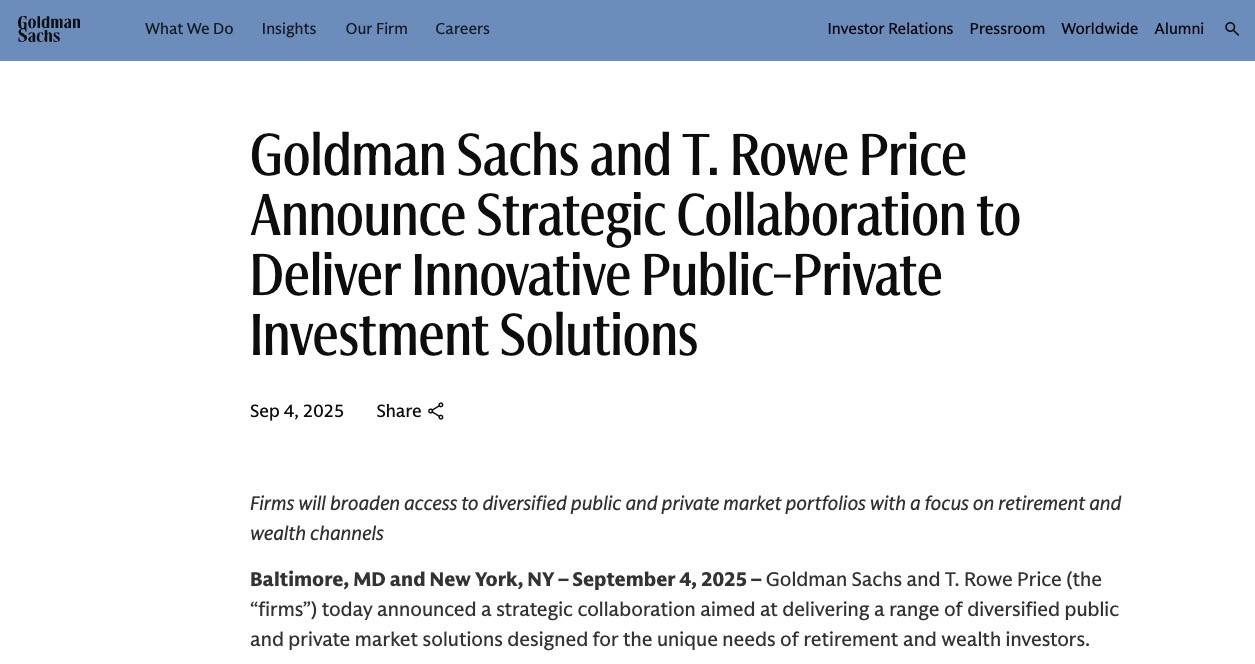
This week, Goldman announced it will invest up to $1 billion in T. Rowe Price, becoming one of its largest shareholders with as much as a 3.5% stake. More importantly, the two firms are teaming up to create new investment products that mix public stocks and bonds with private market assets, targeting retirement accounts and wealth management clients.
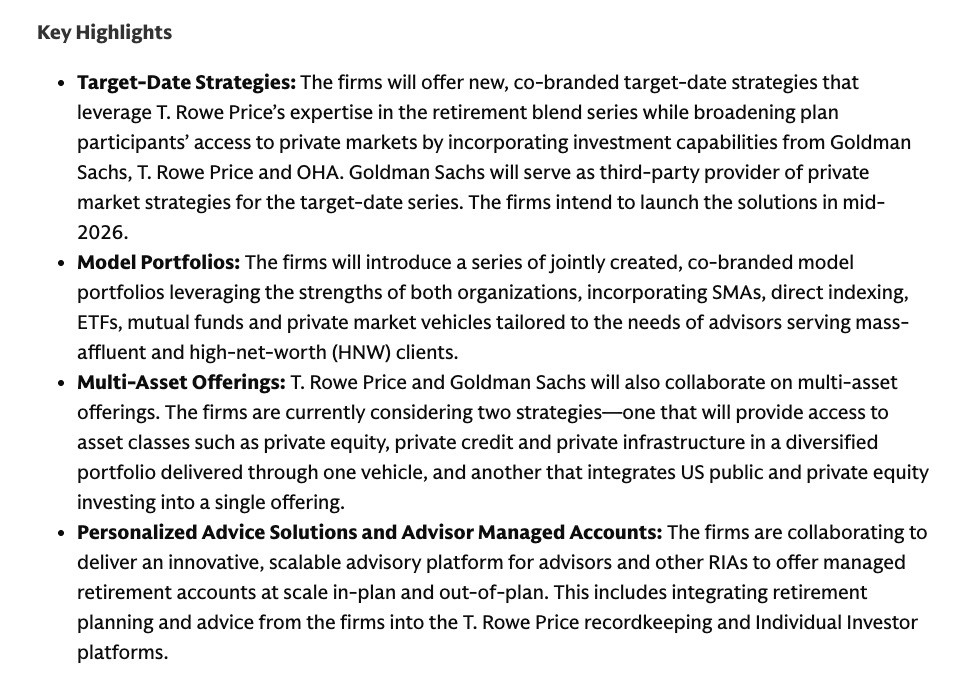
Beginning in 2026, the partnership will introduce retirement-oriented funds that weave Goldman’s private strategies into T. Rowe’s well-known target-date products. It will also develop co-branded portfolios for financial advisors, combining ETFs, mutual funds, direct indexing, and private vehicles, along with broader multi-asset solutions that put private equity, private credit, and infrastructure alongside traditional markets.
The idea is to bring what was once exclusive to institutions into the portfolios of mass-affluent and high-net-worth individuals, and eventually, into personalized retirement accounts at scale.
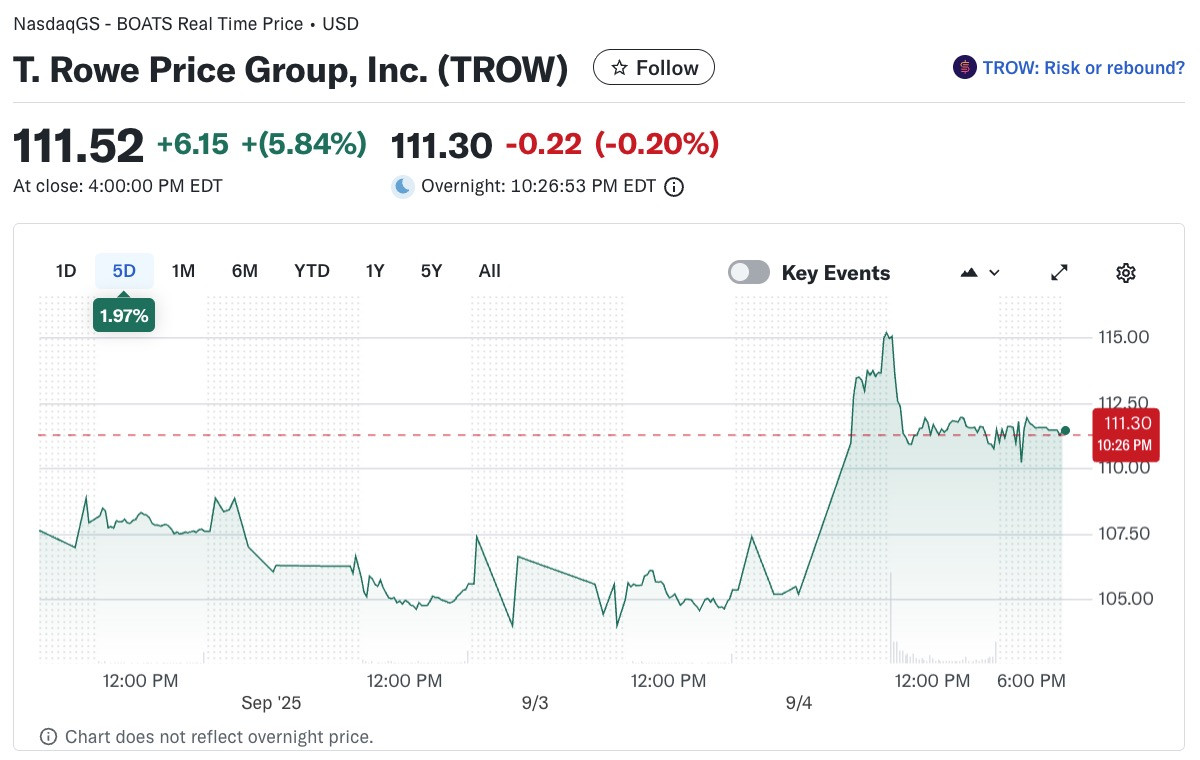
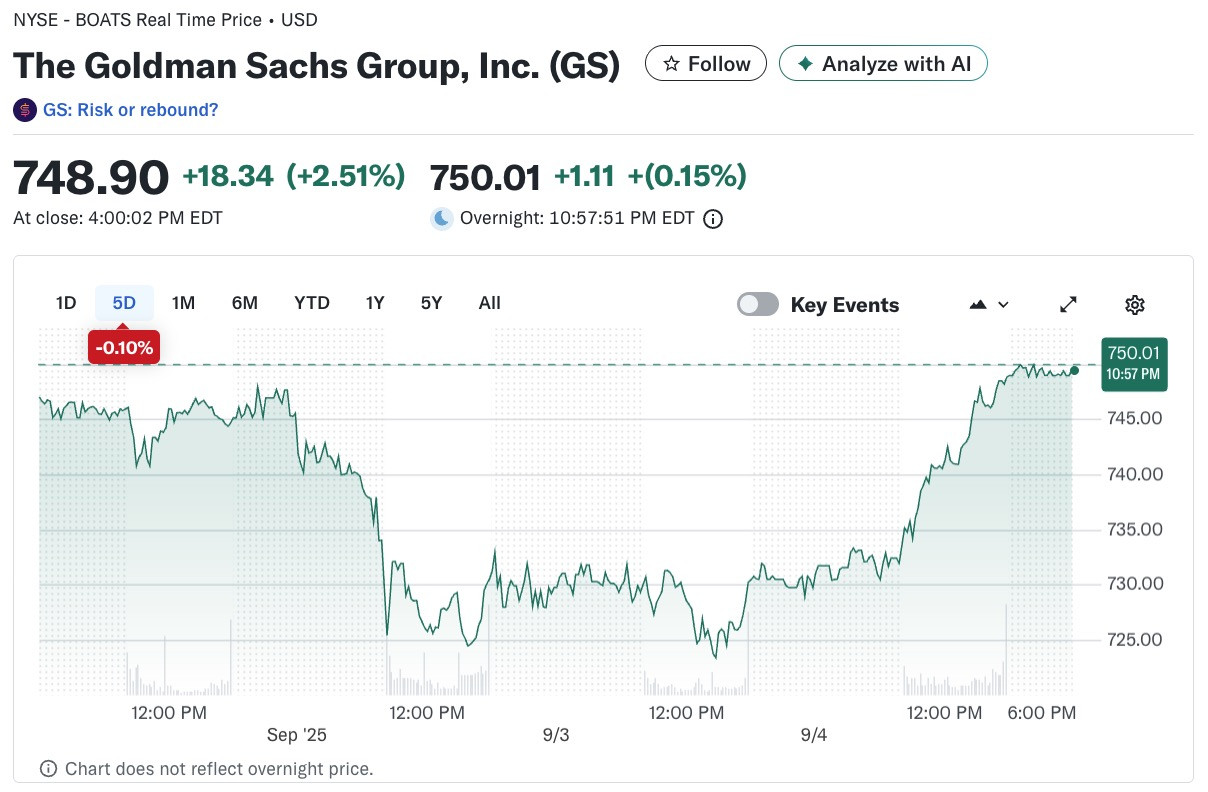
Markets liked the news: T. Rowe Price’s ($TROW) shares jumped 5.8%, while Goldman Sachs ($GS) rose 2.5% after the announcement.
Why It Matters
This isn’t just about one deal. It’s part of a broader shift. It reflects two big forces shaping asset management today.
On one side, traditional firms like T. Rowe are under pressure. Actively managed mutual funds have been bleeding assets for years as investors flock to low-cost ETFs, leaving T. Rowe’s stock down more than 20% over the past five years (excluding dividends). Gaining access to Goldman’s alternative strategies provides a new growth avenue and the chance to offer products that stand out in a crowded field.
On the other side, firms like Goldman, long dominant in private equity and credit, are facing softer demand from their traditional base of pensions and sovereign wealth funds. With trillions of dollars sitting in retail retirement accounts, the growth opportunity now lies with individuals — and partnering with a household name like T. Rowe provides the distribution muscle to reach them.
The Bigger Trend
Goldman and T. Rowe are hardly alone. The asset management landscape is shifting toward alliances between traditional mutual fund giants and private market specialists.
In recent years, Vanguard has partnered with Wellington Management and Blackstone, Capital Group has teamed up with KKR, and BlackRock has gone on an acquisition spree to build its private credit and infrastructure platforms.
Put together, these moves underline a simple reality: asset managers see the retail market as the next frontier for alternatives. U.S. retirement savings alone represent tens of trillions of dollars, and even a small reallocation toward private assets would create an enormous new fee pool.
This shift is also being nudged along by regulation. Just last month, former President Trump signed an executive order allowing private equity and credit to be included in 401(k) retirement plans. That effectively lowers the barriers for ordinary Americans to invest in alternatives through their workplace retirement savings.
If this rule holds, it could redirect billions — even trillions — of retirement dollars toward private markets over the next decade.
My Take
On the surface, this looks like a win-win. Investors get more diversified portfolios with potential for higher returns. Asset managers get new sources of fee income at a time when traditional business lines are under pressure.
But there are real risks. Private assets are by nature illiquid and often come with complex fee structures. Unlike an S&P 500 ETF you can sell with one click, private equity funds may lock up capital for years. Retail investors saving for retirement may not fully understand those risks.
There’s also a bigger philosophical question: are Wall Street firms expanding access to alternatives because it genuinely helps long-term savers, or because they see a lucrative fee pool? Probably a bit of both.
Either way, the direction is clear. The retailization of alternatives is one of the biggest structural shifts happening in finance right now. Goldman and T. Rowe’s deal is just the latest move in what’s shaping up to be a fierce competition among asset managers to dominate this new frontier.
#Private Market: Unlocking Potential#$T Rowe Price Group Inc(TROW)#$Goldman Sachs Group Inc.(GS)