
Figma Earnings Shock, Stock Halved Since IPO

Silicon Valley’s rising software star Figma (FIG.US) released its first earnings report since its July IPO, with Q2 results falling short of Wall Street expectations. The stock plummeted nearly 20% on Thursday, closing at $54.56.
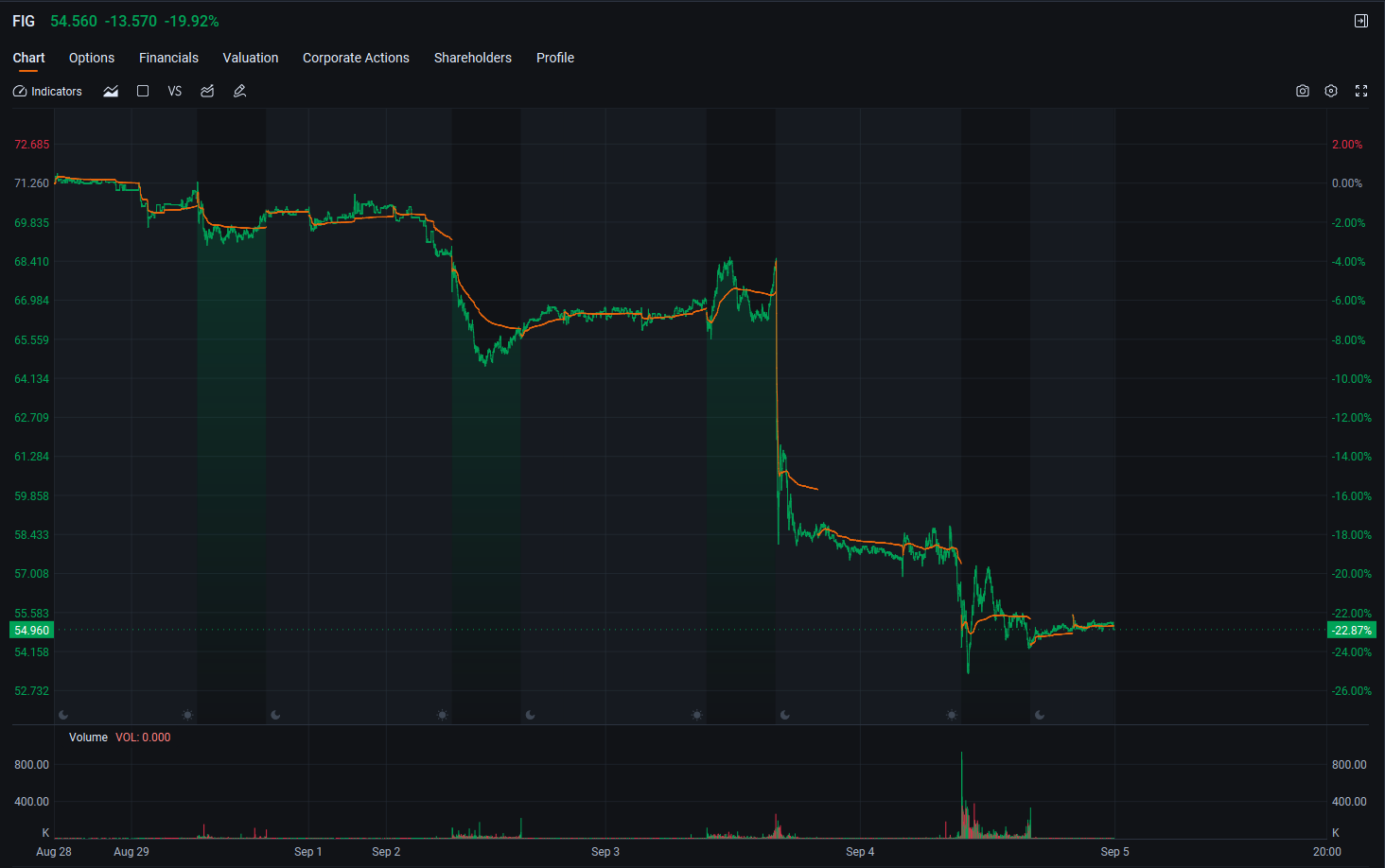
Wall Street believes this earnings report and future outlook fail to justify the company’s valuation, which significantly exceeds that of its software peers, prompting heavy selling.
The peak came at listing, with Figma’s stock dropping over 60% from its high of $142.92 in the two months since its IPO!
Disappointing earnings report
The latest earnings report shows Figma reported Q2 total revenue (for the quarter ended June 30, 2025) at approximately $249.6 million, up 41% year-over-year, but slightly below the Wall Street consensus estimate of $250 million.
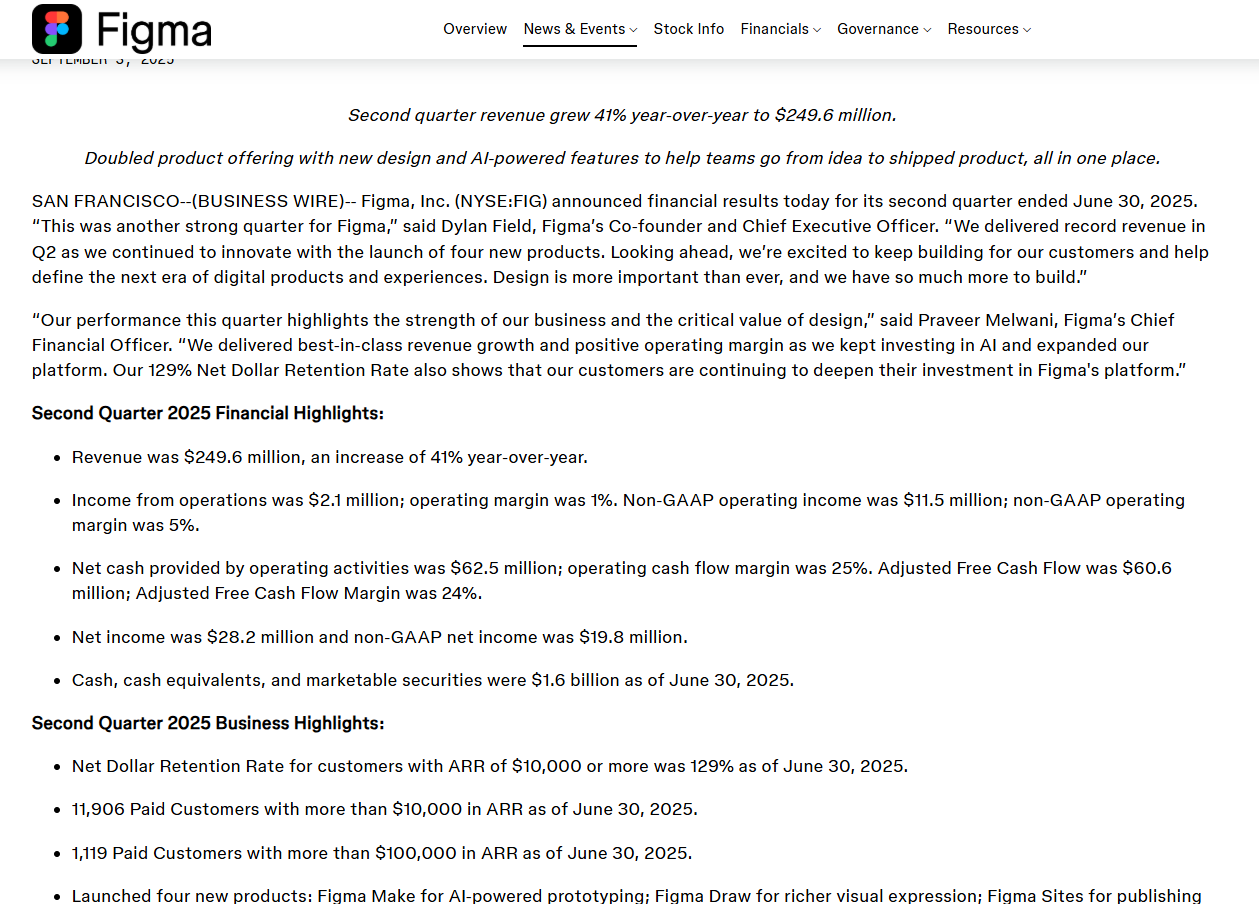
Under GAAP, the company posted a net profit of about $846,000 in Q2, compared to a loss of approximately $827.9 million in Q2 2024. This translates to essentially break-even earnings per share (EPS of $0), falling short of Wall Street’s average expectation of $0.09 per share.
The earnings report highlights Figma’s net revenue retention rate at 129%, a critical operating metric for software companies, reflecting expansion from existing customers.
In its statement, Figma reported a 41% year-over-year revenue increase in Q2, rising from $177.2 million a year ago to $249.6 million, aligning with the preliminary range of $247 million to $250 million provided in its July IPO regulatory filings. The company’s adjusted (non-GAAP) operating profit for Q2 was approximately $11.5 million, within the preliminary range of $9 million to $12 million previously provided.
For Q3, Figma forecasts total revenue between $263 million and $265 million, implying a mid-range growth of about 33%, surpassing Wall Street’s average estimate of $262 million. However, for a highly valued company like Figma, this slightly above-expectation guidance fails to meet market expectations.
For the full year, management projects adjusted operating profit between $88 million and $98 million, with total revenue expected between $1.021 billion and $1.025 billion. The mid-point of this revenue range suggests a 37% annual growth rate, marginally above Wall Street’s $1.022 billion consensus, yet it still falls short of satisfying market appetite for Figma’s high valuation.
Who Is Figma, Nearly Acquired by Adobe?
As Figma officially debuted on the US stock market, it has been over a year since its merger plan with Adobe—the developer of popular creative software like Photoshop and Illustrator—fell through.
Figma is a platform software company focused on cloud-based collaborative design and product development, with core products including Figma Design, FigJam, and Dev Mode.
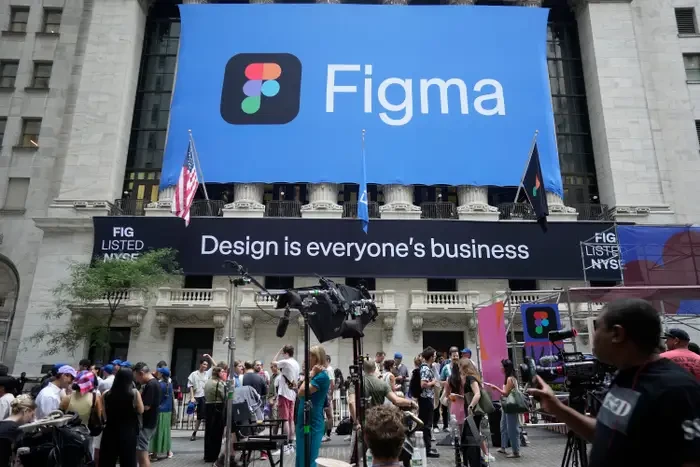
The company listed on the New York Stock Exchange on July 31, 2025, under the ticker FIG. Figma’s software platform stands out not just as a “design tool” but as a collaborative product development platform: designers serve as the entry point, subsequently penetrating product, engineering, marketing, and operations roles.
A major Wall Street brokerage estimates its potential market for design and adjacent roles at approximately $26 billion, highlighting low penetration and a long growth runway.
From a business scope and product strength perspective, end-to-end workflow is a core advantage of the Figma platform: completing idea generation (FigJam), interface design and componentization (Design/Variables/Auto Layout), prototyping and animation (Prototyping), and large-scale design engineering delivery workflows (Dev Mode specs, code snippets, design variables) all within the same platform.
Its other two strengths are the industry’s most robust cross-role collaboration and Figma’s unique design and development ecosystem.
Since last year, Figma has seen strong revenue growth from selling Dev Mode to clients. CEO and co-founder Dylan Field noted in an interview that this strong momentum and high base are suppressing Q3 revenue growth rates.
In Q2, Figma launched Figma Make (an AI tool generating app and website designs based on user descriptions) and Figma Sites (converting design blueprints into functional websites). The company also acquired vector graphics startup Modyfi and content management system startup Payload.
Figma has not yet begun charging fully for its AI-based software products but has factored the underlying costs into its model. The company did not provide Q3 adjusted operating profit guidance.
“We plan to inform customers that they’ll have the option to purchase additional AI credits in the future,” CFO Praveer Melwani said during the analyst call.
Figma is effectively turning AI large language models into a dual amplifier of efficiency and product boundaries, not fully automating all processes but accelerating and expanding creative space through human-AI collaboration.
At the 2025 Config conference, Figma unveiled major new products like Sites, Make, Buzz, and Draw, deeply integrating generative AI tools into website building, prototyping, brand asset generation, and vector creation, broadening its AI-driven software product coverage from design to deployment.
Post-IPO, Figma expects the lock-up period on 25% of employee-held shares to expire after the close on September 4. Investors holding slightly more than half of Figma’s issued Class A shares have agreed to extend the lock-up, with the remaining 35% set to expire in August 2026.
Filings show that as of June 30, the company held approximately $1.6 billion in cash, cash equivalents, and marketable securities, including $90.8 million in Bitcoin exchange-traded funds (ETFs).
“We don’t intend to become Michael Saylor,” Field said in the interview, referring to Strategy’s co-founder and executive chairman. “This isn’t a Bitcoin vault company. It’s a design company, but I think it has a place in our balance sheet and diversified treasury strategy.”
Wall Street Analysts Take a Cautious Stance on Figma: Strong Software Product but Overvalued
Due to its high valuation, most Wall Street analysts covering Figma have assigned cautious ratings like “Neutral” or “Perform” (in line with the market), rather than bullish “Buy” or “Outperform” ratings.
Undoubtedly, Figma’s AI-integrated design and product development platform has impressed Wall Street, but top analysts refrain from optimistic upgrades due to its lofty valuation. Their 12-month target prices are relatively conservative, suggesting Figma’s stock is unlikely to replicate the explosive gains seen at its IPO.
Overall, major Wall Street investment firms highly praise Figma’s product portfolio and large customer base, viewing its comprehensive product strength as leading the software SaaS industry. However, its extremely high valuation since listing has caused anxiety.
“While investors may worry that AI applications from leaders like OpenAI could simplify app design/development and compete with Figma, we believe AI could be a true tailwind for Figma,” RBC analysts led by Rishi Jaluria wrote in a Monday investor note.
“We note the company is actively embedding AI across its software platform, including its new Figma Make (AI-driven prototyping tool), FigJam AI, and Dev Mode MCP server. These investments may pressure margins in the short term but are positive drivers for long-term growth.”
RBC suggests the market’s valuation of Figma implies a 32x 2026E revenue multiple, compared to about 10x for general software peers, leading to a “In Line with Market” rating and a $75 initial target price.
Similarly, Morgan Stanley initiated coverage with a “Neutral” rating and an $80 target price; JPMorgan also started with a “Neutral” rating but set a lower $65 target.
“Our $65 target price through December 2025 is based on an approximately 30x EV/CY26E revenue multiple, compared to 12x for comparable software companies,” JPMorgan analysts led by Mark Murphy wrote in a report. “A moderate premium is reasonable due to upside potential, early-stage new product categories, and AI monetization expectations, but an excessive premium isn’t rational.”
Meanwhile, Goldman Sachs initiated coverage with a “Neutral” rating and the most bearish $48 target price, implying significant downside ahead.