
Google’s Moment: Can a Court Win and AI Push Take It Past $3 Trillion?

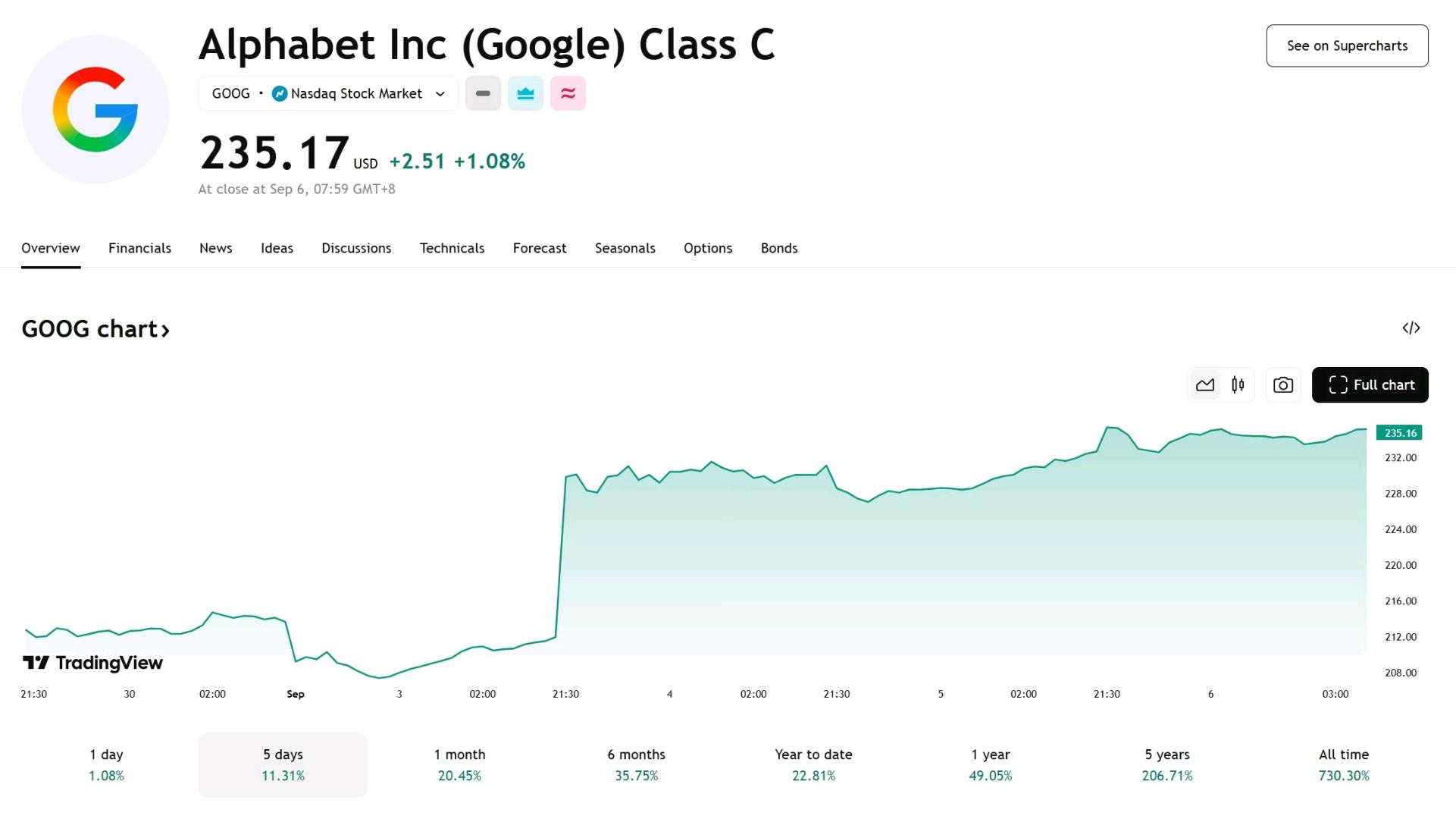
A U.S. district judge’s ruling that spared $GOOGL from the harshest remedies in a long-running antitrust suit cleared a central regulatory overhang and helped propel the stock up sharply — pushing $GOOGL ’s market value to roughly $2.81–2.82 trillion, within striking distance of the $3 trillion club.

Coupled with a robust Q2 that showed AI-driven revenue strength and a steady rollout of Gemini-powered products, Wall Street is increasingly confident $GOOGL can defend its search franchise.
But the victory is partial: the court banned certain exclusive search agreements and ordered data-sharing, $GOOGL will appeal, valuation questions remain, and fresh political noise — including President Trump’s public ire at EU fines — keeps the outlook contested.
Key Points
- A federal judge rejected the government’s request for the most severe remedies, allowing Google to keep Chrome but banning certain exclusive search contracts and ordering search-data sharing. Google intends to appeal.
- Alphabet’s market cap jumped to about $2.81–2.82 trillion after two trading days of gains; the stock rose ~10% in that span.
- Analysts point to accelerating AI revenue and new Gemini features — and the Pixel phone reception — as reasons for optimism.
- Several firms raised price targets (KeyBanc, Oppenheimer, Needham); some analysts remain cautious (Rosenblatt).
- Risks: competitive threats to search from AI startups, technical/valuation overheating (RSI surged above 80), and political friction including EU fines and possible trade actions.
What exactly did the court decide — did Google dodge a breakup?
A U.S. district judge refused the Justice Department’s most severe remedy — divestiture of Chrome and other key assets — removing the prospect of a corporate “break-up.”
But the court did not give $GOOGL a clean bill of health: it barred exclusive search contracts intended to lock in dominance and ordered sharing of certain search data. $GOOGL has said it will appeal parts of the judgment.
Why did markets rally — is this relief or a fresh growth story?
Investors reacted to the removal of the most existential regulatory threat. Two trading days of gains took Alphabet sharply higher as the “worst-case” breakup scenario faded.
At the same time, quarterly results showing AI-driven sales momentum and promising product rollouts (including AI features and a Gemini push) gave the rally a growth narrative beyond pure legal relief.
Can Google defend search — is AI its ace or a new battleground?
Wall Street increasingly bets $GOOGL ’s AI stack will protect search share. TD Cowen highlighted Gemini and new AI search features as reinforcing Google’s lead.

Yet analysts caution that AI search competition from OpenAI and others keeps the long-run picture uncertain; some see lingering structural risk to legacy search revenues despite short-term tailwinds.
Is the stock still a bargain — cheap relative to peers or a momentum trap?
Alphabet’s trailing P/E sits near ~21x — lower than other mega-cap tech peers and below the Nasdaq-100 average. Several portfolio managers called the shares attractively priced, given growth prospects in cloud, AI products, and Waymo.
But technical metrics show exuberance: the 14-day RSI rose above 83, a level rarely sustained. Some analysts warn that near-term upside may be limited as targets tighten with the run-up.
Which analysts raised targets — and who stayed cautious?
Multiple houses adjusted valuations after the ruling and earnings. KeyBanc raised targets and reiterated an overweight stance, Oppenheimer lifted theirs, Needham reaffirmed buy ratings, and Citi maintained a buy with a note that litigation could stretch for years.
Rosenblatt’s Barton Crockett urged restraint: while the immediate legal risk eased, long-run competition for search will cap valuation multiples, and he kept a neutral view.
How big is the AI story — are products already contributing meaningfully?
Alphabet’s Q2 showed AI demand supporting sales, and executives have rolled out Gemini-backed services and features. The Pixel phone’s AI functions also drew positive reception. Analysts say these developments strengthen the case that Google can both defend and extend its core franchises, converting product innovation into revenue growth over time.
What political noise could undermine gains — will trade fights or fines bite back?
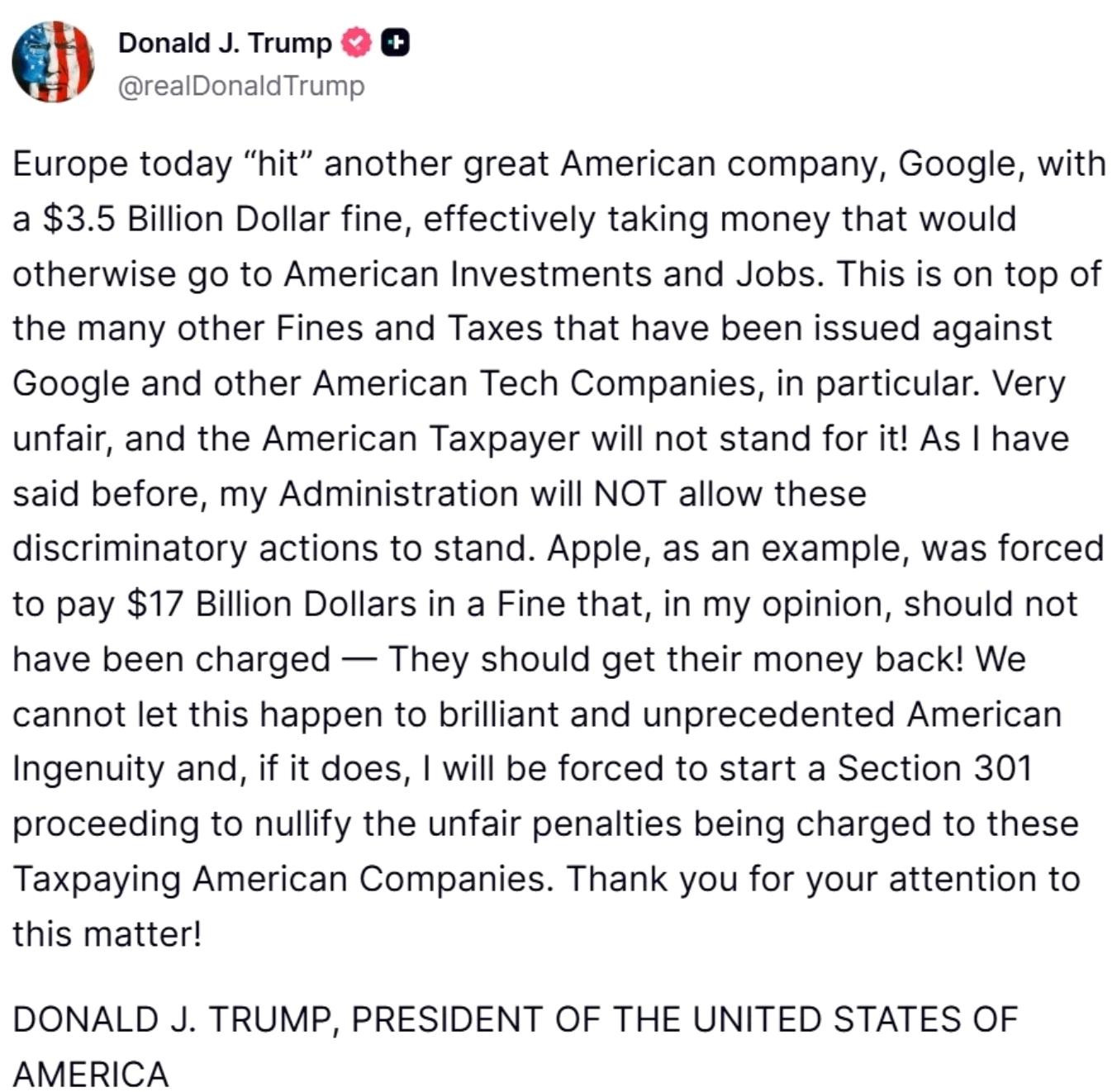
Global political friction is a wild card. President Trump publicly criticized an EU fine (reported at $3.5 billion) and threatened a U.S. trade response under Section 301 — amplifying geopolitical risk around tech regulation.
Meanwhile, Google has signaled it will appeal certain judicial limits. The combination of protracted legal fights, cross-border penalties, and political theatre leaves regulatory risk alive even as the worst breakup scenario receded.
How should investors think about risk and reward — buy, hold, or trim?
The bullish case is clear: a materially lower regulatory overhang plus tangible AI-driven revenue acceleration may justify higher multiples. Long-term holders who believe in Google’s AI roadmap and cloud expansion see value at current P/Es.
The cautious case is also clear: near-term technical overbought conditions, remaining litigation and regulatory obligations, and unresolved competitive threats argue for position sizing, hedges, or partial profit-taking rather than aggressive new exposure.
Final take — victory, but not vindication
The court decision removed the single most extreme legal outcome and gave Google breathing room to press its AI agenda. That combination quickly reshaped investor psychology and pushed the company toward the $3 trillion milestone.
Yet the win is partial: the ruling imposes constraints, appeals are likely, valuation discipline matters, and political headwinds persist. For those who bet on Google, the thesis now hinges on execution — scaling Gemini and AI products into durable revenue — and on navigating a prolonged era of regulatory scrutiny.
Watch the product milestones, litigation timeline, and macro backdrop: any of them could convert today's relief rally into longer-term outperformance — or test the stock's lofty new footing.