
Oracle Q1 FY2026 Earnings Preview: Riding the AI Cloud Wave

Shearing sheep
September 8, 2025
GoGPT Summarizes Articles
Oracle ($ORCL) is gearing up to report its fiscal first-quarter 2026 earnings on Tuesday, September 9, and expectations are running high. After a strong finish to the last fiscal year, investors are watching closely to see if the momentum in cloud and AI can carry into the new one.
Oracle has spent years trying to shake off the image of being a legacy database giant, and now it is increasingly viewed as the “fourth hyperscaler” in artificial intelligence and cloud computing—competing alongside AWS, Microsoft, and Google. The upcoming results will be another test of whether that narrative holds up.
Wall Street analysts are forecasting earnings of around $1.47 per share, which would represent a modest but steady 5.8% growth year over year. Revenue is expected to reach about $15.01 billion, a much stronger 12.8% increase compared with the same period last year.
While the EPS estimate has remained stable in recent weeks, the revenue forecast underscores the optimism around Oracle’s ability to capture a bigger share of enterprise cloud spending. Analysts have not been revising their numbers upward at the last minute, which suggests they believe Oracle’s growth story is solid but already well understood by the market.
What makes this quarter particularly interesting is the shifting composition of Oracle’s revenue. The bulk of the growth is expected to come from its cloud services and license support business, which could reach over $12 billion this quarter.
Within that, the real engine is infrastructure cloud—Oracle’s bet on building GPU-rich data centers designed to handle AI workloads. That segment is projected to grow more than 20% year over year, easily outpacing the growth of applications cloud and other traditional lines of business.
By contrast, more mature businesses such as hardware and consulting services are expected to grow only slightly, if at all, which shows just how central the cloud transformation has become to Oracle’s future.
Geographically, the Americas continue to be the backbone of growth, with analysts estimating revenue of roughly $9.5 billion for the quarter, an increase of more than 13%. Europe, the Middle East, and Africa are also expected to deliver double-digit gains, while Asia-Pacific remains weaker with single-digit growth.
That imbalance isn’t surprising—Oracle’s biggest contracts and cloud buildouts are happening in North America and Europe—but it does highlight the challenge of turning its global reach into evenly distributed growth.
Investors are still buzzing about Oracle’s performance in the previous quarter. In Q4 of fiscal 2025, the company surprised the Street with stronger-than-expected results, posting earnings of $1.70 per share and revenue close to $16 billion.
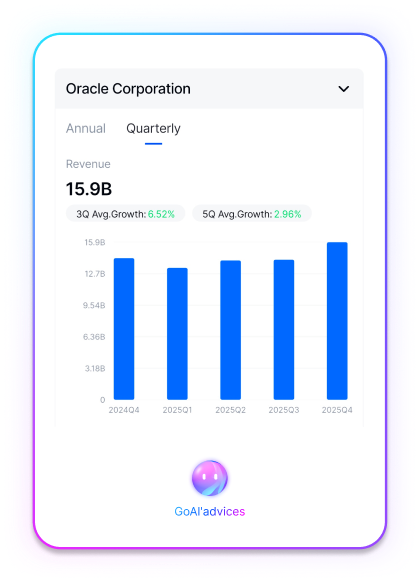
The standout was, once again, the cloud business. Management didn’t just celebrate the win; they raised full-year guidance for fiscal 2026, projecting annual revenue growth in the mid-teens and cloud growth that could accelerate above 40%.
For a company that was once dismissed as a laggard in the cloud wars, that was a bold signal—and one that set a high bar for the coming quarters.
Part of the enthusiasm stems from Oracle’s aggressive investment strategy. The company spent more than $21 billion in capital expenditures in FY2025, much of it tied directly to expanding cloud infrastructure capacity.
Unlike some peers who build ahead of demand, Oracle claims it only builds capacity once contracts are already signed. That means much of the capex is backed by predictable future revenue.
According to an SEC filing and multiple news reports, Oracle has signed a single cloud services agreement—widely believed to be with OpenAI’s Stargate initiative—that is expected to contribute over $30 billion in annual revenue starting in fiscal year 2028.
Analysts have highlighted this as a watershed moment in Oracle’s transformation into a hyperscale AI cloud infrastructure provider, signaling a multi-year revenue runway and significantly higher RPO visibility.
Still, this approach comes with risk. The heavy investment in GPUs and cloud data centers has clear implications for margins. Even if revenue growth stays strong, investors will want reassurance that profitability won’t be permanently diluted.
Beyond the numbers, Oracle’s positioning in the AI era has become central to its investment case. Its pitch to enterprises is that it offers an end-to-end AI stack: from GPU-powered infrastructure to its flagship database technology to business applications like ERP and healthcare IT solutions.
That integrated approach appeals to companies that don’t want to cobble together services from multiple vendors. Partnerships with Nvidia and AI firms such as Cohere reinforce this narrative, giving Oracle access to the latest technology while keeping it relevant in conversations about enterprise AI adoption.
But competition is fierce. AWS, Microsoft, and Google are still far larger in cloud infrastructure, and all three have made AI a top priority.
Oracle may be growing faster from a smaller base, but to sustain its momentum it will need to keep signing major contracts and expanding its footprint in markets where it is still a challenger.
On top of that, global macroeconomic conditions could play a role. While the U.S. enterprise market has been relatively strong, IT budgets in Asia and parts of Europe have been softer, which could limit upside in those regions.
So, what should investors look for on September 9?
Beyond the headline EPS and revenue numbers, the key will be how Oracle talks about cloud momentum. If infrastructure cloud growth holds above 20% and management reiterates confidence in its full-year guidance, the stock could get another boost.
On the other hand, any sign of slowing contract wins or margin pressure could temper the excitement. Guidance for the rest of FY2026 will also matter: the market has already priced in robust growth, so Oracle will need to confirm that it can deliver.
In short, Oracle enters this earnings season with strong momentum, ambitious goals, and a lot to prove. The company has successfully reinvented itself as a cloud-first player with a growing AI story, but now it must show that this transformation is sustainable at scale.
With expectations high, even a small miss could weigh on the stock, while another surprise beat could reinforce the bullish narrative.
For me, the most important question is not whether Oracle grows in the short term—it clearly is—but whether it can carve out a durable niche in the hyperscale AI market.
If it can balance rapid cloud expansion with profitability, Oracle may finally shake off its reputation as a legacy player and stand as a true peer to the big three cloud giants.
#Q2 Earnings Hunter: Share Your Stories#$Oracle Corp(ORCL)