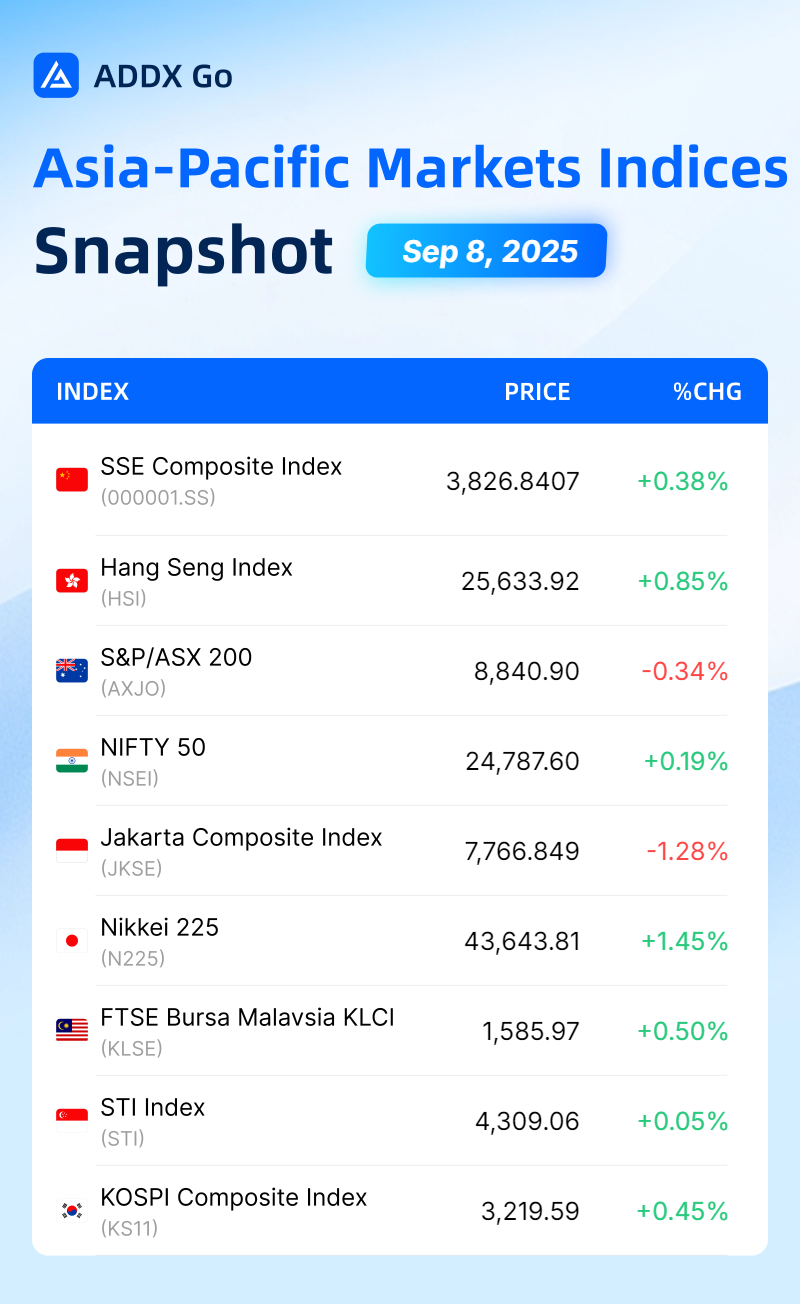
China Stock Market: By the close, the Shanghai Composite Index rose 0.38%, the Shenzhen Component Index gained 0.61%, and the ChiNext Index fell 0.84%. In terms of sectors, robotics, medical devices, and aquaculture sectors led the gains, while large financials, retail, and computing power sectors were among the top decliners.
By sector, solid-state batteries, photovoltaics, CPO, and third-generation semiconductors led the gains, while banking and dairy were among the few sectors to decline.
Hong Kong Stock Market: Hong Kong's three major stock indices all closed higher today. By the close, the Hang Seng Index rose 0.85% to 25,633.91 points; the Hang Seng Tech Index gained 1.17% to 5,753.75 points; and the Hang Seng China Enterprises Index increased 0.71% to 9,121.66 points.
In terms of market performance, stocks related to robotics, paper, pharmaceutical outsourcing, and aviation strengthened, while stocks related to non-ferrous metals fell slightly.
Japan Stock Market: The Nikkei 225 Index rose sharply by 1.45% for the third consecutive trading day, closing at 43,643.81 yen with an increase of 625.06 yen (trading volume was approximately 1.94 billion shares).
By industry, all 33 industries recorded gains, among which sectors such as other products, real estate, non-ferrous metals, pharmaceuticals, and machinery saw particularly significant increases.
South Korea Stock Market: The Korea Composite Stock Price Index (KOSPI) rose 0.45% to 3,219.12 points.
Sectors including health management technology, communication equipment, electrical equipment, and bioengineering led the gains, while power utilities, electrical products, aerospace and defense, internet, and steel sectors were the major decliners.
Australia Stock Market: The S&P/ASX 200 Index (XJO) fell 0.24% to close at 8,849.600 points. In terms of sectors, semiconductors, aerospace, and hardware sectors rose, while pharmaceutical manufacturers, education, and insurance sectors dropped significantly.
Singapore Stock Market: The Straits Times Index rose 0.03% to close at 4,308.52 points. By sector, other energy, steel, and credit sectors rose slightly, while medical distribution, furniture, and industrial sectors declined sharply.
Malaysia Stock Market: Malaysia's stock market rose 0.47% to 1,585.59 points. In terms of sectors, utilities and business trust sectors gained, while energy, communication equipment, and transportation & logistics sectors fell.
Key Events
They also noted that Russian oil is also facing fierce competition from other countries.
Thailand's Former Prime Minister Thaksin Returns from Dubai to Face Court Ruling on Schedule
Thaksin Shinawatra, Thailand's former prime minister, returned to Bangkok on Monday. A few days ago, he suddenly left the country for Dubai, sparking speculation that he was evading a court ruling that could lead to his imprisonment.
According to a live broadcast by 3 Plus News, the 76-year-old Thaksin appeared at the private jet terminal of Bangkok's Don Mueang International Airport on Monday afternoon. Flight tracking website Flightradar 24 showed that his private jet made a stopover in Singapore for several hours on its way to Bangkok.
This return is in line with Thaksin's commitment to return on time to attend the court ruling on Tuesday. Thaksin is one of Thailand's most prominent political figures and has served as prime minister twice. He traveled to Dubai last week, claiming the trip was for a health check-up.
The European Union is considering imposing new sanctions on approximately six Russian banks and energy companies as part of the latest round of measures to pressure Russia to end the Russia-Ukraine conflict.
This plan will be the 19th round of sanctions introduced by the EU since the outbreak of the Russia-Ukraine conflict in 2022.
Informed sources said that the EU may also target Russia's payment and credit card systems, cryptocurrency exchanges, and impose further restrictions on the country's oil trade.
Standard Chartered: Expects Fed to Cut Interest Rates by 50 Basis Points in September
Standard Chartered stated that after the U.S. nonfarm payrolls increased far less than expected in August and the unemployment rate rose to 4.3%, it expects the Federal Reserve to cut interest rates by 50 basis points in September. The broker previously predicted a 25-basis-point rate cut by the Fed in September, but now it says the latest data shows the labor market is slowing rapidly, opening the door for a larger-scale rate cut.
Barclays: Expects Fed to Cut Rates Consecutively This Year; ECB to Stay on Hold This Week
As the U.S. employment report indicates increasing downside risks to the labor market, economists at Barclays expect the Federal Reserve to cut interest rates consecutively in September, October, and December, even if data to be released this week may show accelerated consumer inflation. However, they ruled out the possibility of a sharp rate cut by the Fed.
The report said, "We believe the possibility of a 50-basis-point rate cut is very small, and the market is indeed pricing in this scenario. The upcoming CPI data and the Quarterly Census of Employment and Wages (QCEW) will have limited impact on this expectation."
Citigroup: Maintains View of Steeper U.S. Treasury Yield Curve
Strategists at Citi Research said in a report that after Friday's weaker-than-expected U.S. nonfarm payrolls data, their core view on U.S. Treasuries remains unchanged. They expect the yield curve between 5-year and 30-year Treasuries to steepen further, while the Federal Reserve will implement lower interest rates in 2026 and 2027.
They pointed out that the risk of a steepening 5/30-year Treasury yield curve lies in the fact that if the 30-year Treasury yield rises above 5% amid a large-scale sell-off, it may attract demand to return. Strategists believe the market still underestimates the risk of the 5-year Treasury yield driving a sharp steepening of the 5/30-year yield curve.
Goldman Sachs: French Government Bonds May Be Dragged Down by Budget Crisis; Yield Spread with German Bonds to Narrow by Year-End
Analysts at Goldman Sachs said in a report that if France's budget turmoil leads to new elections, French government bonds may still come under pressure. However, they expect the yield spread between 10-year French government bonds and 10-year German government bonds to be lower than the current level by the end of the year.
The report said, "New elections may prolong the underperformance of French government bonds, but we maintain our baseline expectation that the 10-year French-German government bond yield spread will be 70 basis points by the end of 2025." According to Tradeweb data, the current spread is 78.5 basis points. The government of French Prime Minister Elisabeth Borne will face a confidence vote on its budget on Monday, and there is a risk of losing the vote.
ING (International Netherlands Group): Uncertainty Remains Over Japan's Rate Hike Outlook; Maintains Expectation of October Rate Hike
Min Joo Kang from ING said that Japan's latest GDP data shows that wage growth and household spending will continue to drive the economy, but this does not mean the Bank of Japan will definitely raise interest rates. The economy withstood the impact of U.S. tariffs in the second quarter, but ING expects a contraction in the future, as the front-loading effect of exports weakens and stricter construction regulations curb residential investment.