
Market on Edge: Is the Fed About to Deliver a Shock 50-bp Cut?

After an unexpectedly weak August payrolls print and a wave of rapid forecast revisions across Wall Street, the possibility of a larger-than-expected Federal Reserve cut in September has moved from theoretical to very much live.
Standard Chartered now forecasts a 50-basis-point cut at the Fed’s September meeting, doubling its prior call. Markets, policymakers and traders are all scrambling to price two nearby, decisive data releases that could make or break that scenario.
Key Points
- Standard Chartered has shifted to a 50-basis-point cut at the Fed’s September meeting, up from its prior 25-bp forecast.
- The August payrolls report showed only 22,000 jobs added and an unemployment rate rising to 4.3%, signaling a notable cooling of the labor market.
- The Bureau of Labor Statistics will publish a preliminary annual benchmark revision on Sept. 9 covering Apr. 2024–Mar. 2025, which could materially revise historical payrolls.
- The CPI report on Sept. 11 will clarify whether inflation remains stubborn or is cooling—an outcome that will strongly influence the Fed’s room to ease.
- Futures markets have largely priced a 25-bp cut for September, but the odds of a 50-bp move have risen from near zero to a non-negligible level.
What just happened — and why it matters
Last Friday’s jobs print changed the game for many forecasters. A 22,000 payroll increase and a jump in unemployment to 4.3% offered clearer evidence the labor market is cooling.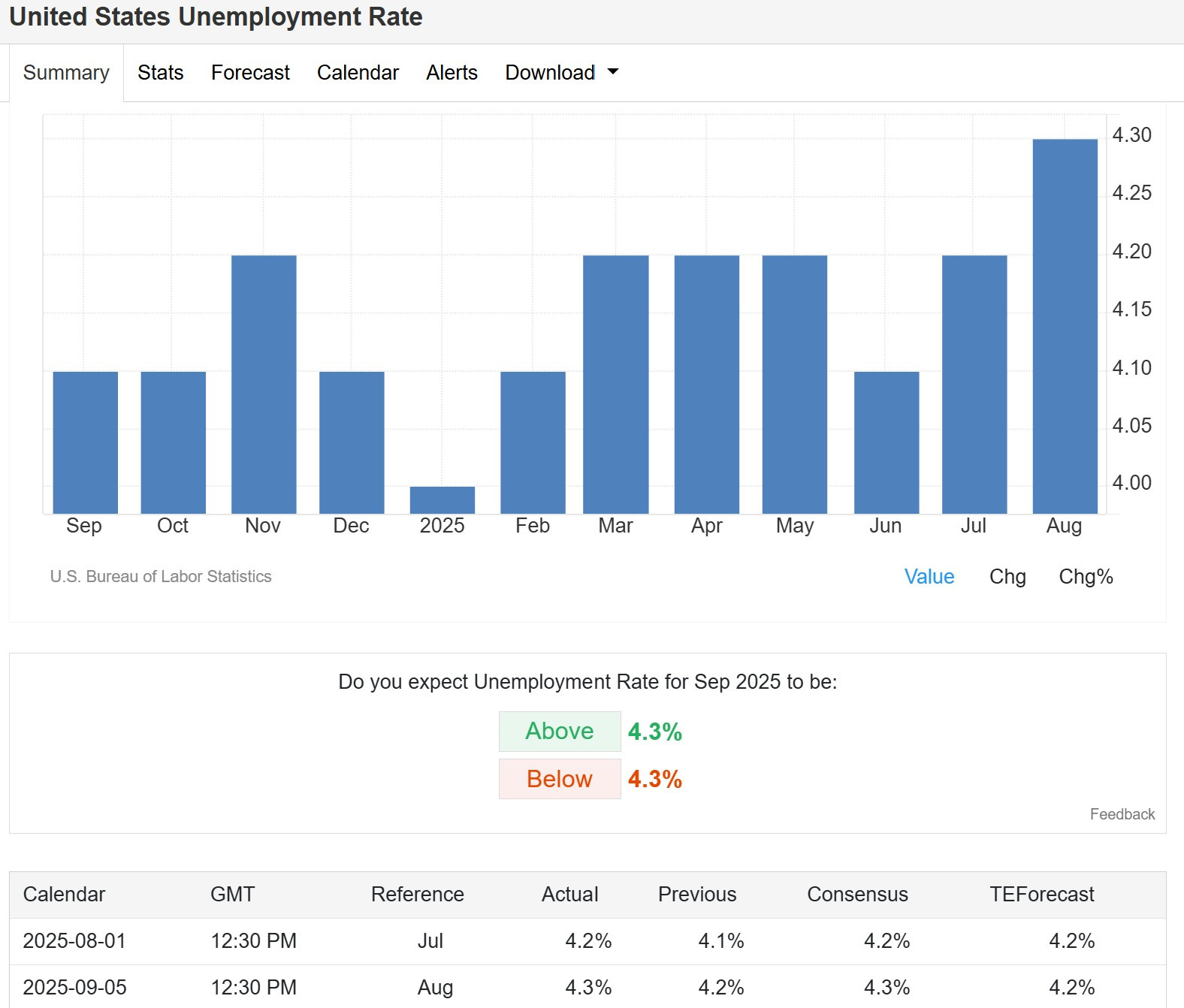 That single data point prompted Standard Chartered to move to a 50-bp call for September, arguing the Fed might need a “catch-up” easing step similar to last year’s large adjustment.
This matters because a half-point cut would be an unusually aggressive near-term move. It would compress short-term yields, alter expectations for the path of policy, and likely provoke volatile repositioning across equities, bonds and currencies.
In short: markets that assumed a modest easing would need to rethink positioning quickly.
Two data events that will decide the moment — what to watch
The next week features two events that together hold outsized influence. On Sept. 9 the BLS will publish the annual benchmark revision to payrolls for Apr. 2024–Mar. 2025.
That mechanical revision is based on more complete employer records and can materially change historical job totals; some officials and commentators have suggested revisions could be large.
On Sept. 11 the CPI release will show whether inflationary pressures are re-emerging or continuing to decline. A dovish combination — a sizable downward benchmark revision plus cooler CPI — would strengthen the case for a larger, earlier cut.
Conversely, a persistent or rising CPI print would sharply constrain the Fed’s ability to take an aggressive action, even if jobs look weak.
Where the market stands — pricing and probabilities
Futures currently price a 25-bp cut in September as the most likely outcome, but that view has shifted: the probability of a 50-bp move has risen from effectively zero to a meaningful minority probability.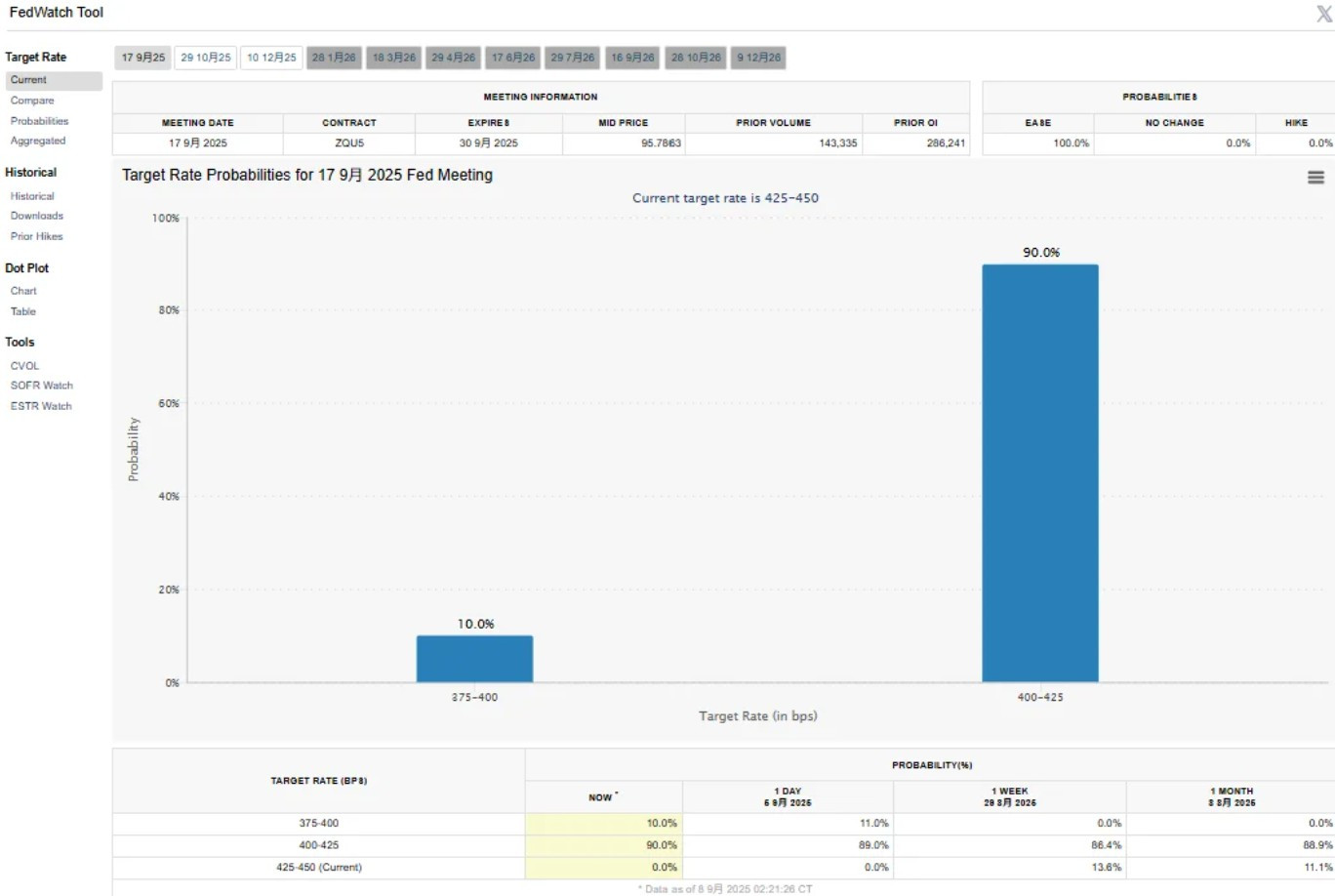 That split between market pricing and some big-bank forecasts creates space for abrupt repricing if either the benchmark revision or CPI surprises.
This gap matters because market positioning is uneven. Many investors are hedged for a modest easing path; a sudden move toward a 50-bp view would lift risk assets and compress term premia.
The opposite is also true: a resilient data flow would reverse the recent repricing and likely weigh on high-duration assets such as growth stocks.
Where forecasters disagree — a compact map
Wall Street’s views now span a wide range. Some major banks (Morgan Stanley, Deutsche Bank) see August’s weakness as insufficient to justify a 50-bp September cut; they treat the payrolls report as a softening signal that encourages later easing rather than an immediate double-sized move.
Others (Standard Chartered) argue the combination of the weak print and the pending benchmark revision justifies a “catch-up” 50-bp step.
Different houses also vary on timing: some expect sequential 25-bp cuts over the coming months, others have shifted the calendar around and pulled expected easing earlier.
These timing differences matter for portfolios because they change both the expected magnitude of rate declines and the tempo at which markets discount them.
A trader’s lens — practical scenarios and option plays
If the benchmark revision and CPI both point dovish, a classic long-call exposure on broad equity ETFs could capture a policy-driven lift. If CPI shows stickiness instead, protective long-puts or volatility buys would be the hedging play.
A neutral but high-volatility outcome argues for long-strangle strategies—simultaneous buys of out-of-the-money calls and puts—to profit from a large move in either direction.
These are not investment recommendations; they are commonly discussed tactical responses when policy ambiguity spikes.
Risk managers should also consider liquidity, gamma exposure and portfolio convexity in an environment where pricing can shift quickly between a 25-bp and 50-bp outcome.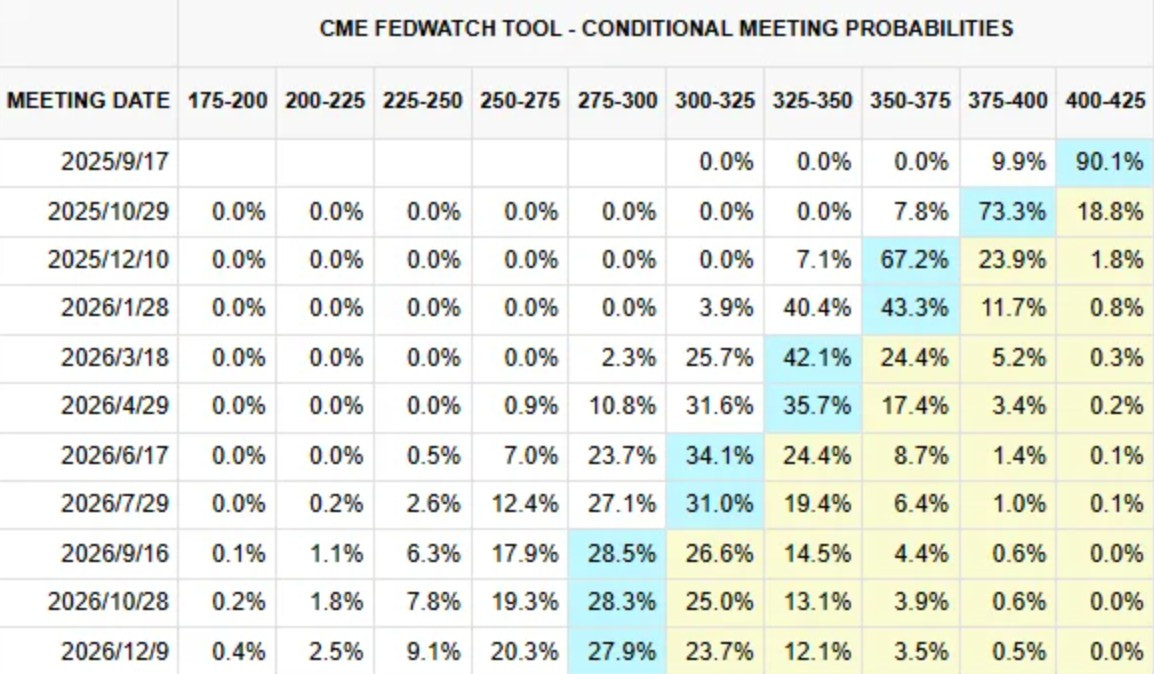
Constraints on the big-cut story — why a half-point might not happen
There are several credible limits on a 50-bp action. Fed officials have repeatedly emphasized that inflation remains the priority and that sticky inflation or fiscal loosening would reduce the scope for aggressive easing.
Even if the jobs numbers look weak, a resilient CPI print or signs of renewed demand could force the Fed to dial back the idea of a half-point move.
Moreover, the Fed values communication and control; a sharp, early easing risks confusing markets if the committee then has to reverse course.
Policymakers must weigh both data and optics — a one-off big cut might be tempting, but it carries reputational and technical tradeoffs.
Why a 50-bp “catch-up” cut would be unusual — Fed optics explained
A 50-bp cut is a decisive policy statement, usually reserved for turning points. Framing September as a “catch-up” event implies the Fed would be correcting a path rather than leading it.
That argument succeeds only if the benchmark revision and inflation readings both align. Otherwise, the Fed risks looking reactive rather than deliberative — an uncomfortable place for a central bank navigating inflation still above target.
What could change the story quickly — wildcards to monitor
Beyond the benchmark revision and CPI, watch for Fed communications in the blackout window before the September meeting. Any unexpected commentary from officials about inflation persistence or financial stability could swing odds.
Also monitor market liquidity and term-structure moves; dramatic moves in long-dated yields or risk spreads can force the Fed to consider financial stability implications alongside the economic data.
A simple checklist for the week ahead
1.Sept. 9 — BLS preliminary annual benchmark payroll revision (covers Apr. 2024–Mar. 2025).
2.Sept. 11 — CPI headline and core readings.
3.The Fed’s communication and any commentary before the Sep. 16–17 meeting.
4.Market pricing shifts in futures and swaps showing moves between a 25-bp and 50-bp expectation.
5.Equity and fixed-income positioning for quick repricing risks.
Final read — probabilities, prudence and posture
The core takeaway is that the path to easing just got more ambiguous. Standard Chartered’s 50-bp call highlights how fast forecasts can change when a major datapoint surprises. But the dominant market pricing still centers on a 25-bp cut, leaving a narrow window where a 50-bp move could cause abrupt repricing across asset classes.
Prudent market participants should treat both outcomes as live. That means preparing for rapid volatility, watching the benchmark payroll revision and CPI closely, and aligning hedges or tactical exposure to a range of plausible policy moves.
If the revision is large and CPI cools, the Fed could indeed opt for a more aggressive near-term easing. If inflation remains sticky, the Fed’s decisions will be constrained and markets will have to adjust to slower, smaller rate reductions.