
GameStop Q2 Earnings Preview: Can Billions in Cash and Bitcoin Fuel Real Growth?

Shearing sheep
September 9, 2025
GoGPT Summarizes Articles
GameStop ($GME) is set to report its second-quarter results after the market closes on Tuesday, September 9. For longtime watchers of the original meme stock, the conversation has shifted dramatically over the past few years. The story is no longer about whether GameStop can avoid bankruptcy — it’s about how CEO Ryan Cohen chooses to deploy the company’s unexpectedly massive war chest, and whether its latest pivots into Bitcoin and collectibles can offer a real future beyond video games.
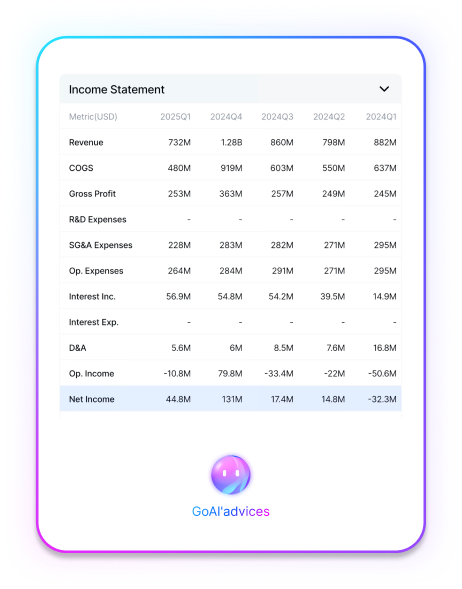
Source: GoAI (👉 Full GoAI analysis)
Last quarter, GameStop surprised many by delivering a fourth consecutive profit. Revenue fell short of Wall Street’s expectations, but what grabbed attention was its balance sheet. Cash and marketable securities surged to more than $6 billion, a stunning leap from roughly $1 billion a year earlier. As one market commentator put it, GameStop is no longer “a retailer burning cash” but “a lean, profitable shell with a fortress balance sheet.” That is a striking turnaround for a company once written off as a relic of the brick-and-mortar gaming era.
What to Expect in the Numbers
Forecasts for Tuesday’s report vary, underscoring how tricky GameStop is to model. Earnings estimates range from about $0.16 to $0.19 per share, while revenue projections stretch from a cautious $823 million to as high as $900 million. Hitting the top end would mark a solid 12–13% year-over-year increase from last year’s $798 million. Still, the key question is whether that kind of growth can be sustained, or if it’s just a temporary lift.
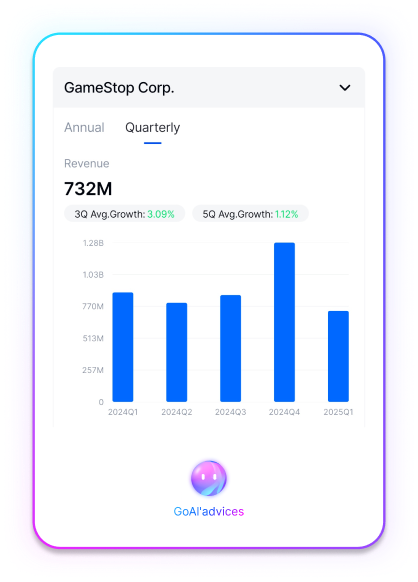
Source: GoAI (👉 Full GoAI analysis)
One consistent trend is that GameStop has repeatedly missed revenue expectations in recent years. The company’s core gaming business — hardware, software, and accessories — is under constant pressure as consumers shift to digital downloads and as competition from online retailers intensifies. That reality explains why investors are far more focused on what lies beyond the traditional game shop.
Bitcoin: Headline Grabber or Real Hedge?
The boldest move so far has been GameStop’s decision to add Bitcoin to its treasury reserves. Back in March, the board approved the shift, and in May and June the company disclosed buying about 4,710 Bitcoin, at prices ranging from $93,000 to $112,000. With Bitcoin now trading slightly above that range as of early September, the holdings are already in the black. Whether GameStop quietly added more during Q2 is something investors will be watching closely.
Cohen has been clear that he doesn’t want GameStop to become a “mini-MicroStrategy.” Instead, he describes the purchases as a hedge against inflation and money printing, insisting that capital deployment will be done responsibly. Still, with Bitcoin up more than 28% since the policy shift was announced, it’s hard to ignore the role crypto might play in the company’s financials — not to mention its stock price narrative. For some investors, Bitcoin is the new meme fuel.
Collectibles: A More Tangible Pivot
Meanwhile, GameStop has been leaning harder into collectibles and trading cards, an area that has quietly become its strongest growth engine. In the first quarter, collectibles revenue reached $211 million, the only one of its three main segments to show year-over-year growth. The company has launched partnerships with PSA, the grading company, and rolled out “Power Packs,” a blind-bag product aimed at the booming trading card market.
This shift is more than a novelty. Collectibles carry higher margins than traditional hardware and software, helping to improve profitability. And culturally, the move makes sense: GameStop is essentially trying to reinvent itself as a hub for enthusiasts, not just gamers. If it can successfully reposition around nostalgia, fandom, and alternative assets, it might carve out a niche that pure-play gaming retailers can’t match.
The Skeptics’ View
Not everyone is convinced. Wedbush analyst Michael Pachter — one of the few still covering GameStop — remains bearish. His price target sits at $13.50, well below current levels around $23. In his view, most of GameStop’s value comes from its cash and securities, worth about $12.50 per share, and it’s hard to justify paying much more unless you believe management can create significant value from Bitcoin or other speculative plays. For investors who want exposure to crypto, Pachter argues, there are simpler ways than buying shares of a struggling retailer.
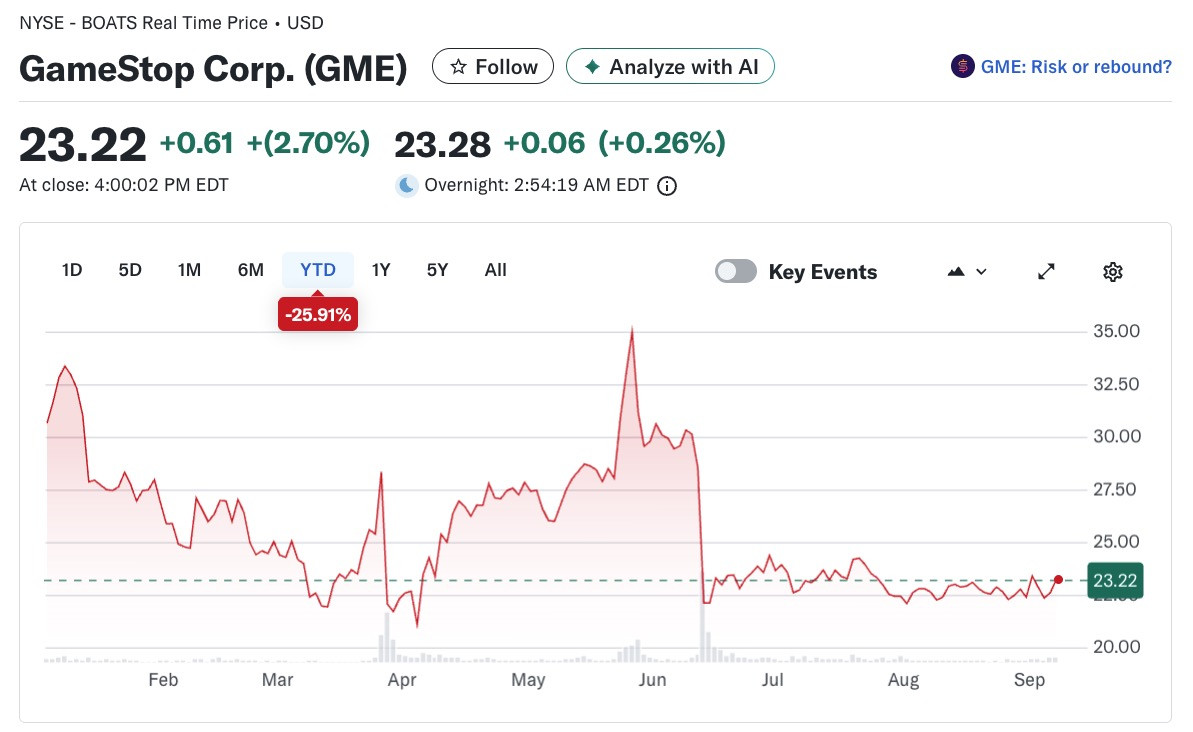
Source: Yahoo Finance
Beyond that, GameStop faces ongoing structural challenges. It is still in the process of closing underperforming stores, and the reliance on trading cards may not be enough to offset long-term declines in its legacy business. The stock has already fallen more than 25% year-to-date, underperforming the broader S&P 500, which is up around 10%.
Why It Still Matters
Despite the skeptics, GameStop remains one of the market’s most-watched tickers. It has been a symbol of retail investor power ever since the meme-stock frenzy of 2021, and the company’s balance sheet transformation has given it new life. The fact that it has managed to post profits in five of the past six quarters is no small feat for a business that used to be a perennial money-loser.
The upcoming Q2 results won’t answer every question, but they will set the tone for whether GameStop can sustain profitability while making bold bets outside its core. For some, it’s a case of waiting to see if Ryan Cohen’s disciplined capital deployment pays off. For others, the very uncertainty is the attraction — the optionality that keeps the stock alive in the meme imagination.
My Take
Personally, I think this report will show GameStop is still in “transition mode.” Profits may beat expectations, but the revenue story will likely disappoint again. Collectibles are a bright spot, but they’re still too small to carry the whole business. Bitcoin, meanwhile, adds excitement, but it doesn’t solve the structural decline of physical game retail.
For short-term traders, the stock will probably swing hard after earnings — options markets are pricing in a 10% move either way. For long-term investors, the real question is whether GameStop can turn cash and crypto into something more sustainable. Until then, it’s less about fundamentals and more about Cohen’s next chess move.
That’s what keeps GameStop both frustrating and fascinating — fundamentals often take a back seat while narrative drives the ride.
#Q2 Earnings Hunter: Share Your Stories#$GameStop Corp. Class A(GME)