
APAC Market Wrap - 9 Sep

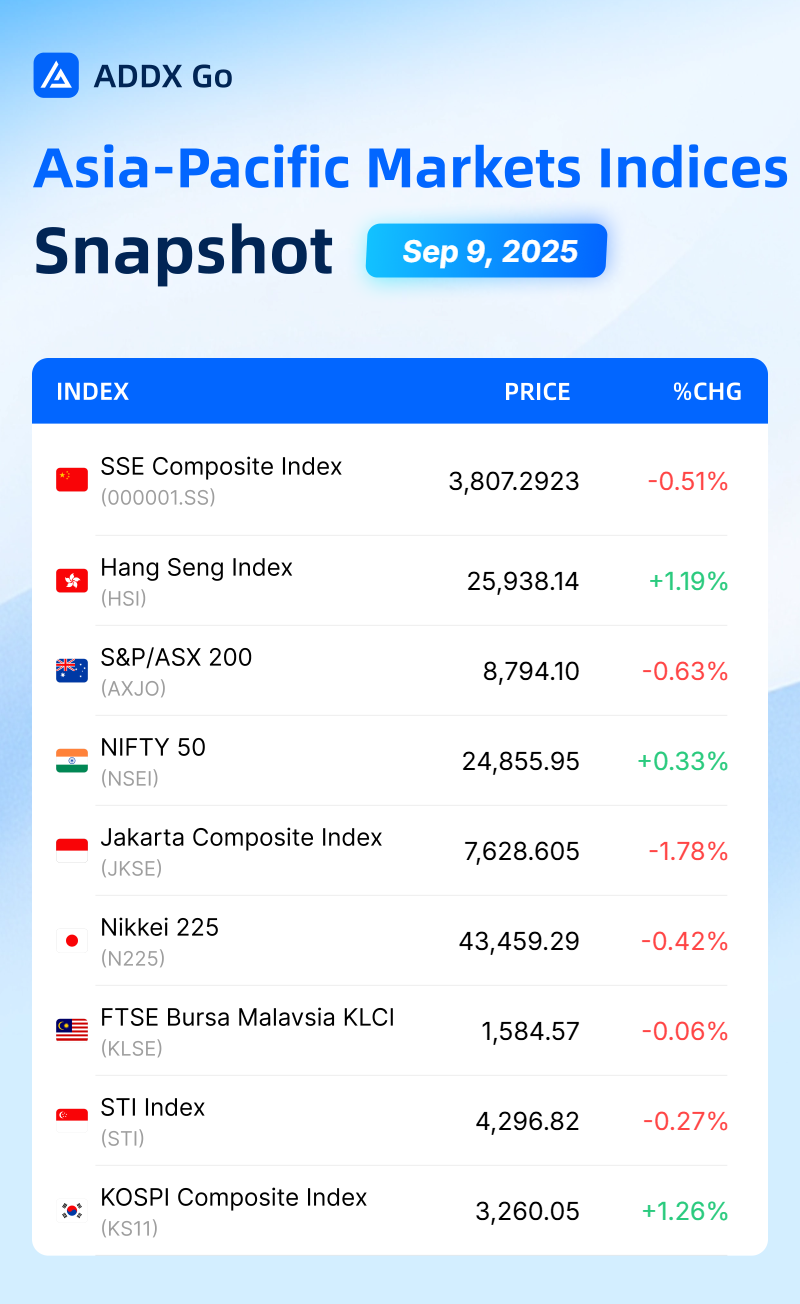
China Stock Market: The market oscillated throughout the day, with all three major indices closing lower. At close, the Shanghai Composite fell 0.51%, the Shenzhen Component Index dropped 1.23%, and the ChiNext Index declined 2.23%.
Sector-wise, gold, real estate, and banking sectors led the gains, while semiconductors, consumer electronics, and healthcare services saw the largest declines.
Hong Kong Stock Market: Hong Kong’s three major indices closed higher today. The Hang Seng Index rose 1.19% to 25,938.13 points; the Tech Index gained 1.30% to 5,828.74 points; and the State-Owned Enterprises Index increased 1.32% to 9,242.40 points.
Market performance showed strength in real estate, gold, and internet healthcare stocks, while consumer electronics, photovoltaic, and lithium battery stocks weakened.
Japan Stock Market: After four consecutive trading days of gains, the Nikkei Average retreated, falling 0.42% to close at 43,459.29 yen, down 184.52 yen.
By industry, eight sectors including pulp and paper, warehousing and transportation, real estate, and electrical equipment rose. Conversely, 25 sectors, including non-ferrous metals, steel, mining, oil, and coal, declined.
South Korea Stock Market: The KOSPI rose 1.26% to 3,260.05 points.
Sectors leading the gains included securities, life insurance, semiconductors, and conglomerates, while diversified communication media, tobacco, North Korea-related, and home appliances sectors lagged.
Australia Stock Market: The S&P/ASX 200 (XJO) fell 0.52% to 8,803.500 points.
Sectors such as semiconductors, aerospace, and hardware rose, while pharmaceutical manufacturers, education, and insurance sectors saw significant declines.
Singapore Stock Market: The Straits Times Index rose 0.03% to close at 4,308.52 points.
Sectors like agriculture, education, and hardware saw slight gains, while aerospace, apparel, and furniture sectors experienced larger drops.
Malaysia Stock Market: The Malaysian stock market rose 0.08% to 1,586.51 points.
Consumer goods, closed-end funds, and construction sectors advanced, while business trusts, transportation and logistics, and technology sectors declined.
Key Events
Global Bond Prices Up 20% Since 2022 Lows, Fed Poised to Restart Rate Cuts
As US labor data cools, bets on increased Fed policy easing have driven a global bond index up over 20% from its 2022 low. Amid broad fixed-income gains, the Bloomberg GlobalAgg Index, tracking sovereign and corporate debt in developed and emerging markets, has climbed to its highest level since March 2022.
Traders widely expect a Fed rate cut next week, with some betting on a half-percentage-point reduction. As central banks lower borrowing costs to address falling inflation and tightening labor markets, bond prices rise.
South Korean Fintech Toss Plans Global Expansion Starting in Australia, Eyes Won-Backed Stablecoin
Toss, a South Korean fintech unicorn, plans to launch its “all-in-one” financial app in Australia this year, with CEO Lee Seung-gun aiming to expand to other markets. The company also intends to issue a won-backed stablecoin once regulatory approval is granted.
Japan’s Top Trade Negotiator: US Order to Lower Tariffs on Japanese Goods Effective September 16
Japan’s chief trade negotiator, Ryozo Akazawa, stated that an executive order signed by President Donald Trump to reduce US tariffs on Japanese goods will take effect on September 16. Tariffs on Japanese autos and parts will drop to 15%, ending the previous practice of stacking additional tariffs on the 15% base rate, with Japan hoping the trade agreement will proceed as agreed.
Silver Lease Rates Surge! Proposed US “Critical Minerals List” Including Silver Spooks Market
Industry insiders suggest that the spike in silver lease rates on the London market could disrupt precious metals dynamics again, with traders fearing US tariffs might strain already tight supplies. Price dislocations between major gold and silver trading hubs are re-emerging.
The root cause traces back to a late-August report from the US Geological Survey under the Interior Department, published on August 25 in the *Federal Register*. The draft list of 54 minerals, open for 30 days of public comment, proposes adding six new minerals, including copper, potash, silicon, silver, lead, and rhenium.
The prospect of silver being listed as a “critical mineral” has raised concerns, potentially drawing President Trump’s attention.
Institutional Views
Goldman Sachs analysts note that despite OPEC+’s decision to further ease production cuts, OECD member countries’ oil inventories remain low. The pledged October increase is modest at 137,000 barrels per day, far below the 547,000 barrels per day agreed in September.
Analysts say, “While a full unwind of the 1.65 million barrels per day cut is feasible, under our assumption of a notable OECD commercial inventory rise in Q4 2025, we expect the group to leverage flexibility and pause quota increases from January 2026.” Due to limited spare capacity among some members, Goldman estimates actual production growth from September to year-end at about 190,000 barrels per day.
Capital Economics suggests OPEC+ will adopt a more cautious approach to adding oil supply compared to the first round of cuts. Commodity economist Hamad stated, “OPEC’s decision seems driven by some strong oil market signals.”
“However, beneath the surface, the market cracks we’ve been warning about persist.” Capital Economics still forecasts a significant oil market surplus in Q4, predicting Brent crude will fall to $60 per barrel by the end of 2025.
Goldman Sachs strategists indicate that as the economic outlook remains strong, laggards including small caps are starting to catch up, potentially broadening the US stock market’s record rally. Led by David Kostin’s team, they note that so far, the rally has been driven by a few stocks, with the median S&P 500 component still 11% below its 52-week high.
They believe expected Fed rate cuts and rising corporate earnings increase the likelihood of the rally spreading to small caps. Kostin wrote, “The limited breadth of the market rise suggests room for ‘catch-up’ rallies in underperforming sectors.”
Goldman Sachs warns that after 15 years of decline, Europe’s power demand is set to rise, posing new risks to energy security. The bank forecasts annual growth of 1.5% to 2% from 2026, suggesting that by 2029, the power system’s reserve margin during peak demand— a measure of buffer capacity—will approach zero.
When reserves fall below 10% to 15%, blackout risks emerge. To avoid outages, Europe may need up to €3 trillion in investments over the next decade, roughly double the past decade’s spending on backup gas generators, battery systems, and grid modernization.
CITIC Securities: Global Liquidity to Support Gold Prices Mid-Term
CITIC Securities’ research report notes that mid-term, global liquidity will provide some support for gold prices. In this global rate-cut cycle, non-US central banks have cut rates ahead of the Fed, with liquidity spillovers boosting gold.
Recent US inflation data fell short of expectations, and tariff pressures on inflation may be less severe than anticipated. Based on real inflation forecast indicators, US inflation risks are expected to remain manageable this year.
The Fed still has room to cut rates, with recent comments from Governors Waller and Bowman supporting a cut as early as July. As some central banks may follow the Fed, the global rate-cut wave isn’t over, offering mid-term support for gold prices.