
ORCL Reports Strong Q1 2026 Cloud Revenue Growth, Exceeding Analyst EPS Estimates

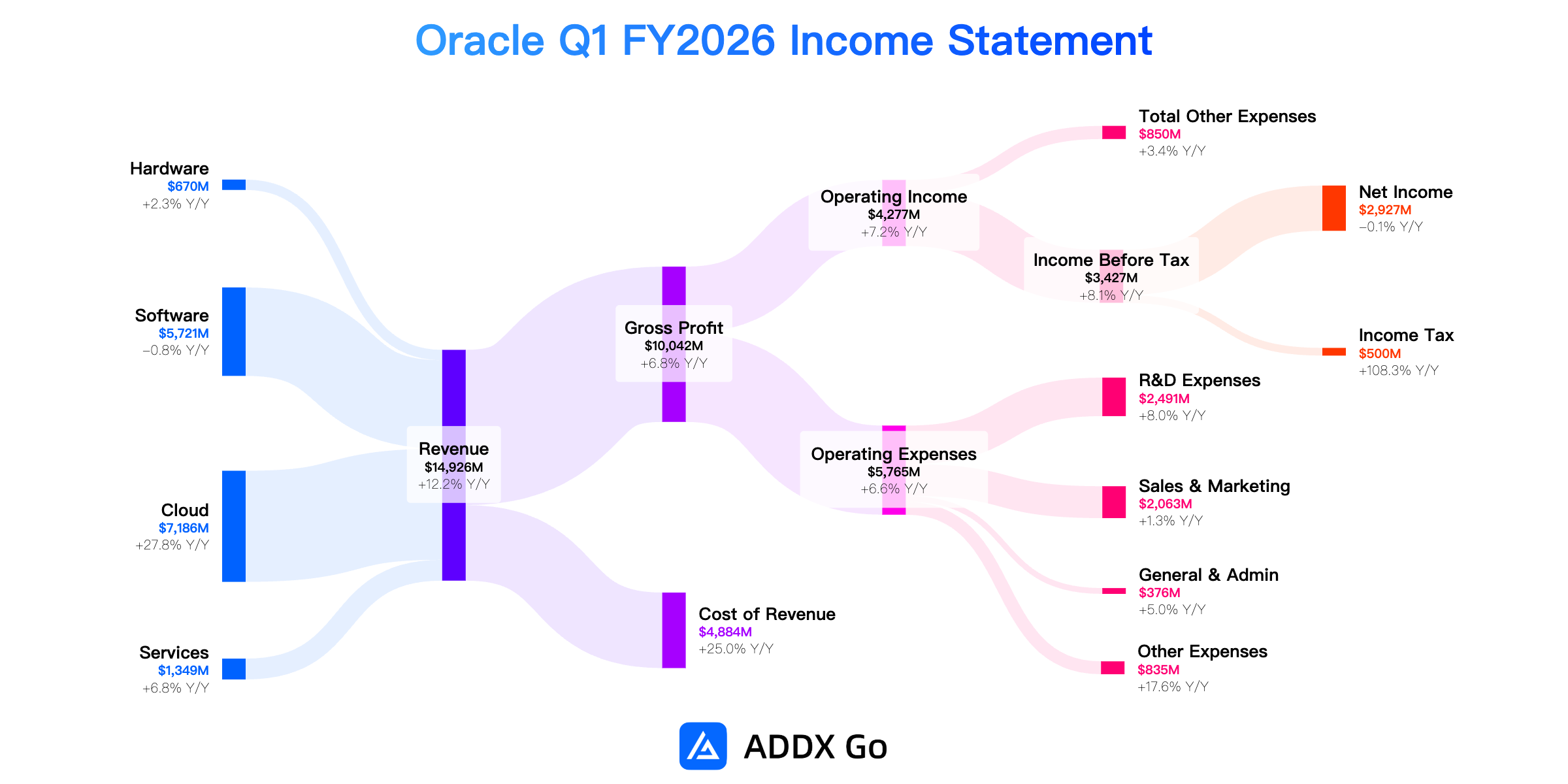
Oracle (ORCL.US) announced its fiscal 2026 first quarter results, reporting total revenue of $14.9 billion, representing a 12% year-over-year increase. Non-GAAP earnings per share reached $1.47, marking a 6% increase year-over-year, and in line with analyst estimates of $1.47. Non-GAAP net income for the quarter stood at $4.3 billion, up 8% compared to the prior year period.
Cloud Segment Drives Growth
The company's strong performance was primarily driven by its Cloud segment (IaaS plus SaaS), which generated $7.2 billion in revenue, an impressive 28% increase year-over-year. Within the cloud portfolio, Cloud Infrastructure (IaaS) revenue surged by 55% to $3.3 billion, while Cloud Application (SaaS) revenue grew 11% to $3.8 billion. Notably, Fusion Cloud ERP (SaaS) and NetSuite Cloud ERP (SaaS) each contributed $1.0 billion in revenue, increasing by 17% and 16% respectively.
Astounding RPO and MultiCloud Database Growth
Oracle reported an astonishing 359% increase in Total Remaining Performance Obligations (RPO) to $455 billion, reflecting significant customer commitments. Management highlighted the signing of four multi-billion-dollar contracts in Q1. Furthermore, MultiCloud database revenue from Amazon, Google, and Microsoft experienced extraordinary growth of 1,529% in the quarter, with expectations for continued substantial growth as Oracle plans to deliver an additional 37 datacenters to its Hyperscaler partners.
Aggressive Cloud Infrastructure Forecast and AI Innovation
Looking ahead, Oracle anticipates Cloud Infrastructure revenue to grow 77% to $18 billion this fiscal year, with projections to reach $144 billion over the next four years. A significant portion of this five-year forecast is already secured in reported RPO. The company also announced the upcoming introduction of a new 'Oracle AI Database' service, designed to enable customers to integrate various Large Language Models directly with the Oracle Database, aiming to significantly boost cloud demand and consumption.