
Synopsys (SNPS.US) Reports Q3 2025 Revenue and EPS, Exceeding Analyst Estimates

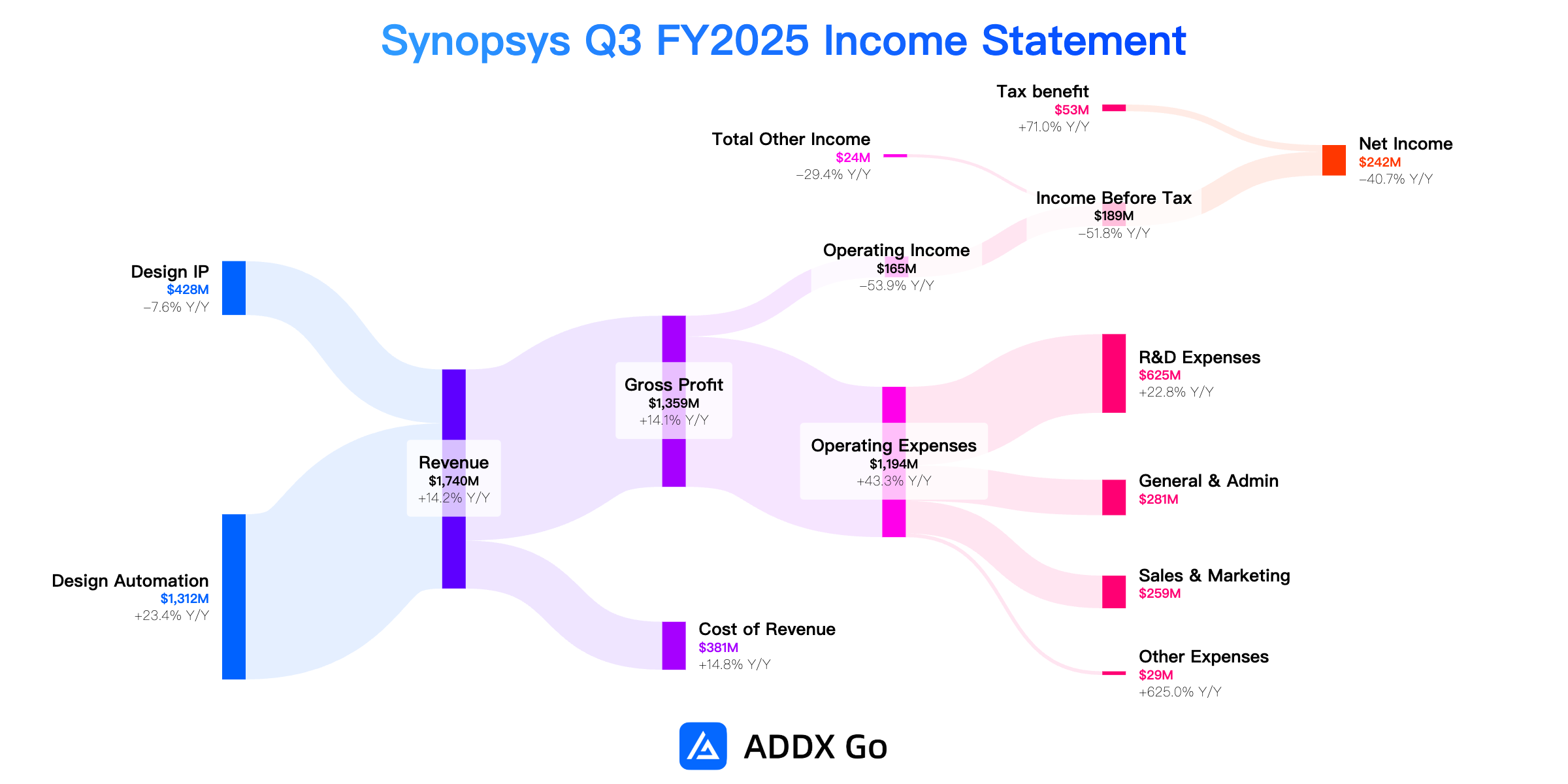
Synopsys (SNPS.US) announced its financial results for the third fiscal quarter of 2025, with revenue reaching $1.740 billion, marking a 14% increase year-over-year compared to $1.526 billion in Q3 2024. Non-GAAP earnings per diluted share stood at $3.39, surpassing the analyst estimate of $3.84.
These results reflect the strategic closing of the Ansys acquisition on July 17, 2025, which significantly expanded Synopsys' portfolio and customer base. Despite a challenging geopolitical environment, the company demonstrated strong performance, particularly in its Design Automation segment.
Key Business Drivers
The third quarter of fiscal year 2025 was described as a "transformational quarter" due to the Ansys acquisition. This integration is expected to position Synopsys as a critical partner in AI-powered product design and delivery. The company reported strength in its Design Automation segment, which includes advanced silicon design, verification products, and simulation and analysis solutions.
Conversely, the Design IP business underperformed expectations during the quarter. Management indicated that actions are being taken to enhance competitive advantage and foster resilient, long-term growth in this segment. The Ansys acquisition's operating results for the three and nine months ended July 31, 2025, were not material to the overall financial results for these periods.
Management Outlook
Synopsys provided its consolidated financial targets for the fourth quarter and full fiscal year 2025, reflecting a more conservative view for Q4. For the full fiscal year 2025, the company expects revenue to be between $7.03 billion and $7.06 billion. This guidance also anticipates another consecutive year of profitable growth.
The financial targets account for a change in Synopsys' fiscal year, resulting in eight fewer days in fiscal year 2025 compared to fiscal year 2024. These targets assume no further changes to export control restrictions or the current U.S. government "Entity List" restrictions, highlighting potential external challenges.