
After Three Years of Inflation Devastating Fixed-Income Markets, Global Bond Markets Finally Return to Bull Territory

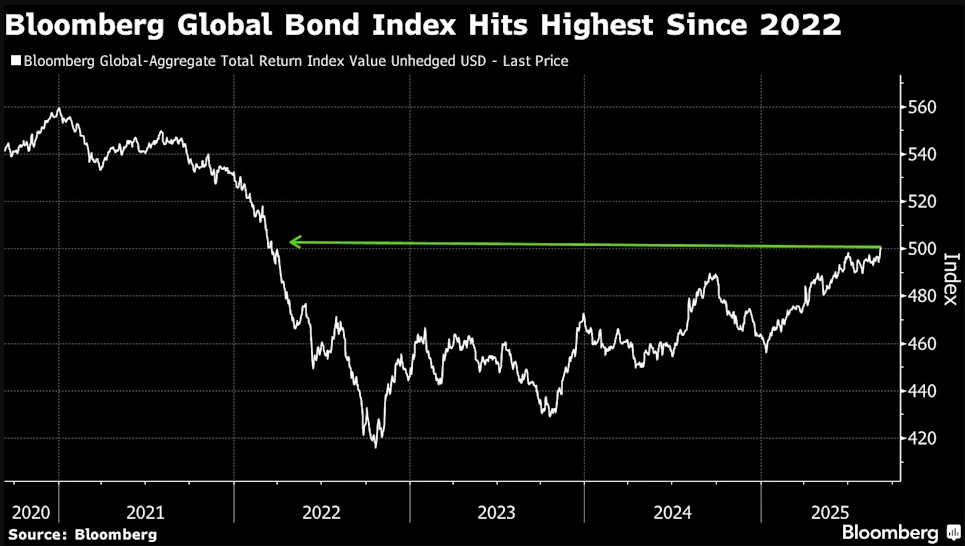
Market data shows that as the fixed-income market fully rebounds, the Bloomberg Global Aggregate Bond Index, which tracks returns on sovereign and corporate bonds in developed and emerging markets, has soared over 20% from its 2022 low.
This not only marks the highest level since March 2022 but also officially signals a return to technical bull market territory.
The latest rally stems from cooling US labor data, bolstering market expectations of increased policy easing from the Federal Reserve.
Traders currently anticipate a 25-basis-point rate cut from the Fed next week, with some betting on a 50-basis-point reduction. As major central banks lower borrowing costs in response to declining inflation and mounting labor market pressures, global bond markets have been gaining strength in recent days.
Deutsche Bank strategist Jim Reid noted in a report to clients, “The dominant theme in the market over the past 24 hours has been the continued rise in global bonds. This has eased pressure from France’s latest political crisis.”
Primary market demand remains robust, with issuers including the UK seeing oversubscribed offerings in recent weeks. On Tuesday, the EU’s 30-year bond issuance attracted over €98 billion (approximately $115 billion) in subscriptions, while its five-year bond garnered more than €70 billion.
Government Bonds Still Lag
However, with rising fiscal risks, long-term government bonds in some regions continue to face pressure. In fact, despite the global bond market entering a new bull phase by standard technical definition, this does not reflect a resurgence of confidence in sovereign debt—quite the opposite, if anything.
The Bloomberg Global Aggregate Bond Index comprises sovereign bonds, corporate bonds, and securitized debt. In this rebound, global corporate bonds have significantly outperformed other bond types.
Concerns over sovereign debt are particularly acute in markets like France, where Prime Minister Barnier officially tendered his resignation to President Macron on September 9.
His government failed a no-confidence vote in the National Assembly, receiving 194 votes in favor and 364 against—marking France’s fourth prime minister to step down in two years.
In the UK, investors await Finance Minister Reeves’ November plan to balance growth initiatives with spending constraints. Last week, UK 30-year government bond yields hit a 1998 high of 5.75% before retreating to around 5.47%.

In Japan, Prime Minister Shigeru Ishiba’s resignation over the weekend has heightened uncertainty, with his successor widely seen as potentially lacking commitment to fiscal discipline. Japan’s 30-year government bond yields have hovered near historic highs this week.
By contrast, in the corporate bond space, the Bloomberg Index shows global investment-grade bond yields have fallen for four consecutive days, dropping to 4.26% on Monday—the lowest since August 2022.
Ben Hayward, CEO of TwentyFour Asset Management, pointed out that despite tensions over government debt levels, investors remain optimistic about current buying opportunities in the bond market. A recent survey by the firm found that 80% of institutional investors see bonds as attractive in cross-asset allocations at current yield levels.