
APAC Market Wrap - 11 Sep

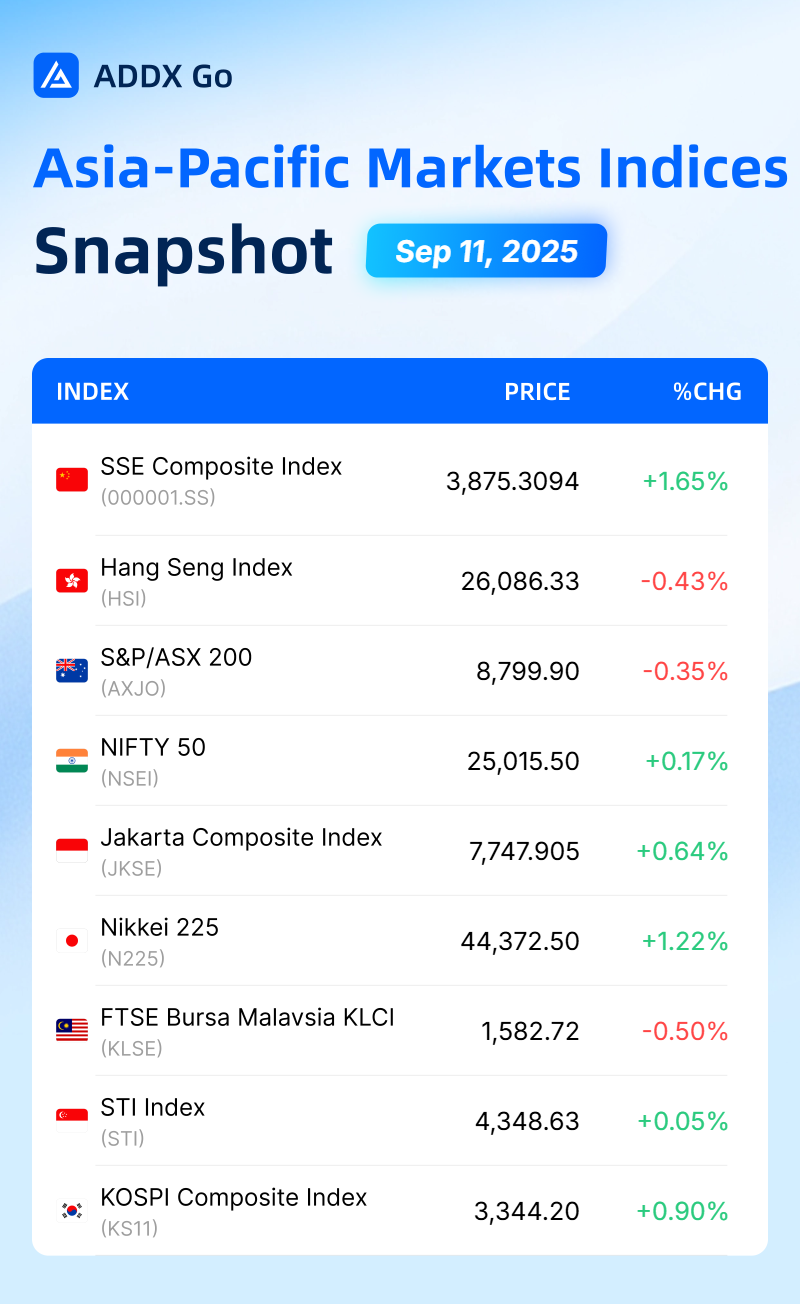
China stock market: The market remained strong throughout the day, with the three major indices staging a robust rebound. At close, the Shanghai Composite rose 1.65%, the Shenzhen Component Index gained 3.36%, and the ChiNext Index surged 5.15%.
Sector-wise, CPO, PCB, and liquid-cooled server sectors led the gains, while precious metals, oil and gas, and tourism sectors saw the largest declines.
Hong Kong stock market: The three major Hong Kong indices collectively retreated. At close, the Hang Seng Index fell 0.43% to 26,086.32 points; the Tech Index dropped 0.24% to 5,888.77 points; and the State-Owned Enterprises Index declined 0.73% to 9,260.25 points.
From today’s trading action, semiconductors, telecom equipment, non-ferrous metals, consumer electronics, and cement stocks performed strongly, while healthcare and new consumption-related stocks showed weaker trends.
Japan stock market: The Nikkei Average saw a significant rise, closing up 534.83 yen at 44,372.50 yen, marking the first time it closed above 44,000 yen.
By industry, 16 sectors including information and communication, other products, non-ferrous metals, mining, and oil and coal rose. Conversely, 16 sectors such as banking, insurance, warehousing and transportation, aviation, and transportation equipment fell.
South Korea stock market: The KOSPI rose 0.90% to 3,344.20 points.
Sectors leading the gains included other financials, energy equipment, aerospace and defense, and food, while power utilities, integrated facilities, and securities lagged.
Australia stock market: The S&P/ASX 200 (XJO) declined 0.29% to 8,805.000 points.
Sectors such as agriculture, industrial products, and oil and gas rose, while home construction, diversified media, and aerospace saw significant declines.
Singapore stock market: The Straits Times Index rose 0.07% to close at 4,349.53 points.
Sectors like medical distribution, forestry products, and industrial products saw slight gains, while agriculture, furniture, and tourism and leisure experienced larger drops.
Malaysia stock market: The Malaysian stock market fell 0.50% to 1,582.85 points.
Sectors including technology, healthcare, and real estate advanced, while financial services, energy, and consumer goods declined.
Key events
Goldman CEO: Goldman to face busiest IPO week in over four years
Goldman Sachs CEO David Solomon told CNBC on Wednesday that the firm will experience its busiest initial public offering (IPO) week since July 2021.
His remarks came after Swedish “buy now, pay later” lender Klarna achieved its long-awaited listing in New York earlier that day, setting the stage for more fintech firms eyeing IPOs.
“This week, the number of IPOs and related activities completed by Goldman will reach the highest level since July 2021,” he said.
Japan central bank hinting at ETF sell-off?
The Bank of Japan’s deputy governor recently signaled that the central bank will consider how to manage its holdings of ETFs and real estate investment trusts, marking one of the strongest hints of a divestment plan.
Analysts believe the bank favors a long-term, phased market sell-off approach, with no decision likely at next week’s policy meeting. However, Governor Kazuo Ueda may comment on this during the post-meeting press conference.
Valuation hits record high, South Korean President Lee says “Korean stocks still severely undervalued”
As the stock market hit a new high, South Korean President Lee Myung-bak said Thursday during a press conference that he will leave the controversial capital gains tax revision proposal to Congress.
This ambiguous stance failed to meet investors’ expectations of the government fully abandoning the plan. The original proposal, introduced in late July, aimed to lower the shareholding threshold for capital gains tax from 5 billion won to 1 billion won, expanding its scope. It faced strong resistance from retail investors in South Korea, triggering a sell-off wave.
European firms favor ASEAN market, over half plan expansion in Singapore
A survey found that ASEAN is viewed by European firms as the region with the best economic opportunities. This marks the third consecutive year ASEAN has surpassed China and India as the top market of choice for European companies. The survey also revealed that 51% of European firms plan to expand operations in Singapore.
This year, 474 European business representatives participated in the survey. While confidence in ASEAN has persisted over the past decade, geopolitical uncertainties, slow regional integration, and insufficient EU institutional involvement have slightly dampened optimism this year.
Notably, 73% of respondents believe ASEAN has become increasingly important to their global revenue over the past two years—a slight dip of one percentage point from 2024 and 2023, yet stable above 70%, underscoring ASEAN’s core role in European growth strategies.
Institutional views
Wells Fargo predicts the Federal Reserve will cut rates five times by mid-2026, each by 25 basis points. The bank expects three consecutive cuts in upcoming meetings, lowering rates to 3.50%–3.75% by year-end, followed by two more in March and June 2026, bringing the range to 3.00%–3.25%.
This outlook reflects a weak labor market, with average job growth of 29,000 in August and unemployment at 4.3%. Inflation remains a challenge, with core PCE up 2.9% year-over-year, but Wells Fargo notes stable inflation expectations. The bank raised the US recession probability for next year to 35% but anticipates stronger growth in coming years, projecting a 2.4% GDP growth rate in 2026 as fiscal stimulus and rate cuts take effect.