
Fed on Fast-Forward: Are Four Rate Cuts Already Priced In?

A hotter-than-expected August CPI failed to derail markets’ growing conviction that the Federal Reserve will begin cutting rates soon.
Despite headline CPI surprising on the upside, a sharp jump in weekly jobless claims and a string of weak employment datapoints have pushed traders to price multiple cuts — even four 25-bp moves by next January — ahead of the Fed’s September meeting.

Key Takeaways
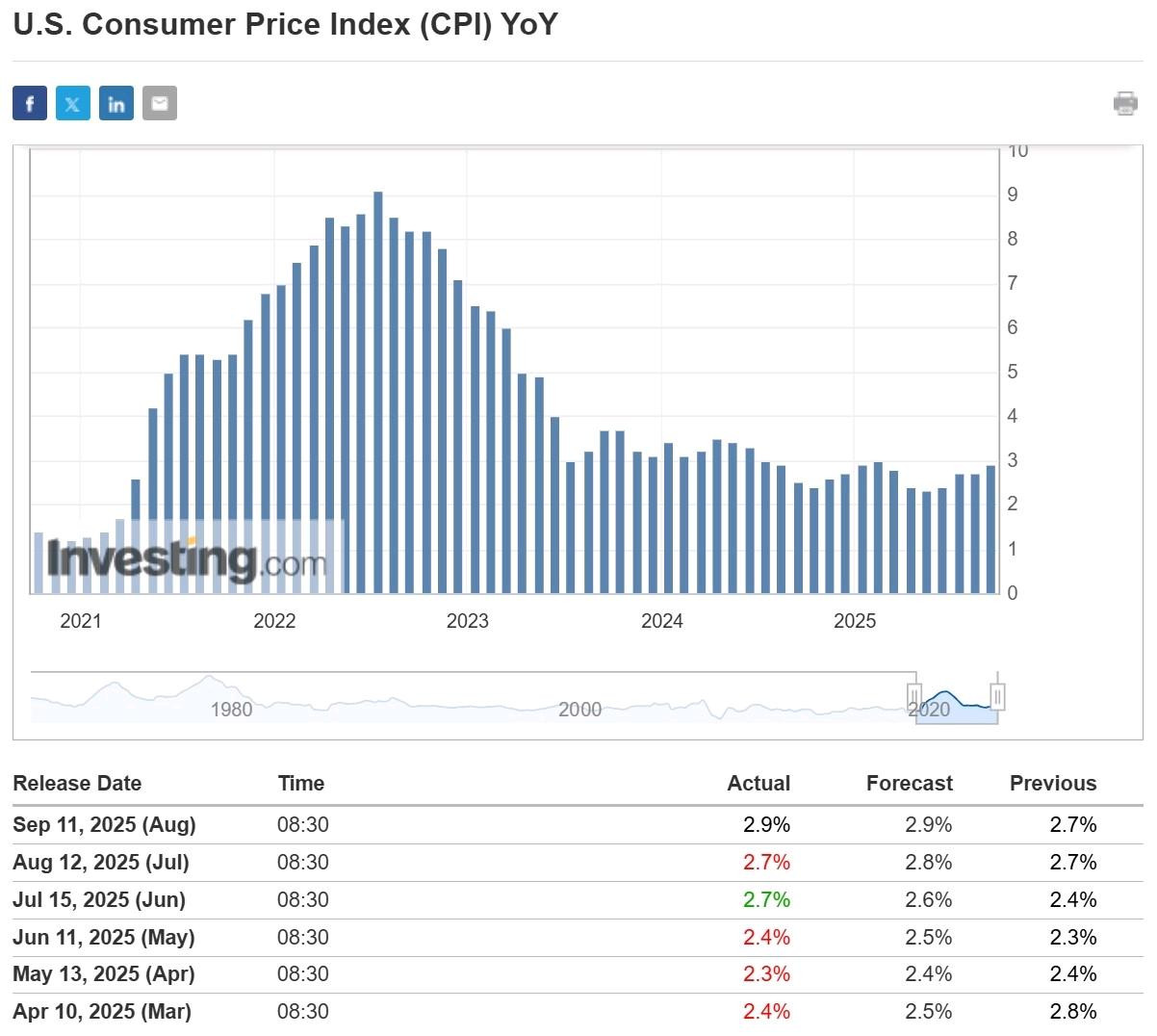
- August headline CPI rose 0.4% month-over-month (seasonally adjusted) and 2.9% year-over-year; core CPI rose 0.3% m/m and 3.1% y/y.
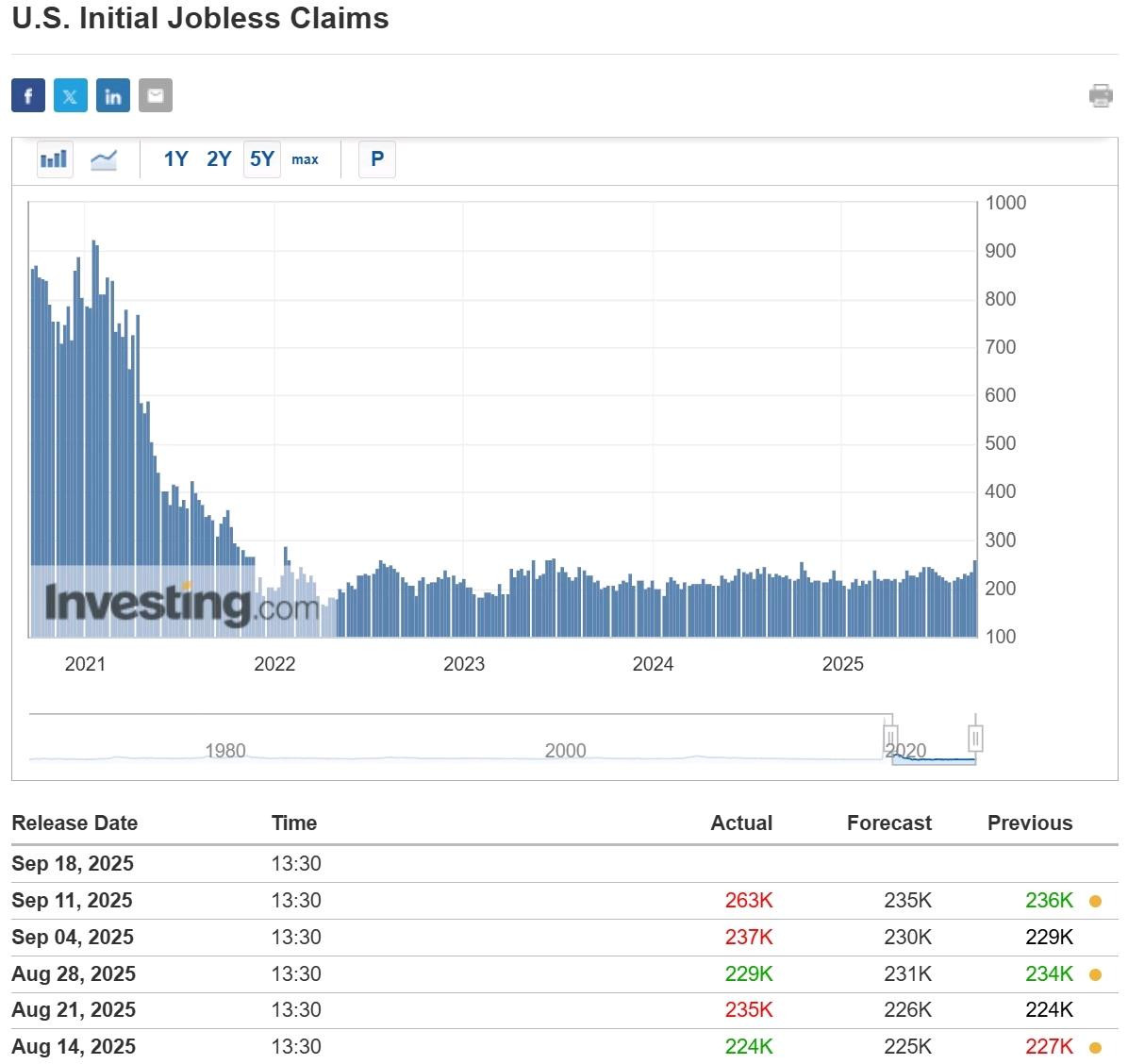
- Initial jobless claims surged to 263,000 in the week ending Sept 6, the highest weekly reading since October 23, 2021.
- Markets rapidly increased odds of Fed easing: futures price about three cuts by end-2025 and full pricing for four 25-bp cuts by next January; CME FedWatch shows a 93.7% chance of a 25-bp cut in September (and had briefly put a ~10.9% chance on a 50-bp move).
- Housing and food were the largest contributors to August CPI’s monthly increase.
- Policymakers face a tension: persistent price pressure from tariffs and housing vs. growing evidence of labor-market weakness.
So which signal matters more: hotter prices or softer jobs?
The concise answer: markets are betting on the labor market.
August’s CPI reading showed an acceleration in the headline rate to 0.4% m/m — its strongest monthly jump since January — and a 2.9% y/y pace. Core inflation (excluding food and energy) matched expectations at 0.3% m/m and 3.1% y/y. But the labour market — traditionally the governor of Fed policy — flashed fresh weakness.
The monthly nonfarm payrolls report showed only 22,000 jobs added in August, and the Bureau of Labor Statistics’ recent annual benchmark revisions trimmed employment by roughly 911,000 jobs for the April 2024–March 2025 window. Those employment signals now carry more weight for traders than a single hotter CPI print.
What exactly rose in August CPI — and why does it matter?
Housing costs stood out as the largest monthly driver, rising 0.4% in August. Food prices also showed broad gains: the food index rose 0.5% (home-consumed food +0.6%; food away from home +0.3%). In short, shelter and food — durable components of household budgets — pushed headline inflation up.
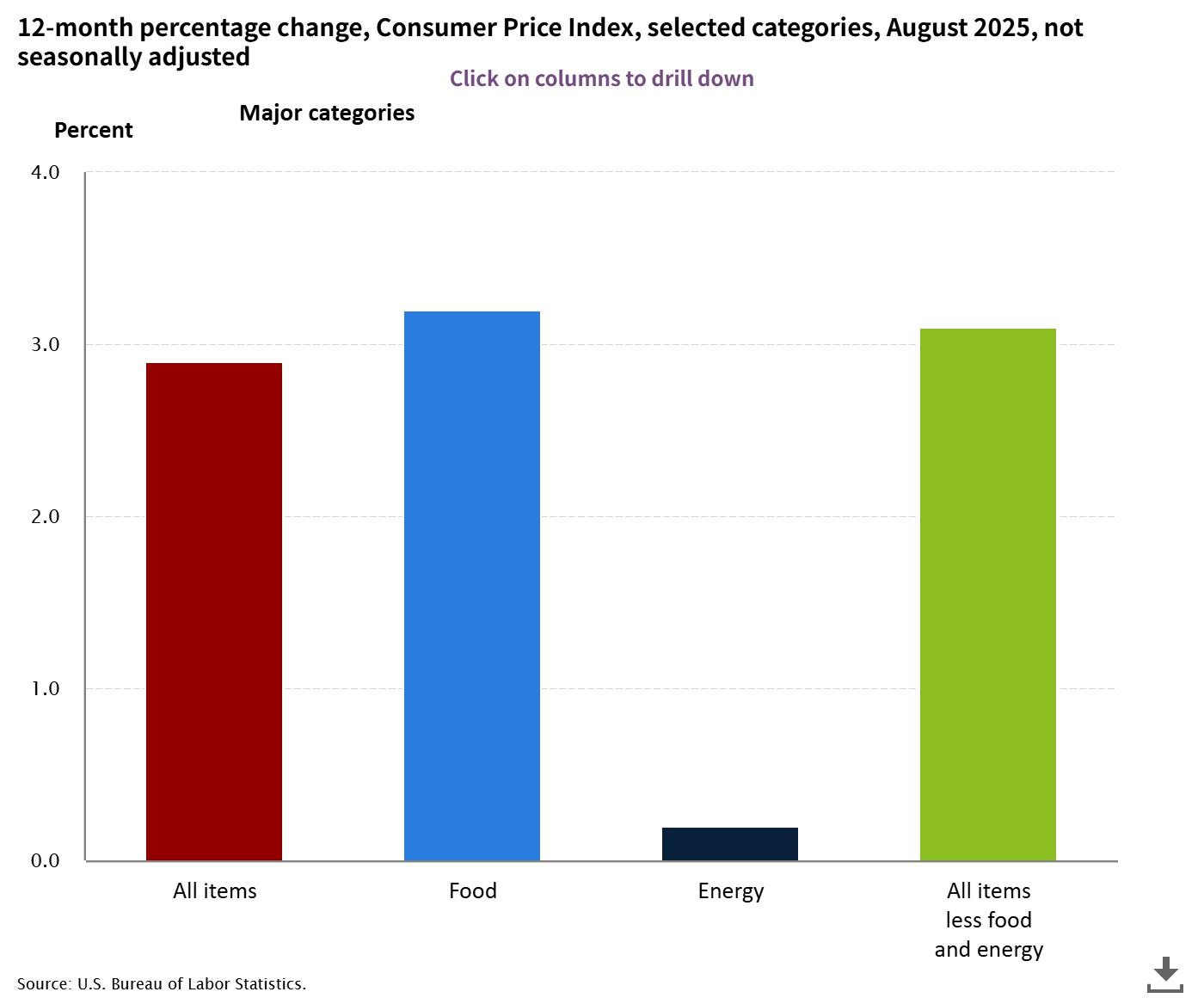
That pattern matters because shelter tends to be sticky and transmits more slowly through to headline measures. Still, the Fed weighs the overall trend: core inflation held steady at expected rates, making the hotter headline less decisive in isolation.
The labor shock: are jobless claims the canary in the coal mine?
Yes — the recent jump in weekly initial claims is hard to ignore. Initial unemployment claims rose by 27,000 to 263,000 for the week ending Sept 6, the highest weekly tally since October 2021. The four-week moving average climbed to roughly 240,500, its highest since June.
While weekly claims can be noisy around holidays — this sample included Labor Day — the breadth of weakness is worrying when combined with the soft monthly payrolls and the large annual employment benchmark revisions.
A key driver of the spike was an outsized increase in Texas (an unadjusted jump of 15,304 claims), with Michigan second in line (+2,980). Most other states showed declines. Analysts caution that if initial claims begin to rise more broadly across states, the signal would point to a genuine deterioration in hiring and firing dynamics.
Markets moved fast — what did they price in?
Financial markets reacted quickly. Short-term rate futures rose and traders boosted the odds of Fed easing. By the close, futures implied roughly three cuts priced in by the end of 2025, with the market fully pricing four 25-bp cuts by next January.
The CME “FedWatch” tool pegged the probability of a 25-bp cut in September at about 93.7%, while the probability of a 50-bp cut — though much smaller — briefly lifted to around 10.9%.
Currency and commodity moves mirrored the repricing. The U.S. dollar slipped immediately after the data, while spot gold rallied roughly $30 and reclaimed levels above $3,640 per ounce. Those moves reflect a market that sees lower policy rates ahead and a somewhat softer dollar.
Could tariffs re-ignite inflation down the road?
Several economists warn of a delayed inflation threat linked to tariff policy. The narrative: if tariffs are imposed broadly and firms have run down pre-tariff inventories, price pressures could accelerate over coming months as higher import costs are passed through to consumers.
Santander’s Stephen Stanley noted there is “substantial evidence” more tariff-driven inflation is coming, though he and others stress the effects might take months to fully transmit.
In other words, a window has opened where labor weakness implies easing is warranted now, while tariff dynamics could push inflation higher later — complicating the Fed’s path.
Voices on the extremes: is 25 bps enough?
Most market participants expect a 25-bp cut next week, but some on Wall Street argue for far bolder action. Jefferies’ chief market strategist David Zervos publicly suggested the Fed should consider a 75-bp reduction, arguing that recent employment revisions and weak hiring justify an aggressive reversal.
He framed it as an argument that the Fed’s employment narrative has “broken” and that a larger pivot could be warranted. Zervos himself conceded that such a move is politically unlikely and would be a radical departure from typical FOMC practice.
At the other extreme, commentators like Peter Schiff warn that cutting rates risks stoking further inflation, especially if tariffs and a weaker dollar increase prices. The Fed therefore faces a classic policy dilemma: cut to shore up a weakening labor market, or hold fast to prevent upside inflation surprises.
What should market participants watch next?
- The Federal Open Market Committee meeting on Sept 16–17 is now the focal point. Traders have baked in a high chance of a 25-bp cut; the Fed’s statement and Chair commentary will be parsed for the path ahead.
- Incoming monthly inflation reports and labor indicators in the coming weeks will test the consistency of the recent signals. Look especially for shelter and food trends, and whether jobless claims broaden beyond a few states.
- Watch for any new tariff announcements or shifts that could change import price trajectories in late Q4 and early next year.
- Market positioning — futures and options flows — could amplify moves if traders need to adjust quickly to fresh data.
Bottom line: a tricky policy trade-off for the Fed
The immediate policy story is simple: labor weakness has become the dominant force in Fed-rate expectations despite an unexpectedly hot August CPI headline. Markets now expect easing — multiple cuts — and traders have already re-priced currency, gold, and money-market instruments accordingly.
Yet the Fed cannot ignore the inflationary undercurrents from housing, food, and potential tariff pass-through. That leaves policymakers balancing a near-term case to support employment against the risk of rekindling inflation later.
How the Fed communicates its reaction function at the Sept meeting will determine whether markets see easing as a temporary reprieve or the start of a slower, data-dependent easing cycle.
Quick reference:
- Headline CPI: +0.4% m/m (seasonally adjusted); +2.9% y/y.
- Core CPI (ex food & energy): +0.3% m/m; +3.1% y/y.
- Initial jobless claims (week ending Sept 6): 263,000 (up 27,000).
- Four-week moving average of claims: ~240,500.
- August nonfarm payrolls: +22,000 jobs.
- BLS annual benchmark revision (Apr 2024–Mar 2025): -911,000 jobs (cumulative downward adjustment).
- Market odds: ~93.7% for a 25-bp cut in September (CME FedWatch); futures price three cuts by end-2025 and four cuts by next January.