
APAC Market Wrap - 10 Sep

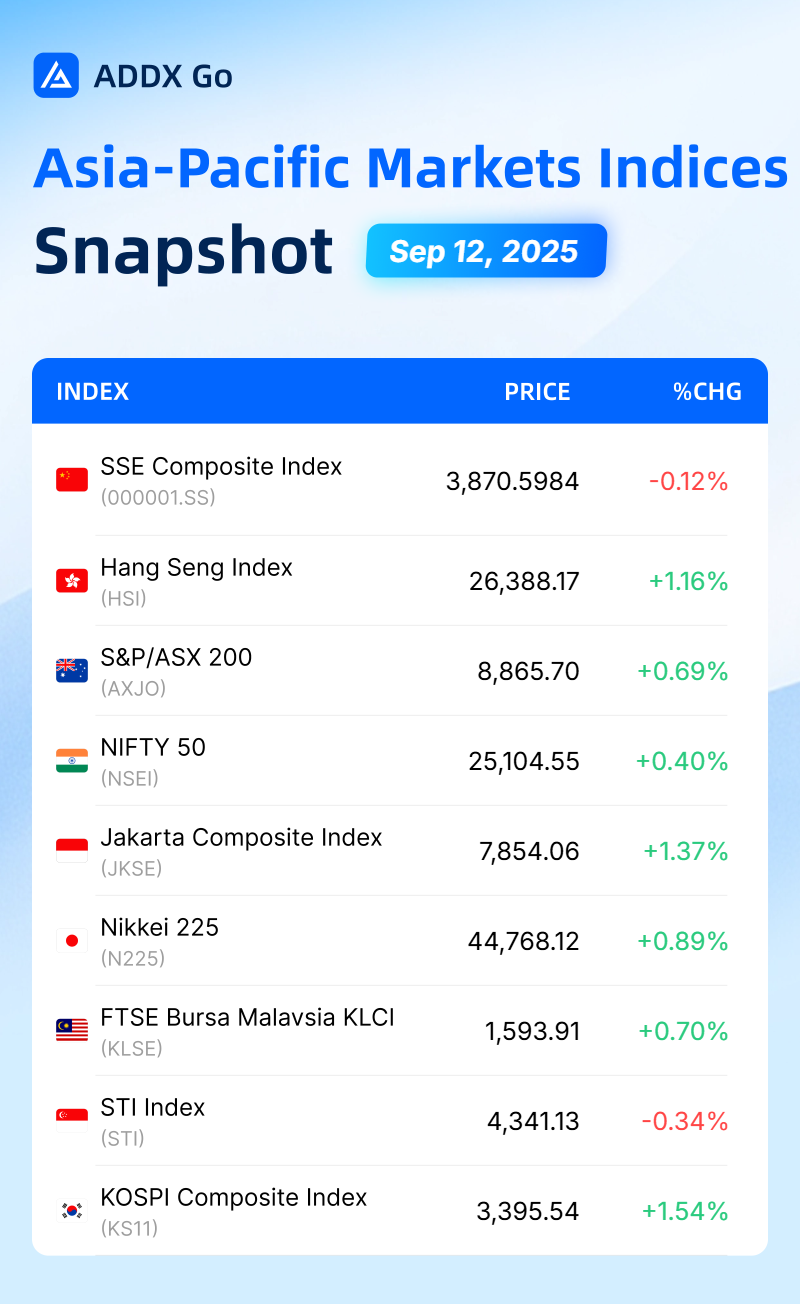
China Stock Market: The market surged early but closed lower, with all three major indices declining. At close, the Shanghai Composite fell 0.12%, the Shenzhen Component Index dropped 0.43%, and the ChiNext Index declined 1.09%.
Sector-wise, non-ferrous metals, storage chips, and film and cinema chains led the gains, while financials, liquor, and gaming sectors saw the largest losses.
Hong Kong Stock Market: The three major Hong Kong indices posted strong weekly gains. At close, the Hang Seng Index rose 3.82% to 26,388.16 points; the Tech Index gained 5.31% to 5,989.27 points; and the State-Owned Enterprises Index increased 3.40% to 9,364.94 points.
Today’s trading showed leadership from tech, non-ferrous, and pharmaceutical stocks, while coal and photovoltaic sectors underperformed.
Japan Stock Market: The Nikkei Average rose significantly by 0.89%, closing at 44,768.12 yen.
By industry, 16 sectors including information communication, other products, non-ferrous metals, mining, and oil and coal saw gains.
Conversely, 16 sectors including banking, insurance, warehousing and transportation, aviation, and transportation equipment declined.
South Korea Stock Market: The KOSPI index rose 1.54% to 3,344.20 points.
Leading sectors included non-ferrous metals, healthcare management, semiconductors, and bioengineering, while construction products, utilities, and diversified communications lagged.
Australia Stock Market: The S&P/ASX 200 (XJO) climbed 0.68% to 8,864.900 points.
Sectors like restaurants, aerospace, and industrial products rose, while industrial distribution, oil and gas, and travel and leisure saw notable declines.
Singapore Stock Market: The Straits Times Index fell 0.27% to 4,344.24 points.
Sectors such as industrial distribution, non-alcoholic beverages, and cyclical retail saw slight gains, while forestry products, diversified media, and oil and gas experienced larger drops.
Malaysia Stock Market: The Malaysian stock market rose 1.09% to 1,600.13 points.
Sectors including communications and media, healthcare, and construction advanced, while real estate investment and closed-end funds declined.
Key Events
Global Investors Rush In as Gold Breaks 45-Year Inflation-Adjusted Peak
Amid growing uncertainty in the US economic outlook, gold prices delivered another stunning performance.
Spot gold hit a record high of $3,674.27 per ounce on Tuesday, marking over 30 nominal record highs this year. It also surpassed the inflation-adjusted peak set on January 21, 1980, signaling a new phase in its three-year bull run.
Japanese PM Ishiba Plans Late September Visit to South Korea
Unnamed government officials report that Japanese Prime Minister Shigeru Ishiba plans to visit South Korea as early as late September, where he will meet South Korean President Lee Jae-myung.
Singapore’s Carro Plans Australian Expansion and Mergers to Pave Way for Dual Listing
The CEO of Southeast Asia’s largest online used car platform Carro stated the company is considering a dual listing and plans to scale up, targeting an entry into the Australian market next quarter alongside two to three merger deals.
Carro aims for an IPO in the US with a valuation exceeding $3 billion. According to LSEG data, if successful, this would be the largest US listing by a Southeast Asian firm since SEA’s $989.3 million IPO in 2017. It would also mark Singapore’s first major auto-tech and e-commerce startup to list in the US.
South Korea Releases 25,000 Tons of Reserve Rice to Stabilize Rice Prices
South Korea’s Ministry of Agriculture, Food and Rural Affairs announced on Friday the release of an additional 25,000 tons of rice from reserves to help stabilize soaring rice prices due to supply shortages.
As of last Friday, the factory price for a 40-kg bag of rice exceeded 220,000 won (about $158) for the first time in nearly four years, while the average retail price for a 20-kg bag reached 61,000 won, up 20% from last year.
Japan’s Chip Stock “New King” Emerges
On Wednesday, September 10, Japan’s chip testing equipment maker Advantest closed at 13,125 yen, with its market cap surpassing 10 trillion yen ($68 billion) for the first time, overtaking peer Tokyo Electron since 2006. By Friday morning, Advantest’s stock has risen over 50% this year, far outpacing the broader Topix Index.
Advantest has become Japan’s largest chip-related stock by market cap.
Institutional Views
UBS has raised its gold target to $3,800 per ounce by the end of 2025 (previously $3,500/oz) and expects it to reach $3,900/oz by mid-2026 (previously $3,700/oz). It also increased its forecast for gold ETF holdings, anticipating a record high close to 3,900 metric tons by the end of 2025.
Citi notes oil prices are caught between deteriorating fundamentals and escalating geopolitical risks. Following OPEC+’s decision to gradually unwind voluntary production cuts from October, assuming Russian oil supply is capped at 10.1 million barrels per day due to military conflicts and Saudi supply remains at 10.3 million barrels per day next year, Citi reaffirms its expectation of a decline in Brent crude prices, projecting $65/bbl in the next three months and $60/bbl in the next 6-12 months.
S&P Global’s Chief Economist for Europe, Middle East, and Africa, Sylvain Broyer, said, “The ECB has ended its rate-cutting cycle. However, sticky services and food inflation are weighing on consumer confidence. Real wage growth outpacing productivity means easing policy rates to weaken the euro would be ineffective under current conditions.”
JPMorgan now expects the ECB to cut rates in December, rather than the previously anticipated 25-basis-point cut in October, following the ECB’s latest meeting where rates were held steady.
After three days of oil price gains driven by geopolitical tensions in Europe and the Middle East, prices stabilized on Thursday. Soojin Kim of Mitsubishi UFJ Financial Group (MUFG) said traders are balancing weak demand and oversupply against rising geopolitical risks.
She noted the market is digesting Trump’s latest comments on potential sanctions against Russia, alongside the EU’s pledge to increase sanctions after Russian drones entered Polish airspace.
Commerzbank forex analyst Michael Pfister said those hoping the ECB meeting will drive significant EUR/USD volatility may be disappointed. He noted, “While new forecasts will be released, the meeting is unlikely to offer much new information.
All signs point to rates remaining unchanged, a scenario already priced in by the market.” Any difference might hinge on ECB President Lagarde’s comments.
Capital Economics’ Deputy Chief Eurozone Economist Jack Allen-Reynolds said, “The ECB’s decision to maintain the deposit rate at 2.0% with no guidance on future rate decisions was expected. The bank is unlikely to adjust rates this year, but we see risks leaning toward a cut in 2026.”
Rabobank analyst Pesola said the pound faces downside risks before the November 26 autumn budget due to concerns over UK fiscal sustainability. He noted that as UK long-term government bonds rebound from last week’s sell-off, the pound has recently strengthened against the euro.
However, its sensitivity to bond sell-offs compared to the euro and dollar suggests risks persist pre-budget, though higher short-term rates due to the Bank of England’s cautious stance make shorting the pound “expensive” during bond stability.
Rabobank analyst Jane Foley said the entry of Russian drones into Polish airspace could provide some support for the dollar, whose safe-haven status remains intact. Following Poland’s request, the UN Security Council held an emergency meeting on Thursday. Foley added, “This reignites debate around the dollar’s safe-haven role.”