
Nasdaq Aggressively Expands into Crypto Asset Trading

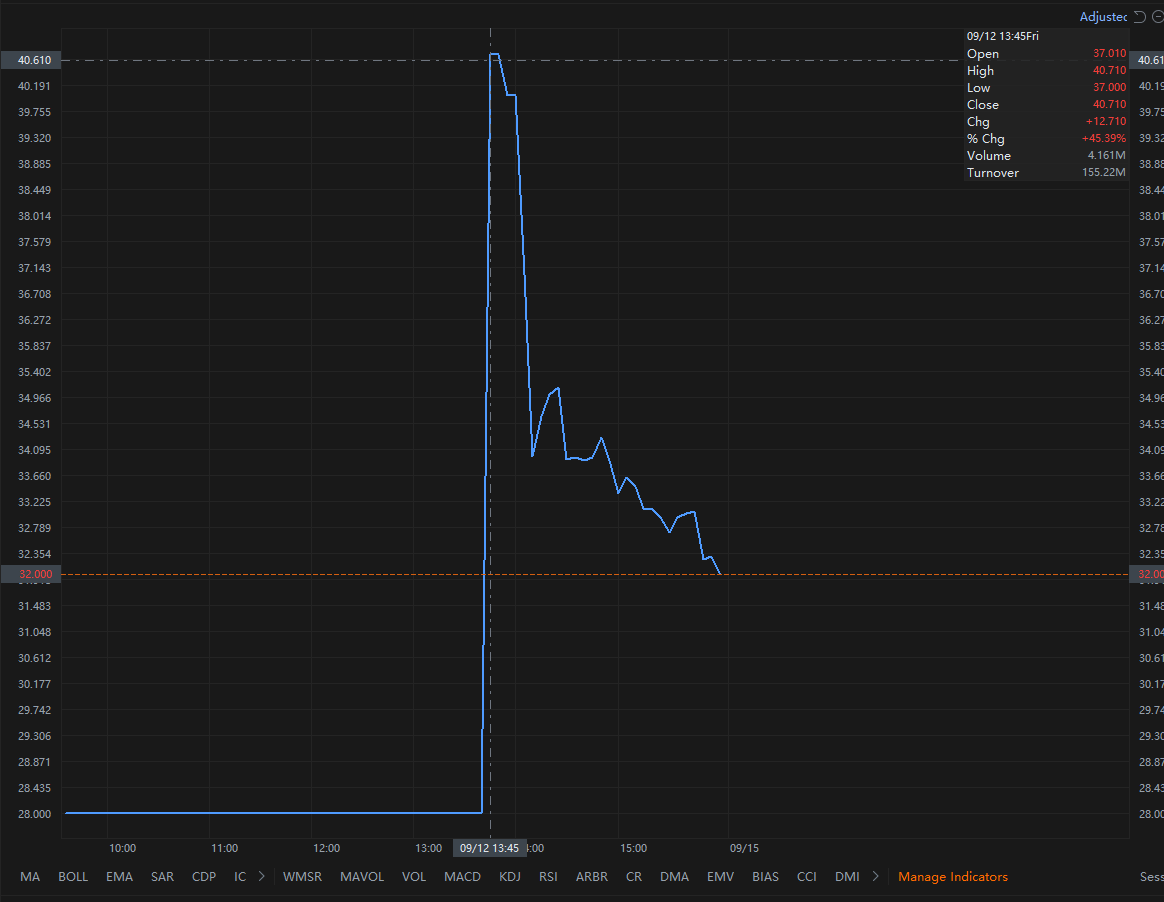
On September 12 (last Friday), the crypto asset exchange Gemini officially listed on Nasdaq, with its stock surging over 60% on the first day.
Notably, to further bolster its presence in the crypto trading space, Nasdaq has taken a stake in the exchange.
Gemini IPO Soars, Founders Remain Bullish on Bitcoin
Gemini Space Station (GEMI.US) priced its initial public offering (IPO) at $28 per share, higher than the previously anticipated range of $24–$26 per share, raising $425 million by issuing approximately 15.2 million shares.
The company’s stock soared over 45% after listing on Friday, triggering a circuit breaker, with an intraday peak gain exceeding 60%. By the close, the stock was up 14.29%, valuing the company at $3.801 billion.
Gemini’s successful listing makes it the third crypto exchange to list in the US, following Bullish and Coinbase, with Coinbase being the first crypto exchange included in the S&P 500.
Founded in 2014 and headquartered in New York City, Gemini employs 700 full-time staff and operates as a crypto exchange and custody provider, established by billionaire twins Cameron Winklevoss and Tyler Winklevoss.
According to its prospectus, the company serves clients in over 60 countries and regions, catering to both individual and institutional customers.
Gemini’s platform offers trading and custody services for over 70 digital assets, along with innovative products like the US dollar-backed stablecoin (Gemini Dollar) and a rewards credit card for crypto enthusiasts.
The prospectus shows that as of June 30, 2025, Gemini had 523,000 monthly active users, 10,000 institutional clients, $18 billion in crypto assets under custody, and $285 billion in total trading volume. Financially, the company reported $68.6 million in revenue and a net loss of $282.5 million for the first half of 2025.
Documents indicate Nasdaq participated in a $50 million private placement at the IPO pricing level. Additionally, Gemini plans to allocate up to 10% of its IPO shares to long-term users, management, employees, and their families, and up to 30% to retail investors participating via self-directed investment platforms operated by companies like Robinhood Markets, SoFi Technologies, and Webull.
According to the filing, the Winklevoss brothers held nearly all of the company’s shares pre-IPO and are expected to retain about 94.5% of voting power post-IPO.
On the listing day, Gemini’s co-founders, the Winklevoss brothers, reiterated their optimistic long-term outlook for Bitcoin in a CNBC interview. Tyler predicted that if Bitcoin disrupts the gold market, its price could reach $1 million within a decade.
This year marks Gemini’s 10th anniversary. When Gemini launched in 2015, Bitcoin was priced at around $380 per coin; its latest trading price exceeds $116,000 per coin, a more than 300-fold increase.

The Winklevoss brothers are among the earliest Bitcoin investors and the first billionaires to amass wealth through the cryptocurrency. They began applying for a Bitcoin exchange-traded fund (ETF) in 2013, over a decade before the first Bitcoin ETFs were approved.
The duo also donated $21 million in Bitcoin to a Republican political action committee supporting Trump.
Traditional Financial Institutions Actively Expand
Nasdaq’s decision to invest in Gemini as a traditional stock exchange signals a broader push by conventional financial institutions into digital asset trading.
Following its investment, Nasdaq will establish a strategic partnership with Gemini, gaining access to its custody and staking services.
The collaboration aims to integrate Gemini’s custody and staking offerings, enabling Gemini’s institutional clients to manage and track traded collateral via Nasdaq’s Calypso platform—a synergy expected to enhance trading efficiency and security.
Nasdaq has also been actively pursuing tokenized securities, planning to allow traditional stocks driven by blockchain technology to trade as tokens, reflecting its commitment to modernizing financial infrastructure.
Notably, Gemini has already launched tokenized products for some stocks in the European market, emphasizing that “traditional financial infrastructure is hard to access and urgently needs modernization”—a stance aligning with Nasdaq’s intent to introduce tokenized products in regulated markets.
While specific plans may adjust based on market conditions, this strategic partnership outlines new possibilities for integrating digital assets with traditional finance.
Beyond its investment, Nasdaq is applying to launch a tokenized securities trading business.
On September 8, Nasdaq submitted a proposal to the US Securities and Exchange Commission (SEC) to amend its rules, allowing listed stocks and exchange-traded products to trade in “traditional digital or tokenized form.”
The SEC recently published its rulemaking agenda, including a potential rule revision to permit crypto trading on national securities exchanges and alternative trading systems.
In its proposal, Nasdaq proposes raising standards for tokenized securities, requiring them to have “the same substantive rights and interests as comparable traditional securities.”
The exchange stated that if these conditions are met, tokenized securities would trade on the “same order book with the same execution priority rules” as traditional securities.
Nasdaq added, “If a tokenized instrument does not fully or substantially confer such rights, the exchange will not consider it equivalent to traditional securities but rather a distinct financial instrument.”
The largest US crypto exchange, Coinbase, has previously applied to the SEC for permission to offer “tokenized stock” services to clients. Major global banks, including Bank of America and Citigroup, have also indicated they may explore tokenized asset offerings. $GEMI