
APAC Market Wrap - 16 Sep

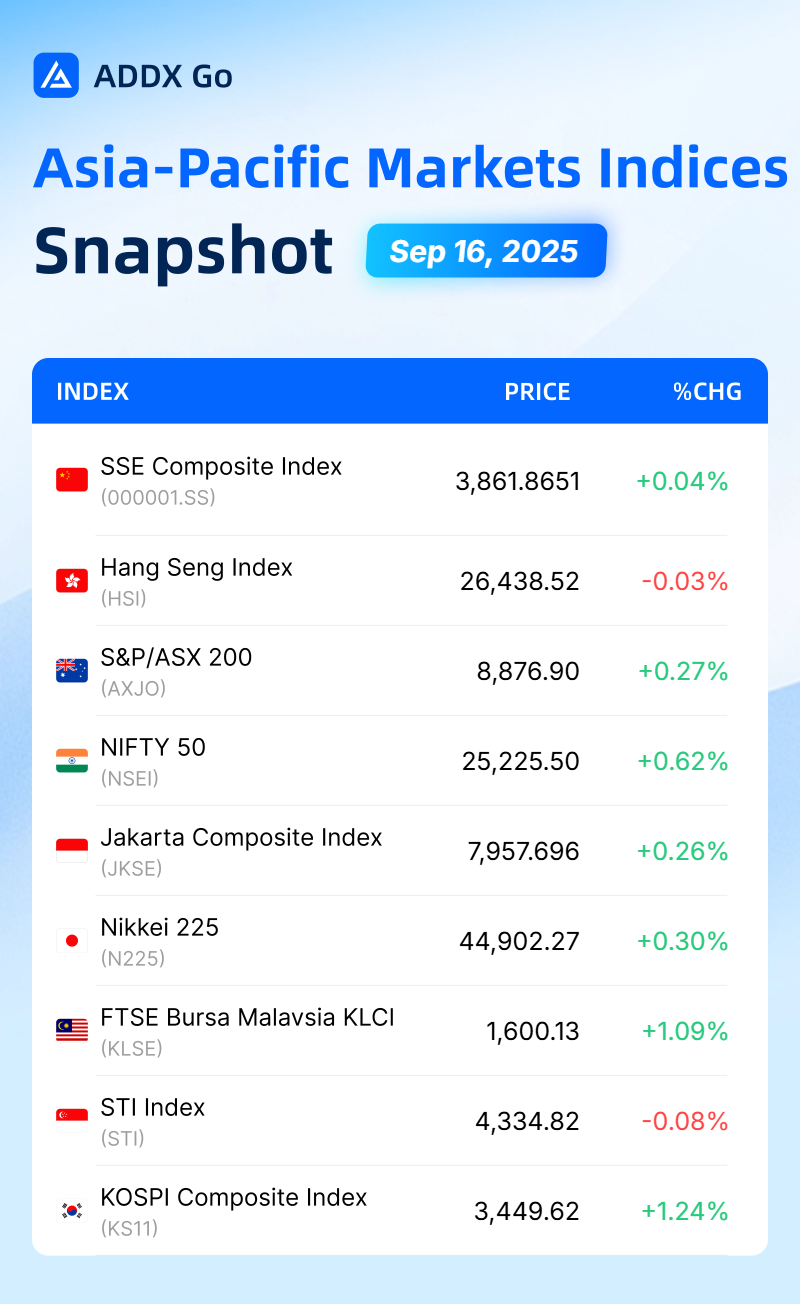
China Stock Market: At close, the Shanghai Composite rose 0.04%, the Shenzhen Component Index gained 0.45%, and the ChiNext Index increased by 0.68%.
Sector-wise, robotics, e-commerce, and logistics led the gains, while pork, non-ferrous metals, and film industries saw the largest declines.
Hong Kong Stock Market: The three major Hong Kong indices showed mixed performance today. At close, the Hang Seng Index fell 0.03% to 26,438.51 points; the Tech Index rose 0.56% to 6,077.66 points; and the State-Owned Enterprises Index gained 0.02% to 9,386.39 points.
From a market perspective, aviation, photovoltaic, and automotive stocks led the gains, while most crypto, cement, and innovative drug stocks weakened.
Japan Stock Market: The Nikkei 225 rose for the fourth consecutive trading day by 0.30%.
Although it breached the symbolic 45,000-point mark and continued upward, it failed to hold above 45,000 points at close.
South Korea Stock Market: The KOSPI index rose 1.24% to 3,449.62 points.
Leading sectors included panels, aviation, and semiconductors, while sales, building materials, and food sectors lagged.
Australia Stock Market: The S&P/ASX 200 (XJO) rose 0.28% to 8,877.700 points.
Sectors like industrial products, semiconductors, and furniture advanced, while aerospace, forestry products, apparel, and restaurants saw slight declines.
Singapore Stock Market: The Straits Times Index dropped 0.02% to 4,337.74 points.
Sectors such as retail, automotive parts, and industrial products saw slight gains, while forestry products, credit, and waste management experienced larger declines.
Malaysia Stock Market: The FTSE Malaysia KLCI rose 1.09% to 1,600.13 points.
Sectors like communications and media, healthcare, and construction advanced, while closed-end funds and real estate investment trusts declined.
Key Events
Israel Launches Ground Offensive in Gaza City to Militarily Defeat Hamas
Israel launched a long-awaited ground offensive in Gaza City, the most densely populated area of the Gaza Strip, early Tuesday morning, aiming to militarily eradicate Hamas.
The offensive was accompanied by extensive bombings. Israeli Prime Minister Benjamin Netanyahu stated that Gaza City is Hamas’s “last significant stronghold,” and capturing it would deliver a decisive blow.
US Lowers “Japan Auto Tariffs” to 15%, Effective Tuesday!
Reports indicate that on Monday local time, the Trump administration announced that import tariffs on Japanese autos will be reduced to 15% starting at 12:01 AM Eastern Time on September 16.
The US Department of Commerce released a document on the change, which will be published in the *Federal Register* on Tuesday, making it officially effective. The new rate halves the existing 25% tariff to 12.5%, plus the current 2.5% levy. This adjusted tariff aligns with the baseline rate applied to most other Japanese goods.
IEA Warns: Global Needs $540 Billion Annually by 2050 to Stabilize Oil and Gas Supply
The International Energy Agency (IEA) released a report stating that to maintain current oil and gas production levels, the global community must invest approximately $540 billion annually in exploration and development through 2050.
Christophe McGlade, head of the IEA’s energy supply division, revealed at a seminar that while global oil and gas exploration spending is projected at $57 billion this year, it remains slightly below 2024 levels. This trend suggests that without accelerating the transition from fossil fuel demand, companies will need to tap into unproven reserves.
Goldman Warns Bond Traders’ Next Pain Point: Japan and Germany 5-Year Bonds as “Weakest Link”
Goldman Sachs strategists indicated that the next pain point for bond traders may emerge in the five-year segment of the yield curve.
Strategists George Cole and William Marshall wrote in a Monday report that five-year bonds are particularly vulnerable in Japan and Germany—Japan is moving toward a more sustainable tightening cycle, while Germany’s economic outlook is improving.
Shorter-term bonds are heavily influenced by monetary policy expectations, while bonds of 10 years and beyond are more sensitive to inflation and deficit concerns. This positions five-year bonds—favored for their relative resilience to dual risks—as the “sweet spot” in the global bond market.
US Government Sends Two Teams to India This Week to Restart Bilateral Trade Talks
The US and India are intensifying negotiations to resolve bilateral trade tensions, with two separate US official teams visiting New Delhi this week.
A US trade delegation, led by Assistant US Trade Representative for South and Central Asia Brendan Lynch, arrived in India late Monday for a one-day meeting. US defense officials and Boeing executives are also visiting this week to negotiate the sale of naval reconnaissance aircraft worth approximately $4 billion.
Institutional Views
The market widely expects the Fed to announce a rate cut on Wednesday. HSBC’s Paul Mackel said that unless the Fed signals “potential for multiple future cuts,” the dollar could see a brief uptick post-announcement. He noted that further boosting already high rate-cut expectations would require exceptionally strong conditions from the Fed.
Goldman stated that robust supply growth could drive oil prices lower next year, though several factors might lay the groundwork for an earlier rebound. Typically, oil prices bottom out before inventory peaks; once forward-looking traders see signs of supply-demand rebalancing, they begin raising bids.
Meanwhile, with US active rig counts down 35% from late 2022, prolonged weak oil prices could curb shale production, tightening supply faster. Analysts added that if a significant oversupply occurs in Q4 this year, OPEC might reverse current policies and implement cuts to stabilize the market. Currently, Goldman forecasts Brent crude prices to settle in the low $50 per barrel range by the end of 2026.
Beyond the widely anticipated 25-basis-point cut on Wednesday, Fed officials may include at least one additional cut before year-end in their plans. Goldman analyst David Mericle noted that the Fed’s latest “dot plot” from June showed a median expectation of two cuts in 2025, a level likely to hold.
S&P predicts that amid cooling employment data and persistent inflation, the Fed will cut rates by 25 basis points this week to 4%-4.25%, with another cut expected in Q4.
S&P stated, “We believe the latest economic projections summary and Powell’s press conference, compared to the September FOMC rate decision, will be key to understanding how the Fed balances its inflation and employment mandates.” The agency also expects the Bank of Canada to lower rates by 25 basis points to 2.5%, with at least one more cut likely this year.
JPMorgan: Fed Rate Cut Could Harm Stocks and Bonds
David Kelly, Chief Global Strategist at JPMorgan Asset Management, said that if the market perceives this week’s Fed rate cut as driven by political pressure and inconsistent with its economic outlook, the widely expected cut could increase risks to stocks, bonds, and the dollar.
Kelly wrote that Wall Street bond and stock investors have cheered the Fed’s potential resumption of rate cuts after a nine-month pause, but after recent rallies, they should adopt a cautious stance and seek diversified investments.
Kelly added, “To some extent, the Fed’s decision this week is seen as yielding to political pressure, adding new risks to US financial markets and the dollar.” “Market bubbles exist,” and the current easing policy is more likely to weaken demand than boost it, “ultimately harming stocks, bonds, and the dollar.”