
Fed Cuts Rates by 25 bps: A Modest Step, or the Start of Something Bigger?

Shearing sheep
September 18, 2025
GoGPT Summarizes Articles
After nine months on hold, the Federal Reserve finally pulled the trigger on its first rate cut of 2025. At 2 a.m. Singapore time on Thursday, the Fed announced a 25 basis point cut, lowering the federal funds rate to 4.00%–4.25%. The decision was in line with market expectations, but the details around the statement, the dot plot, and the dissenting voices suggest that the debate inside the Fed is far from settled.
Why the Fed Cut Now
In its statement, the Fed highlighted a softer economic backdrop: growth has slowed, job gains have cooled, and unemployment has ticked up, even if still at historically low levels. At the same time, inflation has edged higher again and remains above target. This is the core of the Fed’s dilemma: protect the labor market while not reigniting inflationary pressures.
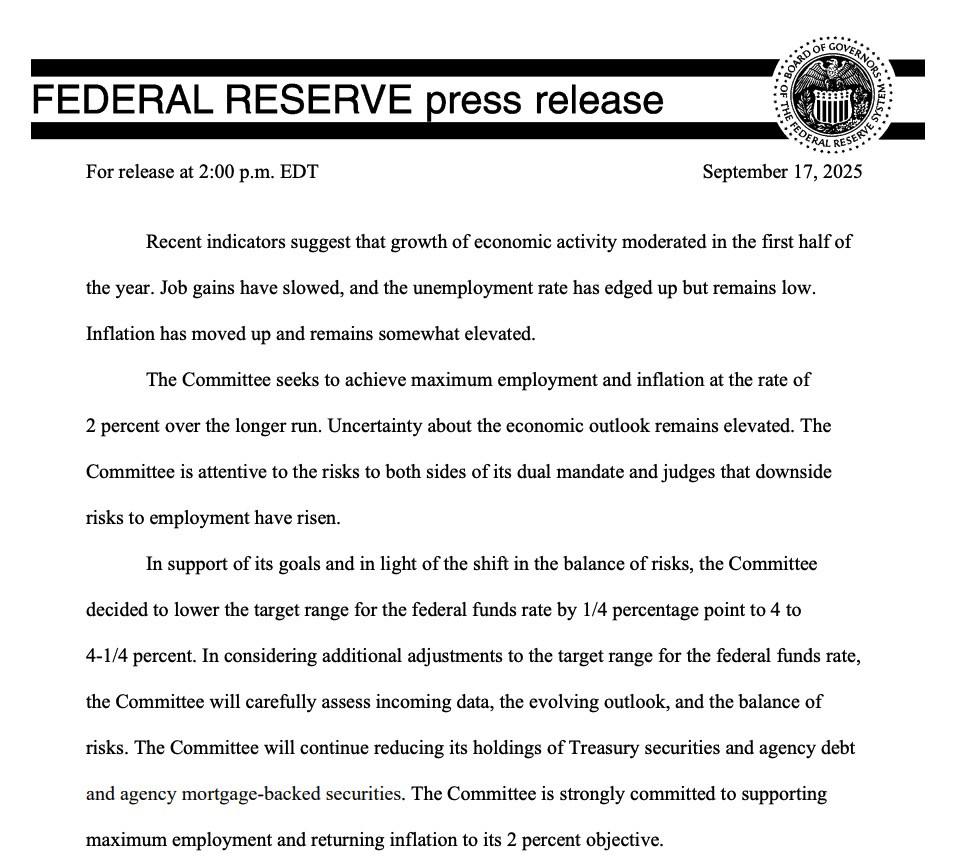
Powell labeled the move a “risk management” cut—designed to get ahead of labor market weakness rather than a full pivot into a rate-cutting cycle. He was quick to note that the Fed doesn’t see the need for aggressive action right now. That choice of words clearly aimed to temper market expectations of a rapid easing cycle.
The Dot Plot Tells a Split Story
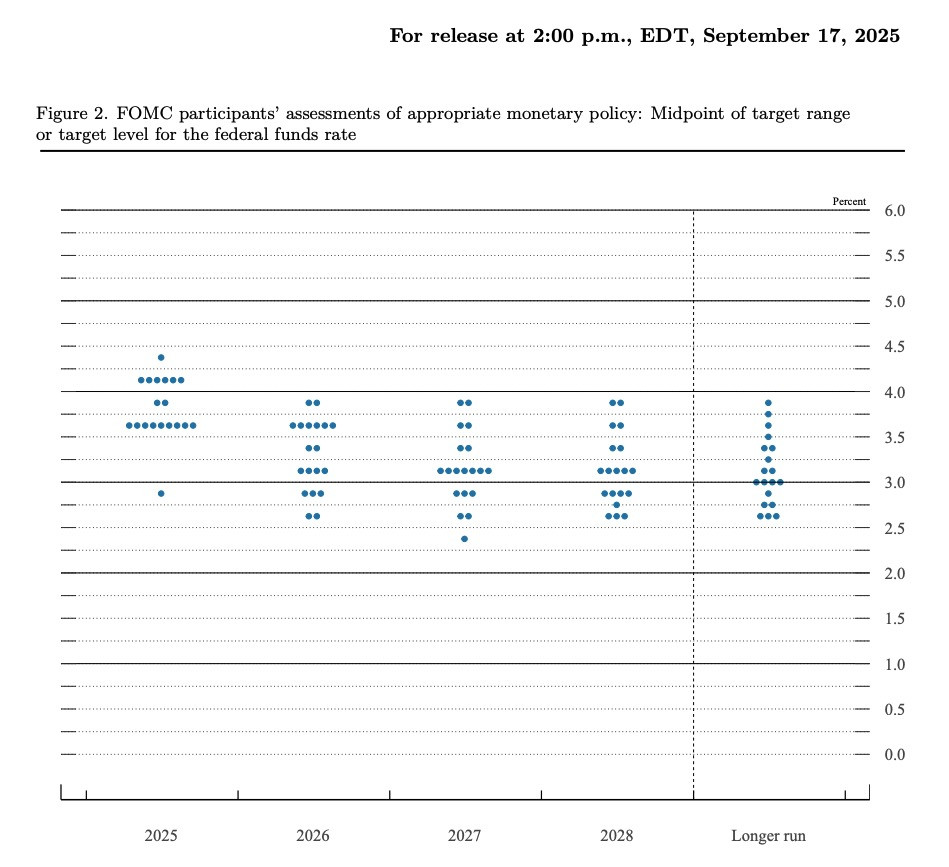
The September dot plot added some drama. The median forecast points to two additional 25bps cuts this year, aligning with what markets had already priced in. But the dispersion of views is striking:
-
1 official even saw room for a hike,
-
6 officials preferred no further moves this year,
-
2 officials penciled in one more cut,
-
9 officials expected two more cuts,
-
And then there’s Milan.
Milan, a White House economic advisor who was recently appointed as a Fed participant, argued for a 50bps cut immediately and called for at least another 100bps by year-end. That aggressive view stood out as the “outlier dot” on the chart, underlining a bigger issue: political voices are now showing up visibly in Fed policy discussions.
Gundlach’s Caution with a Bullish Gold Call
Jeffrey Gundlach—nicknamed the “Bond King” for his track record in fixed income—was quick to weigh in after the Fed’s move. He described the 25bps cut as “the right decision,” arguing that going bigger would have been a mistake. In his view, the Fed faces a genuine risk of overdoing it: “We’ve already seen downward revisions to payroll data, rising signs of stress in the job market, and if the Fed comes in with aggressive cuts, inflation could easily flare up again.”
That cautious stance lines up closely with Powell’s own messaging. Both see value in moving preemptively to protect employment but want to avoid giving markets the impression of an all-out easing cycle. For Gundlach, the key risk is slipping into a world where nominal rates fall below inflation—what he calls a negative real rate environment. That’s when savers lose purchasing power, capital flows into hard assets, and speculative behavior tends to accelerate.
This is where his gold call comes in. Gold has already staged a massive run—up more than 100% over two years and 45% year-to-date. Gundlach noted that not only institutional buyers but also retail investors and even gold miners themselves are piling into the trade. He described the current rally as “almost irrational,” but at the same time said he’s more confident than ever that gold will break $4,000 before the end of the year.
Goldman Sachs: This Is Just the Beginning
Goldman Sachs’ economists offered a slightly different perspective, suggesting that the Fed has effectively kicked off a new easing cycle. They highlighted five key signals pointing in this direction:
-
The dot plot now shows a majority of officials supporting three rate cuts this year.
-
The language in the policy statement has shifted noticeably dovish, signaling a softer tone.
-
Powell emphasized labor market weakness, particularly among vulnerable groups such as younger and minority workers.
-
The move was framed as an “insurance cut,” which historically tends to occur in a series rather than as a single action.
-
Powell acknowledged the need for bond market pricing to align with policy, implicitly signaling that further action may follow to meet market expectations.
Based on their scenario analysis, Goldman’s baseline case—estimated at a 60% probability—expects 25bps cuts in October and December 2025. If the labor market worsens beyond expectations, the Fed could even deliver larger 50bps cuts. Looking further ahead, Goldman anticipates additional quarterly cuts in March and June 2026, which would bring the federal funds rate down to a range of 3.0%–3.25%.
My Take
Here’s how I read it: the Fed is trying to engineer a “soft easing cycle,” cutting just enough to prevent job losses from spiraling but without signaling surrender to inflation. But history shows “insurance cuts” rarely happen in isolation. If the data continues to soften, more cuts will follow—even if Powell tries to sound cautious.
The bigger wildcard is politics. Milan’s unusually dovish stance reflects the White House’s desire for faster easing, and his dot on the chart will only fuel speculation about political influence. If that tension intensifies, the Fed could face credibility risks—not just in markets, but globally.
On markets:
-
Gold is the purest play on real rates and policy credibility. If inflation stays sticky while the Fed cuts, Gundlach’s $4,000 call may not be as crazy as it sounds.
-
Bonds may find support from the Fed’s dovish tilt, but if cuts come faster than expected, long-end yields could reprice aggressively.
-
Equities face a more complicated setup. A cautious Fed doesn’t deliver the liquidity rush some bulls hoped for, but steady easing could still underpin risk appetite.
Bottom Line
The Fed’s first cut of 2025 is less about what it did today and more about what it’s signaling. Powell wants gradualism, Gundlach warns against excess, and Goldman sees the start of a cycle. Markets will spend the next few weeks trying to figure out which narrative wins out.
#Breaking Macro Events: Market Impact & Analysis